
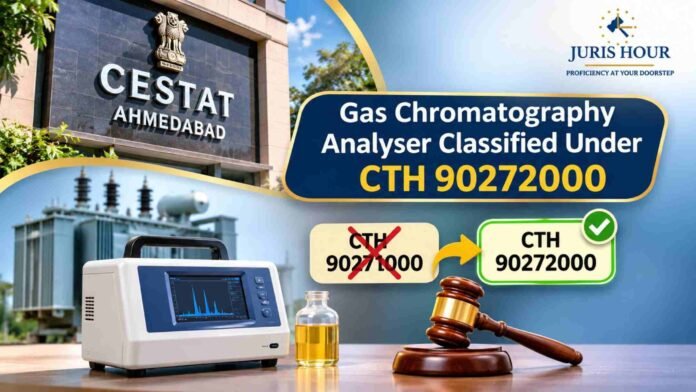
The Customs, Excise and Service Tax Appellate Tribunal (CESTAT), Ahmedabad Bench, has held that the imported Myrkos Portable Gas Chromatography Analyser, used for monitoring dissolved gases in mineral oil, is appropriately classifiable under Customs Tariff Heading (CTH) 90272000 as a chromatograph and not under CTH 90271000 as gas or smoke analysis apparatus.
The Bench of Somesh Arora (Judicial Member) and Satendra Vikram Singh (Technical Member) observed that the issue concerning classification of Gas Chromatographs used for monitoring dissolved gases in mineral oil had already been decided in favour of the appellant in its earlier order.
Buy Now: Indirect Tax Judgments E-Compilation – October 2026
The appellant/assessee had imported a Myrkos Portable Gas Chromatography Analyser by filing Bill of Entry No. 6343469 dated January 3, 2020. The importer classified the goods under CTH 90272000, which attracts Basic Customs Duty (BCD) at 0% under Customs Notification No. 24/2015 (Serial No. 32).
However, the Customs Department disputed the classification and proposed classification under CTH 90271000, covering gas or smoke analysis apparatus.
According to the Department, the imported equipment was not a complete chromatography system but a diagnostic gas analyser operating on the principles of gas chromatography, specifically used as a transformer fault gas analyser. Consequently, Customs reassessed the goods and demanded differential duty, which the importer paid under protest.
The Commissioner of Customs (Appeals), Ahmedabad, upheld the classification under CTH 90271000 vide Order-in-Appeal dated June 30, 2021.
Aggrieved by the decision, the importer approached CESTAT.
The appellant contended that the classification issue had already been decided in its favour by CESTAT in its own case vide Final Order No. 10260/2024 dated January 29, 2024.
It was submitted that the imported equipment was a Gas Chromatograph used for monitoring dissolved gases in mineral oil and therefore appropriately fell under CTH 90272000.
The appellant requested the Tribunal to follow its earlier decision, set aside the impugned order and grant consequential relief.
The Department opposed the appeal, arguing that the imported equipment was essentially a diagnostic gas analyser rather than a complete chromatography system.
It was submitted that CTH 90271000 specifically covers gas or smoke analysis apparatus and that the equipment was used for analysing gases associated with transformer faults.
The Department further contended that the importer had incorrectly classified the goods to avail the exemption benefit available under CTH 90272000 and that the reassessment and demand of differential customs duty were justified.
The Tribunal relied upon its earlier findings and examined the distinction between gas analysis apparatus falling under CTH 90271000 and chromatographs covered under CTH 90272000.
The Tribunal observed that the HSN Explanatory Notes under Heading 90.27 describe gas or smoke analysis apparatus under CTH 90271000 as instruments used for determining the contents of combustible gases or burnt gases.
Such instruments analyse gases such as carbon dioxide, carbon monoxide, oxygen, nitrogen and hydrocarbons in combustible or burnt gases arising from coke ovens, gas producers and blast furnaces.
However, the equipment imported by the appellant did not analyse combustible or burnt gases. Instead, it monitored the presence and nature of dissolved gases in mineral oil.
Accordingly, the Tribunal held that the imported equipment did not fall within the scope of gas or smoke analysis apparatus under CTH 90271000.
The Tribunal explained that a Gas Chromatograph works through a different technical process.
In the imported equipment, the mineral oil sample is injected into the instrument, vaporised through heating and carried by a carrier gas through a chromatographic column. The different components are then separated based on their interaction with the stationary phase.
The Tribunal observed that the word ‘Gas’ in Gas Chromatography does not refer to the type of sample being analysed. Rather, it refers to the carrier gas that transports the vaporised sample through the instrument.
Therefore, merely because the instrument uses gas chromatography technology does not make it a gas analyser under CTH 90271000.
The Tribunal noted that the HSN Explanatory Notes specifically recognise chromatographs, including gas, liquid, ion and thin-layer chromatographs.
The Notes do not exclude Gas Chromatographs from the category of chromatographs.
It was therefore held that classifying a Gas Chromatograph under CTH 90271000 merely because of the presence of the word ‘Gas’ would be contrary to the HSN Explanatory Notes.
The Tribunal also relied upon the decision of the Harmonized System (HS) Committee taken at its 64th Session.
The HS Committee had considered an Online Dissolved Gas Analysis (DGA) Apparatus used for monitoring dissolved gases in transformer oil, which incorporated a Gas Chromatography System.
Applying Note 3 of Chapter 90 read with Note 3 of Section XVI, the HS Committee considered the principal function of the composite machine and held that the apparatus was classifiable as a chromatograph under CTH 90272000 rather than under CTH 90271000.
The Tribunal reiterated that the opinion of the HS Committee carries significant persuasive value and should ordinarily be followed.
Finding that the issue was already settled in the appellant’s favour by its earlier decision, CESTAT held that the imported Myrkos Portable Gas Chromatography Analyser was correctly classifiable under CTH 90272000.
Membership Required to Access Case Details & Order Copy
To view the complete Case Details and Download Order Copy, you must have an active membership. Please subscribe to continue.
Read More: CBI Court Sentences Former Income Tax Inspector to 3 Years’ Imprisonment in Rs. 60 Lakh Bribery Case

