
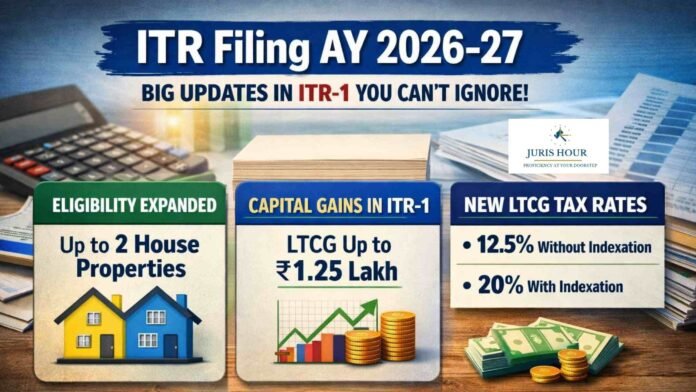
The Income Tax Department has introduced significant changes in the ITR-1 (Sahaj) form for Assessment Year 2026–27, making it more inclusive and taxpayer-friendly.
These updates are aimed at simplifying the return filing process while accommodating the evolving financial profiles of salaried individuals and small investors. The changes are expected to reduce compliance burden and eliminate the need for many taxpayers to shift to more complex return forms.
Eligibility Expanded: Inclusion of Two House Properties
A major change in the revised ITR-1 form is the expansion of eligibility criteria with respect to house property income. Earlier, individuals could file ITR-1 only if they had income from a single house property. This restriction often forced taxpayers owning more than one property to opt for ITR-2.
Now, taxpayers can report income from up to two house properties while still using ITR-1. This is particularly beneficial for individuals who own a self-occupied home along with a second property, whether self-occupied or deemed let-out. The move simplifies compliance and ensures that more taxpayers can continue using the simplest return form available.
Capital Gains Now Permitted in ITR-1
Another significant relief comes in the form of allowing capital gains reporting in ITR-1. Previously, any taxpayer with capital gains income had to mandatorily file ITR-2, regardless of the amount involved.
Under the new rules, taxpayers can now report Long-Term Capital Gains (LTCG) arising from listed equity shares and equity mutual funds within ITR-1, subject to a limit of ₹1.25 lakh. This change is expected to benefit a large number of small investors who participate in the stock market but earn relatively modest gains. It removes the inconvenience of switching to a more detailed and complex form for minor capital gains income.
New LTCG Tax Rates Reflected in ITR-1
The updated ITR-1 also aligns with the revised tax regime for long-term capital gains as introduced in the recent Budget. The applicable tax rates have been streamlined to provide clarity and uniformity.
Taxpayers can now choose between a 12.5% tax rate without indexation or a 20% rate with indexation benefits, depending on what is more advantageous. Incorporating these changes directly into ITR-1 ensures that eligible taxpayers can compute and report their tax liability accurately within the simplified framework.
Boost to Ease of Compliance
These changes reflect the government’s continued push toward simplifying tax compliance and improving ease of filing. By expanding the scope of ITR-1, the authorities have recognized that modern taxpayers often have diversified sources of income, including property ownership and equity investments.
The revised form reduces the need for unnecessary migration to ITR-2, minimizes reporting complexities, and lowers the chances of errors during filing. It also encourages voluntary compliance by making the process more accessible and less time-consuming.
Conclusion: A Taxpayer-Friendly Reform
Overall, the changes in ITR-1 for AY 2026–27 represent a welcome reform for salaried individuals and retail investors. The inclusion of two house properties and limited capital gains reporting within the simplest return form marks a practical and progressive step.
As the filing season approaches, taxpayers should review the updated eligibility conditions carefully and take advantage of these relaxations. The revised ITR-1 is set to make tax filing smoother, faster, and more aligned with the financial realities of today’s taxpayers.
Read More: DGFT Extends ‘Free’ Import Policy for Tur/Pigeon Peas Till March 2027 to Stabilize Supply

