
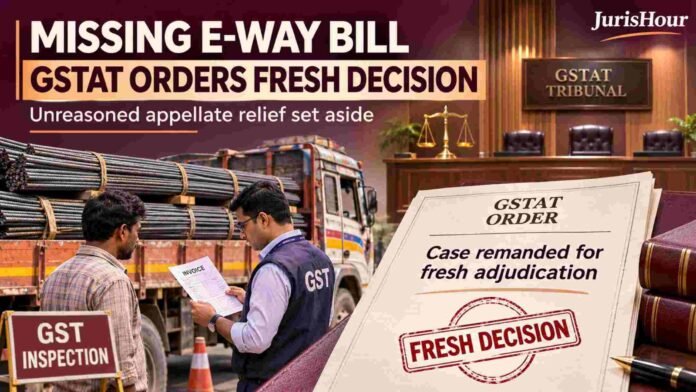
The Goods and Services Tax Appellate Tribunal (GSTAT), Agra Bench, has set aside an appellate order granting relief to a trader in an e-way bill dispute, holding that the first appellate authority failed to give adequate reasons for overturning the original tax and penalty order.
The Bench of Ajeet Singh (Judicial Member) and Vivek Kumar (Technical Member) partially allowed the Uttar Pradesh State Tax Department’s appeal and remanded the matter for fresh adjudication after providing both parties an opportunity of hearing.
Buy Now: 210+ GST Judgments E-Magazine – October 2026
The dispute arose on June 12, 2018, when the Mobile Squad, Fifth Unit, Jhansi, intercepted a vehicle carrying iron and steel. According to the order, no e-way bill was found for the goods being transported.
The proper officer detained the vehicle and goods and issued a show-cause notice in Form GST MOV-07, proposing tax of ₹3,31,712 and an equal amount as penalty.
The owner appeared before the officer and deposited the proposed amount to secure release of the goods and vehicle. An adjudication order in Form GST MOV-09 followed on June 14, 2018.
The respondent/assessee challenged the demand before the Additional Commissioner, Grade-II (Appeal), Jhansi. By an order dated December 19, 2019, the first appellate authority allowed the taxpayer’s appeal and set aside the disputed tax and penalty.
The department challenged that relief before GSTAT.
The department argued that transportation without a valid e-way bill violated Section 68 of the CGST Act read with Rule 138 of the CGST Rules.
Its authorised representative submitted that the first appellate authority had granted relief because an invoice accompanied the goods and payment was said to have been made through a bank. However, the authority had not recorded a finding regarding the absence of an intention to evade tax.
The department also disputed the bank-payment finding. It alleged that substantial amounts had been adjusted through subsequent buy-back entries, while only a small amount had been paid through banking channels. According to the department, these circumstances required examination.
Another objection concerned the quantity covered by the sale invoice. The department questioned how 40.500 metric tonnes allegedly sold during transit had been identified and weighed out of the larger consignment carried in the vehicle.
It further contended that the goods’ owner had not produced the e-way bill for the original Gujarat-to-Jhansi movement before the mobile squad officer.
The taxpayer submitted that it had purchased 51.360 metric tonnes of iron and steel from Bhavnagar, Gujarat, and that the original movement was supported by valid e-way bills and other documents.
Out of that consignment, 40.500 metric tonnes had been sold during transit to M/s Neha Steel & Trading Corporation through Invoice No. 19 dated June 11, 2018. The taxpayer maintained that the driver produced this invoice at the time of interception.
It explained that the purchaser’s premises were situated on the route to its own business premises, enabling delivery from the same vehicle carrying the original consignment.
According to the taxpayer, the goods were intercepted while being unloaded at the purchaser’s premises at Aitiyatalab, Jhansi. It argued that the movement involved a genuine sale rather than any concealed transaction.
The taxpayer also stated that the remaining quantity was subsequently covered by Tax Invoice No. 51 issued in favour of M/s Maya Steels.
It maintained that there was no independent material establishing a fictitious transaction, suppression of value, non-existent parties or an intention to evade tax. It relied on several judicial decisions to support its challenge to the detention proceedings.
After examining the record, GSTAT held that it was undisputed that no e-way bill had been generated for the transaction involving the taxpayer’s sale of the goods.
The tribunal also noted that the accompanying invoice covered only 40.500 metric tonnes, while the vehicle carried a larger quantity.
It held that the intercepting officer had rightly treated transportation without an e-way bill as a contravention of Rule 138 and detained the vehicle and goods.
The Bench further recorded that the taxpayer, instead of replying to the show-cause notice, deposited the proposed tax and penalty to secure release. The officer thereafter passed the adjudication order under Section 129(3).
The tribunal’s principal criticism concerned the reasoning in the first appellate order.
It noted that the order ran to only two pages. Its substantive findings essentially accepted the taxpayer’s sale-in-transit explanation, referred to the availability of an invoice and stated that payment was supported by the bank account.
However, the authority had not explained why the original officer’s findings were legally or factually unsustainable.
GSTAT held that recording reasons is an essential requirement of natural justice. A non-speaking and cryptic order prevents the aggrieved party from understanding the basis on which the decision was reached.
Referring to Supreme Court precedents, including Kranti Associates Pvt. Ltd. v. Masood Ahmad Khan, the tribunal emphasised the obligation of judicial and quasi-judicial authorities to explain their conclusions.
The Bench specifically relied on Section 107(12) of the CGST Act and the corresponding State GST provision.
The provision requires the first appellate authority to state the points for determination, its decision on those points and the reasons for the decision.
The tribunal held that recording reasons is not a mere formality. An appellate authority must examine the relevant facts, applicable law and competing submissions before deciding whether an adjudication order should stand.
Finding that the first appellate authority had not adequately examined the circumstances on record, GSTAT held that its order could not be sustained.
The tribunal partially allowed the departmental appeal, set aside the first appellate order and remanded the matter to that authority for a fresh decision in light of its observations.
Membership Required to Access Case Details & Order Copy
To view the complete Case Details and Download Order Copy, you must have an active membership. Please subscribe to continue.

