
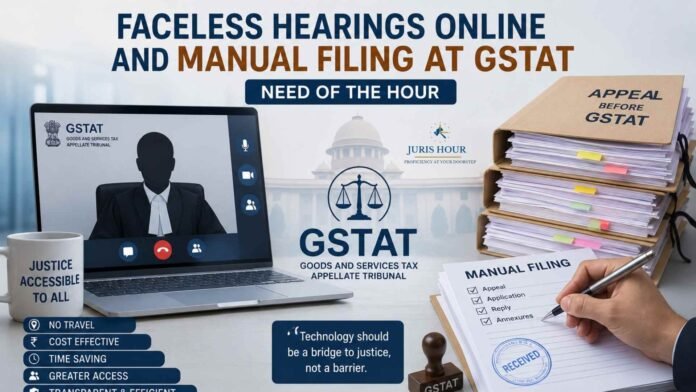
The launch of the Goods and Services Tax Appellate Tribunal (GSTAT) marks a historic milestone in India’s indirect tax dispute resolution framework. After years of waiting, taxpayers finally have a dedicated appellate forum to challenge orders passed by the First Appellate Authority. The GSTAT portal has been designed as a fully digital platform where appeals, applications, replies, and supporting documents are to be filed electronically. The GSTAT (Procedure) Rules, 2025 also emphasize electronic filing and digital processing of appeals.
While digitization is a welcome reform, practical realities on the ground suggest that exclusive dependence on electronic systems may not always serve the interests of justice. As GSTAT begins handling thousands of pending appeals, the time has come to seriously consider two important procedural safeguards: faceless hearings through virtual mode and an optional manual filing mechanism.
GSTAT’s Digital Vision
The GSTAT portal has been developed as an end-to-end electronic filing platform. Appeals are required to be uploaded online, scrutiny is carried out electronically, and proceedings are intended to be managed through the portal itself. The system aims to reduce paperwork, improve efficiency, and create uniformity across the country.
The portal already provides facilities for e-filing, document uploads, defect rectification, and status tracking. Recent GSTAT orders have also introduced relaxed scrutiny norms due to practical difficulties faced by taxpayers during the initial implementation phase of the portal.
However, every digital system faces teething troubles, particularly when it is expected to handle high-value litigation involving voluminous records running into thousands of pages.
Why Faceless Hearings Deserve Greater Importance
One of the most progressive features contemplated under the GSTAT framework is the possibility of conducting hearings through electronic mode. The GSTAT portal FAQs expressly recognize that hearings may be conducted physically or electronically with the permission of the Tribunal.
The experience of faceless proceedings during the pandemic demonstrated that virtual hearings can significantly improve access to justice.
Reduced Litigation Costs
A taxpayer situated in a small town may otherwise have to travel hundreds of kilometres to appear before a State Bench. Virtual hearings eliminate travel expenses, accommodation costs, and the loss of productive working hours.
Better Access to Specialized Professionals
Taxpayers often prefer engaging advocates or chartered accountants having expertise in complex GST matters. Virtual hearings allow professionals located in different cities to represent taxpayers without logistical constraints.
Faster Disposal of Cases
Physical hearings often suffer from adjournments due to travel issues, weather disruptions, or scheduling conflicts. Virtual hearings can substantially improve judicial efficiency and reduce pendency.
Greater Transparency
Digital hearings can be recorded and maintained electronically, creating a clear procedural record and reducing disputes regarding submissions made during arguments.
Environmental Benefits
Reduced travel directly translates into lower carbon emissions and aligns with the government’s broader digital governance initiatives.
The Case for Making Faceless Hearings the Default Option
While physical hearings should remain available where necessary, GSTAT could consider adopting a “virtual-first” approach in certain categories of cases:
- Matters involving pure questions of law.
- Appeals requiring interpretation of notifications or circulars.
- Procedural disputes involving limitation, maintainability, or jurisdiction.
- Cases where parties mutually consent to virtual hearing.
Such a model would enable benches to concentrate physical hearings on matters involving extensive factual disputes or examination of records.
Why Manual Filing Should Continue Alongside E-Filing
The greater concern lies in the absence of a robust alternative when technological systems fail.
GST litigation often involves:
- Large numbers of invoices.
- Audit reports.
- Investigation records.
- Statements.
- Show Cause Notices.
- Orders-in-Original and Orders-in-Appeal.
- Multiple annexures running into several thousand pages.
Uploading such extensive records can become challenging due to file size restrictions, formatting issues, server downtime, internet connectivity problems, and software glitches.
Recent GSTAT orders extending relaxed filing and scrutiny procedures themselves acknowledge the practical difficulties being faced by litigants during the initial operational phase of the portal.
Lessons from Other Judicial Forums
Several Indian judicial institutions continue to provide hybrid mechanisms:
- High Courts permit both electronic and physical filings in many jurisdictions.
- The Supreme Court allows physical filing under specified circumstances.
- Many tribunals maintain filing counters despite introducing e-filing systems.
The rationale is simple: technology should facilitate justice, not become a barrier to justice.
Limitation Risks Cannot Be Ignored
One of the most serious concerns is the risk of appeals becoming time-barred because of portal-related issues.
The GSTAT framework prescribes strict timelines for filing appeals, and significant backlogs are expected to be filed before statutory deadlines. Various guidance documents have repeatedly emphasized the importance of filing appeals within prescribed timelines despite procedural relaxations.
If a taxpayer is unable to upload documents due to technical issues on the final day of limitation, denial of a manual filing option could potentially result in irreversible prejudice.
A simple safeguard could be introduced:
- Allow physical filing where portal issues are demonstrated.
- Permit filing of paper books in cases involving voluminous records.
- Recognize manual filing dates for limitation purposes.
- Enable subsequent digitization by registry officials.
Such measures would preserve substantive rights while retaining the benefits of digitization.
The Digital Divide Remains Real
India’s GST ecosystem includes:
- Small traders.
- MSMEs.
- Rural businesses.
- Cooperative societies.
- Charitable institutions.
Not all taxpayers possess sophisticated digital infrastructure or dedicated compliance teams.
While large corporations may seamlessly navigate advanced e-filing requirements, smaller taxpayers may struggle with document conversion, portal authentication, digital signatures, and electronic uploads.
Justice delivery mechanisms must remain inclusive rather than technology-centric.
A Hybrid Model: The Best of Both Worlds
The ideal solution may not be a choice between physical and digital systems. Instead, GSTAT should embrace a hybrid framework consisting of:
- Mandatory e-filing as the primary mode.
- Manual filing as a backup mechanism in exceptional cases.
- Virtual hearings as the default option where feasible.
- Physical hearings upon request or where complexity demands.
- Electronic records combined with physical paper books for voluminous matters.
- Dedicated technical support cells at every bench.
Such a framework would balance efficiency with accessibility.
Conclusion
The establishment of GSTAT is one of the most significant reforms in India’s GST dispute resolution system. The e-filing portal and digital procedures represent a major step toward modernizing tax litigation. However, the ultimate objective of any judicial system is not technological sophistication—it is access to justice.
Faceless hearings can reduce costs, increase efficiency, and improve accessibility for taxpayers across the country. At the same time, retaining a limited manual filing mechanism would ensure that procedural rights are not sacrificed at the altar of technology.
As GSTAT enters its formative years and prepares to handle thousands of appeals, a balanced hybrid model combining digital innovation with practical flexibility may prove to be the most effective path forward. After all, technology should be a bridge to justice, not a gatekeeper.

