
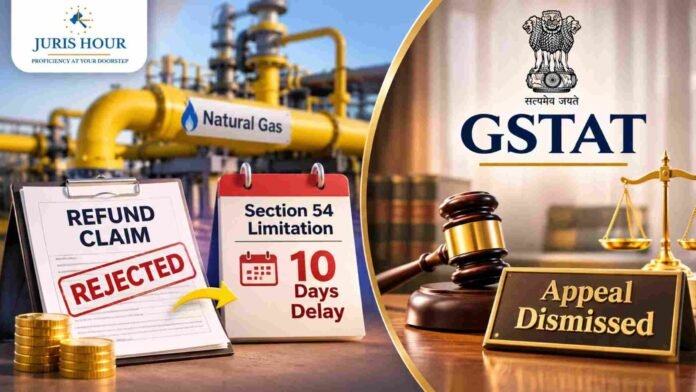
The Goods and Services Tax Appellate Tribunal (GSTAT), Lucknow, held that refund of any amount paid under GST must be claimed within two years and held that the limitation prescribed under Section 54 of the Central Goods and Services Tax Act, 2017, applies even where the taxpayer claims that the amount was paid under a mistake of law and did not constitute tax.
The bench of Santosh Kumar Srivastava (Judicial Member) and Arvind Kumar (Technical Member) observed that Section 54 is a self-contained statutory provision governing refund claims and expressly covers not only tax and interest but also any other amount paid. Consequently, merely describing an amount as an erroneous payment or deposit cannot take the refund claim outside the statutory limitation prescribed under the GST law.
Buy Now: All 200+ GSTAT Judgements Till November 2026 | Comprehensive E-Magazine
The appellant/assessee is engaged in the business of supplying natural gas through a network of pipelines. For expanding its pipeline infrastructure, the company was required to undertake road restoration activities after laying gas pipelines beneath public highways.
During January 2020, the assessee deposited ₹13,16,110 with the National Highways Authority of India (NHAI), Uttar Pradesh, towards road restoration charges.
At the time, the company believed that the payment made to NHAI attracted GST under the Reverse Charge Mechanism (RCM) in terms of Notification No. 13/2017-Central Tax (Rate) dated June 28, 2017.
Accordingly, the assessee discharged GST liability amounting to ₹1,57,932, comprising CGST of ₹78,966 and SGST of ₹78,966, through its GSTR-3B return for January 2020, filed on February 18, 2020.
However, the company subsequently realised that the road restoration activities did not constitute a taxable supply under Section 7 of the CGST Act. It also contended that such activities were compensatory in nature and related to sovereign functions concerning roads and bridges, thereby attracting exemption under Entries 4 and 5 of Notification No. 12/2017-Central Tax (Rate).
The assessee argued that NHAI, being a statutory body corporate, could not be treated as either the Government or a local authority for the purpose of invoking the reverse charge provisions under Notification No. 13/2017-Central Tax (Rate).
On this basis, the company treated the GST paid earlier as an erroneous deposit made under a mistake of law rather than a legally payable tax.
The assessee filed an application for refund in Form GST RFD-01 on February 26, 2024.
However, the adjudicating authority issued a Show Cause Notice in Form GST RFD-08 on April 12, 2024, proposing rejection of the refund claim on the ground that the application had been filed beyond the two-year limitation period prescribed under Section 54 of the CGST Act.
The company did not submit a timely substantive reply to the notice on the GST portal. Subsequently, the adjudicating authority passed the Order-in-Original dated May 14, 2024, rejecting the entire refund claim as time-barred.
The First Appellate Authority, through Order-in-Appeal No. 417/GST/ADC/Alld/2025 dated July 31, 2025, upheld the rejection.
The assessee approached GSTAT under Section 112 of the CGST Act.
Before the Tribunal, the assessee challenged the rejection of its refund claim on several grounds.
The principal contention was that the amount paid under RCM did not represent tax because the underlying road restoration activity did not constitute a taxable supply. According to the appellant, the payment was merely a deposit made under a mistaken belief regarding the applicability of GST.
It was argued that the limitation period of two years under Section 54 applies to refund claims involving tax and cannot be extended to amounts that were never legally payable as tax.
The appellant further submitted that road restoration charges were compensatory in nature and did not satisfy the requirement of reciprocal consideration for constituting a supply under Section 7 of the CGST Act.
Reliance was also placed on Articles 243G and 243W of the Constitution of India, contending that the activities related to roads and bridges were connected with sovereign functions and were covered by the relevant exemption entries under Notification No. 12/2017-Central Tax (Rate).
The appellant also challenged the validity of the Show Cause Notice and Order-in-Original on the ground that they did not contain a separate Document Identification Number (DIN), allegedly violating CBIC Circular No. 128/47/2019-GST.
Additionally, it was contended that the First Appellate Authority had travelled beyond the scope of the Show Cause Notice by referring to parallel disputes involving the appellant in other States.
The departmental representative opposed the appeal and submitted that Section 54 of the CGST Act constitutes a complete statutory mechanism governing refund claims.
It was argued that any refund of tax, including excess tax paid under RCM, must be claimed within two years from the relevant date.
According to the department, the relevant date in the present case was February 18, 2020, being the date on which the appellant filed its GSTR-3B return and discharged the tax liability.
The department further submitted that even after extending the benefit of the COVID-19 limitation relaxation period of 730 days, the refund application filed on February 26, 2024, was delayed by 10 days.
The Revenue also contended that assessee had voluntarily declared the amount as tax liability under RCM in its verified GSTR-3B return. Therefore, the payment could not subsequently be treated as a mere passive deposit to escape the limitation prescribed under Section 54.
It was further submitted that the entire refund proceedings were conducted through the authenticated GST common portal, where notices, replies and orders were electronically recorded. Hence, there was no procedural irregularity or violation of natural justice.
The Tribunal rejected the appellant’s contention that the Show Cause Notice and Order-in-Original were invalid for want of a separate DIN.
It observed that the entire adjudication and refund process had been conducted electronically through the GST common portal.
The Tribunal referred to CBIC Circular No. 249/06/2025-GST dated June 9, 2025, which clarified that communications generated and served through the common portal in compliance with Section 169 of the CGST Act already bear a unique electronically verifiable Reference Number (RFN).
The Board had specifically clarified that requiring a separate DIN for such portal-generated communications would result in unnecessary duplication.
Accordingly, where a valid RFN is available, a separate DIN is not required. The Tribunal therefore upheld the procedural validity of the Show Cause Notice and Order-in-Original.
The Tribunal then examined the central issue concerning the applicability of the limitation period to amounts paid under a mistake of law.
The assessee had argued that the amount paid under RCM was not tax but an erroneous deposit because no taxable supply existed in the first place.
However, the Tribunal found this argument legally unsustainable in view of the express language of Section 54(1) of the CGST Act.
The provision states:
“Any person claiming refund of any tax and interest, if any, paid on such tax or any other amount paid by him, may make an application before the expiry of two years from the relevant date.”
The Tribunal emphasised that the expression “any other amount paid by him” has a wider scope and cannot be restricted only to amounts representing legally leviable tax.
Consequently, whether the amount is characterised as regular tax, tax paid under an incorrect classification, or an erroneous deposit, a claim for its recovery under the GST framework must comply with the statutory limitation prescribed under Section 54.
The Tribunal placed significant reliance on the landmark decision of the Nine-Judge Constitution Bench of the Supreme Court in Mafatlal Industries Ltd. v. Union of India [1997 (5) SCC 536].
The Tribunal referred to the principle laid down by the Supreme Court that where a fiscal statute provides a complete and self-contained mechanism for refund of taxes, claims for recovery must be made in accordance with the provisions and timelines prescribed under that statute.
The principle applies irrespective of whether the claim arises due to a mistake of law, erroneous classification or wrongful payment.
The Tribunal observed that the transition from the erstwhile Central Excise regime to the GST framework does not alter this fundamental principle.
Since Section 54 of the CGST Act operates as a self-contained code governing refund claims, the legal principles laid down in Mafatlal Industries apply with equal force to the GST regime.
One of the decisive aspects of the case was the computation of the limitation period after granting the full benefit of the COVID-19 relaxation.
The Tribunal examined the following timeline:
| Particulars | Details |
| Date of filing GSTR-3B | February 18, 2020 |
| Date of filing refund application | February 26, 2024 |
| Total elapsed period | 1,470 days |
| COVID-19 exclusion | 730 days |
| Net period considered | 740 days |
| Statutory limitation | 730 days |
| Delay beyond limitation | 10 days |
The Tribunal noted that Notification No. 13/2022-Central Tax dated July 5, 2022, provided the relevant COVID-19 limitation relaxation by excluding 730 days, covering the period from March 1, 2020, to February 28, 2022.
Even after granting the entire exclusion, the effective period taken by the assessee to file its refund application worked out to 740 days.
Thus, the refund application exceeded the prescribed two-year limitation period by exactly 10 days.
The Tribunal held that the delay of 10 days constituted a statutory default.
It observed that Section 54 of the CGST Act does not contain any proviso or enabling provision empowering the proper officer, First Appellate Authority or the Tribunal to condone delay in filing refund applications.
According to the Tribunal, statutory authorities and tribunals created under an enactment cannot travel beyond the express mandate of the statute.
Section 54 leaves no scope for discretion or inherent power to condone the delay, irrespective of the nature or nomenclature of the amount paid.
Accordingly, the lower authorities were justified in rejecting the refund application as time-barred.
In view of the foregoing findings, GSTAT Lucknow dismissed Appeal confirming the rejection of the refund claim of ₹1,57,932 on limitation grounds.
Membership Required to Access Case Details & Order Copy
To view the complete Case Details and Download Order Copy, you must have an active membership. Please subscribe to continue.

