
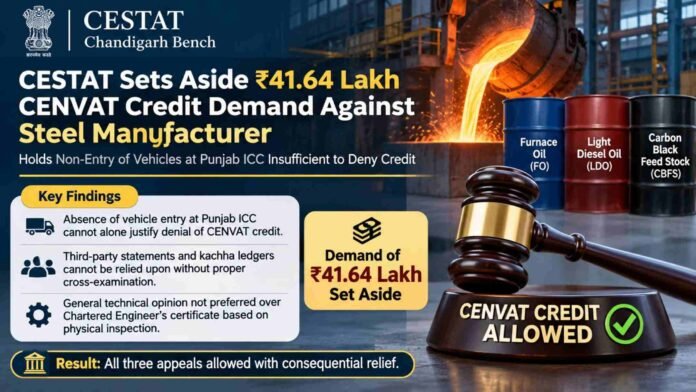
The Customs, Excise and Service Tax Appellate Tribunal (CESTAT), Chandigarh Bench, has held that CENVAT credit cannot be denied merely because vehicle numbers were not recorded at Punjab Information Collection Centres (ICCs), particularly when statutory tax records and other evidence establish receipt of inputs.
The bench of P. Anjani Kumar (Technical Member) set aside the demand of ₹41,64,523 towards alleged wrongful availment of CENVAT credit on Furnace Oil (FO), Light Diesel Oil (LDO) and Carbon Black Feed Stock (CBFS), holding that the Revenue failed to establish, through cogent and independent evidence, that the inputs were not physically received by the manufacturer.
Buy Now: Indirect Tax Judgments E-Compilation – October 2026
The dispute concerned a manufacturer engaged in the production of iron and non-alloy steel ingots, which had availed CENVAT credit on Furnace Oil, Light Diesel Oil and Carbon Black Feed Stock.
Following an investigation involving the manufacturer, its sister concerns, namely M/s Nandan Autotech Ltd. and M/s Adhunik Alloys Ltd., and the suppliers of the inputs, the Department alleged that the manufacturer had availed CENVAT credit without actually receiving the goods.
The Department alleged wrongful availment and utilisation of CENVAT credit amounting to ₹41,64,523 for the period January 2001 to August 2003.
The Revenue primarily relied upon the absence of vehicle entry records at Punjab Information Collection Centres (ICCs), statements of transporters and a technical opinion obtained from the National Institute of Secondary Steel Technology (NISST).
The adjudicating authority confirmed the demand through an Order-in-Original dated March 31, 2021. The Commissioner (Appeals), CGST, Chandigarh, subsequently upheld the demand vide Order-in-Appeal dated March 21, 2023.
Aggrieved by the decision, the manufacturer and its two directors approached the CESTAT.
The appellants contended that the Department had ignored material evidence establishing the actual receipt and consumption of the inputs.
It was submitted that a Chartered Engineer had physically visited the factory, examined the working conditions and certified the consumption requirements of Furnace Oil and Light Diesel Oil.
Further, a certificate issued by the Punjab State Sales Tax Department confirmed that the inputs had been received as reflected in the records.
The appellants also pointed out that the concerned transporters had confirmed transportation of the goods to the factory. The receipts of Furnace Oil, Light Diesel Oil and Carbon Black Feed Stock were duly recorded in the books of accounts.
It was further argued that the Department had relied upon statements of third parties without providing an effective opportunity for cross-examination of the persons whose statements formed the basis of the allegations.
A significant submission before the Tribunal was that substantially identical allegations and evidence had already been examined in the cases of the appellants’ sister concerns.
In the case of M/s Adhunik Alloys Ltd., the Tribunal had allowed the appeal vide Final Order No. 238-242/2016 dated March 21, 2016.
Similarly, in the case of M/s Nandan Autotech Ltd., the Tribunal had dismissed the Revenue’s appeal and allowed the assessee’s appeal vide Final Order No. A/62335-62336/2018 dated March 14, 2018.
The appellants also submitted that the Revenue’s challenge before the Punjab and Haryana High Court in the Adhunik Alloys matter had been dismissed as withdrawn on November 16, 2018.
Accordingly, it was argued that the issue had already attained finality on substantially identical facts and evidence.
After examining the records, the Tribunal observed that the Revenue’s case was primarily founded on three circumstances: The vehicles allegedly transporting the inputs were not found entered at Punjab’s Information Collection Centres. Transporters had allegedly denied undertaking transportation for the appellants in their statements. The Department relied upon the technical opinion of NISST regarding the consumption of Furnace Oil.
The Tribunal noted that the same issue, involving an identical set of evidence, had already been examined in the case of M/s Adhunik Alloys Ltd.
Following the earlier findings, the Tribunal observed that the absence of vehicle entry records at the ICCs could not, by itself, disentitle the manufacturer from availing CENVAT credit when the relevant tax records and certificates established that the transactions had been duly declared and the goods received.
The Tribunal reproduced the earlier findings observing that the purpose of ICCs was to establish that goods entering Punjab had suffered the applicable VAT, Central Sales Tax or Sales Tax.
Since the appellant had produced the certificate issued by the Excise and Taxation Officer confirming payment of the applicable taxes, mere non-entry of vehicle numbers at the ICCs was insufficient to deny CENVAT credit.
The Tribunal also examined the evidentiary value of statements recorded during the investigation.
It noted that the statement of a person associated with M/s LOT had initially been recorded on February 25, 2005, but was retracted the following day. Despite subsequent summons, the concerned person was not produced for cross-examination.
The Tribunal observed that statements of third parties, particularly when retracted or resiled from, require corroboration through independent evidence.
It further held that the kachha ledger recovered from a third party could not be relied upon as evidence when the concerned person had not been made available for cross-examination.
The Tribunal also observed that producing a different person for cross-examination, instead of the individual who had originally made the statement, would not satisfy the requirement of effective cross-examination.
In this regard, reliance was placed on the principles laid down in Vishnu & Co. Pvt. Ltd., concerning the necessity of independent corroborative evidence when third-party statements are retracted.
Another important issue concerned the Department’s reliance on the technical opinion of NISST, which suggested that Furnace Oil consumption in the case of oil firing of ladles would be approximately 3–4 litres per tonne.
The Tribunal noted that the expert who furnished the opinion had never visited the appellant’s factory premises and had given a general opinion.
On the other hand, the manufacturer had produced a certificate from a Chartered Engineer who had physically inspected the factory and examined its actual working conditions.
The Chartered Engineer had certified that Furnace Oil was required for the operation of the manufacturer’s induction furnace. The Revenue had not cross-examined the Chartered Engineer, who had affirmed the contents of his certificate.
The Tribunal also took note of the fact that Furnace Oil was actually found in the manufacturer’s stock during the investigation.
In the absence of contrary evidence, the Tribunal considered the certificate issued by the Chartered Engineer to have evidentiary value and found that the Revenue had failed to establish that Furnace Oil was not required for the manufacturing process.
Accordingly, the CESTAT set aside the impugned Order-in-Appeal insofar as the three appeals were concerned and allowed all three appeals with consequential relief, if any, in accordance with law.
Membership Required to Access Case Details & Order Copy
To view the complete Case Details and Download Order Copy, you must have an active membership. Please subscribe to continue.

