
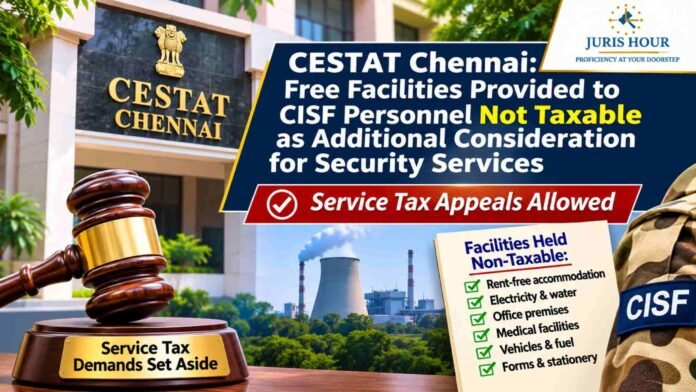
The Customs, Excise and Service Tax Appellate Tribunal (CESTAT), Chennai, has set aside the service tax demands holding that the notional value of facilities provided to Central Industrial Security Force (CISF) personnel cannot be treated as additional consideration for security services under Section 67 of the Finance Act, 1994.
The bench of M. Ajit Kumar (Member Technical) and P. Dinesha (Member Judicial) held that facilities extended by a service recipient to facilitate the performance of services do not automatically become consideration for such services.
Buy Now: Indirect Tax Judgments E-Compilation – October 2026
The bench rent-free accommodation, electricity, water, medical facilities, vehicles, fuel and other amenities provided to CISF personnel cannot be included in the taxable value of security services merely because they are contractually provided under an MoU.
The appellant/assessee is a Navratna Government of India Enterprise, operates open-cast lignite mines and thermal power stations. For the security of its industrial establishments, NLC had engaged the Central Industrial Security Force (CISF).
Under a Memorandum of Understanding dated October 27, 2011, NLC was required to bear the deployment-related expenses of CISF personnel. Apart from the monetary payments towards salaries, allowances, pension contributions, training, supervision and other deployment costs, NLC also provided several facilities to CISF personnel.
These included rent-free residential accommodation, office premises, electricity, water, communication facilities, vehicles, fuel, medical facilities, forms and stationery.
Following an audit of CISF accounts, the Department alleged that the monetary value of these additional facilities constituted consideration for the security services provided by CISF.
Accordingly, two Show Cause Notices dated September 4, 2014 and October 1, 2014 were issued for the Neyveli and Barsingsar units, respectively, covering the period July 2012 to March 2014.
The Adjudicating Authority confirmed demands of ₹44,93,376 and ₹6,40,719, respectively, along with applicable interest and penalties under the Finance Act, 1994. The Commissioner (Appeals) upheld the demands, except in respect of vehicles, for which verification of supporting documents was directed.
Aggrieved by the decision, NLC approached CESTAT, Chennai.
The Appellant contended that the consideration payable to CISF was specifically governed by Clause 23 of the MoU, which dealt with deployment costs, including salaries, allowances, pension contributions, training, supervision, clothing and equipment.
NLC submitted that service tax had already been discharged on the amounts invoiced by CISF towards deployment costs and that there was no justification for additionally including the notional value of facilities provided to CISF personnel.
It was argued that Clauses 3, 7 and 20 of the MoU merely required NLC to provide infrastructure and amenities necessary for the effective deployment of CISF personnel. Such facilities were operational and contractual arrangements and did not constitute additional consideration for the security services.
The Appellant also relied upon several Tribunal decisions involving similar arrangements between public sector undertakings and CISF.
The department argued that with effect from July 1, 2012, security services provided by CISF, being a Government organisation, attracted service tax under the reverse charge mechanism under Rule 2(1)(d)(E) of the Service Tax Rules, 1994.
It was submitted that the facilities provided by NLC, including accommodation, electricity, water, vehicles, fuel, medical facilities and communication infrastructure, constituted consideration in kind for the security services.
According to the Department, Explanation (a) to Section 67 of the Finance Act, 1994, read with Rule 3 of the Service Tax (Determination of Value) Rules, 2006, permitted the inclusion of the monetary equivalent of non-monetary consideration in the taxable value.
The Revenue further contended that since NLC had expressly undertaken under the MoU to provide these facilities, their monetary value was liable to service tax under the reverse charge mechanism.
The Tribunal observed that the central issue was whether the facilities provided by NLC to CISF personnel constituted consideration within the meaning of Section 67 of the Finance Act, 1994.
It emphasised the distinction between consideration received by a service provider in exchange for rendering services and facilities or amenities provided by the service recipient merely to facilitate the performance of those services.
The Tribunal observed that:
“The mere existence of a contractual obligation on the part of the service recipient to provide certain facilities does not, by itself, establish that the monetary equivalent of such facilities constitutes consideration for the services rendered.”
Thus, merely because an MoU requires the recipient to provide certain facilities, their notional monetary value cannot automatically be included in the taxable value.
The Tribunal placed significant reliance on the Supreme Court’s decision in Bhayana Builders (P) Ltd. The Supreme Court had held that the expression “gross amount charged” refers to the amount charged by the service provider for the services rendered and that the value of goods or materials supplied free of cost by the service recipient cannot be included in the taxable value merely by assigning a notional monetary value.
CESTAT observed that the taxable value must have a direct nexus with the consideration for the taxable service.
The Tribunal also relied upon Intercontinental Consultants and Technocrats Pvt. Ltd., wherein the Supreme Court held that amounts which do not constitute consideration for services rendered cannot be included in the taxable value merely by resorting to valuation rules.
It clarified that Rule 3 of the Service Tax (Determination of Value) Rules, 2006, provides a mechanism for determining the monetary equivalent of non-monetary consideration.
However, the applicability of Rule 3 presupposes that the amount or benefit in question constitutes consideration for the service rendered.
The Tribunal observed that the valuation rule cannot independently convert every facility or expenditure incurred by the service recipient into consideration merely because it is capable of monetary valuation.
The Tribunal examined the relevant clauses of the MoU dated October 27, 2011.
It noted that Clause 23 specifically dealt with the financial obligations towards deployment of CISF personnel, including salaries, allowances, pension contributions, training, supervision, clothing, equipment and other agreed expenses.
On these amounts, CISF had raised invoices and applicable service tax had already been discharged.
On the other hand, Clauses 3, 7 and 20 dealt with the provision of infrastructure, accommodation, communication facilities, transport, medical facilities and other amenities necessary for the effective deployment of CISF personnel.
The Tribunal held that these two sets of obligations were distinct in nature.
While Clause 23 dealt with deployment costs, the remaining provisions primarily concerned infrastructure and facilities necessary for CISF to discharge its security functions effectively.
Consequently, these facilities could not be equated with additional consideration charged by CISF.
The Tribunal also noted that the issue had already been considered in several decisions involving similar arrangements between public sector undertakings and CISF.
The Tribunal observed that these decisions supported the proposition that free accommodation, medical facilities, transportation and other amenities provided to CISF personnel could not automatically be treated as additional consideration for security services.
The Tribunal specifically observed that the facilities were provided to enable CISF personnel to discharge their statutory security functions at NLC’s establishments.
The Revenue had not established that the monetary value of these facilities was separately charged by CISF or that they constituted an agreed additional payment in exchange for security services.
It held that the mere fact that such facilities were stipulated in the MoU could not, by itself, determine their taxability.
The Tribunal noted that the Commissioner (Appeals) had already directed verification of supporting documents and set aside the demand to that extent for verification.
However, considering its findings on the principal issue, CESTAT held that the notional value of vehicles provided as a facility for deployment of CISF personnel would also not be includible in the taxable value.
Therefore, no demand could be sustained merely on the basis of the notional value assigned to such vehicles.
Having held that the value of the facilities was not includible in the taxable value of security services, the Tribunal concluded that the demand itself was unsustainable on merits.
Consequently, the question of invoking the extended period of limitation under Section 73(1) of the Finance Act, 1994, did not survive.
The Tribunal further held that interest under Section 75 and penalties under Section 76 were also liable to be set aside.
The Tribunal held that the value of rent-free accommodation, electricity, water, office facilities, medical facilities, fuel, forms and stationery provided by NLC to CISF could not be included in the taxable value of security services in the facts and circumstances of the case.
Membership Required to Access Case Details & Order Copy
To view the complete Case Details and Download Order Copy, you must have an active membership. Please subscribe to continue.

