
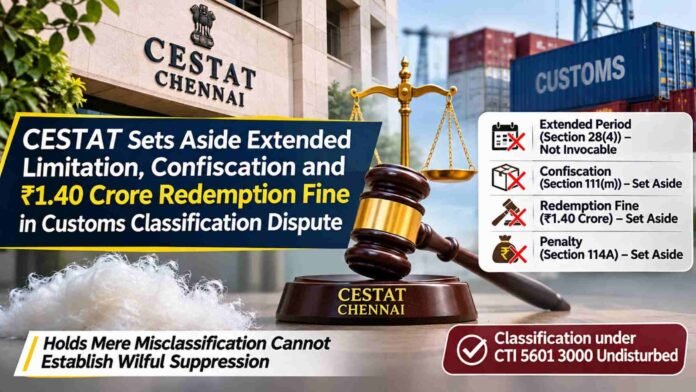
The Customs, Excise and Service Tax Appellate Tribunal (CESTAT), Chennai held that an incorrect classification of imported polyester and acrylic fibres cannot, by itself, justify invoking the extended period of limitation under Section 28(4) of the Customs Act, 1962.
The bench of P. Dinesha (Judicial Member) and M. Ajit Kumar (Technical Member) set aside confiscation under Section 111(m), redemption fine under Section 125 and penalty under Section 114A, while protecting the differential duty already paid for the normal period.
Buy Now: Indirect Tax Judgments E-Compilation – October 2026
The issue raised was in respect of the classification of imported polyester and acrylic fibres and the consequential demand of customs duty by the Department.
The dispute arose when the importer brought goods described as “Binder 1/16”, “Binder 3/16” and “PAN Fibres” into India under Bill of Entry No. 3680108 dated 10 December 2022. The goods were initially classified under CTI 5503 2000 and CTI 5503 3090.
The Special Intelligence and Investigation Branch (SIIB), Chennai-III, initiated an investigation on the suspicion that the imported goods were short-cut or milled polyester and PAN fibres measuring not more than 5 mm in length, which were classifiable under CTI 5601 3000.
Representative samples were forwarded to the Central Revenue Control Laboratory (CRCL). According to the test report dated 19 January 2023, the imported goods comprised cut polyester and acrylic fibres measuring 2–5 mm in length, technically described as flock.
Following the laboratory findings, the importer accepted classification under CTI 5601 and paid differential customs duty of ₹2,11,46,155 along with interest of ₹35,60,969 for the period September 2021 to November 2022.
However, the Department issued a Show Cause Notice dated 1 September 2023 invoking the extended period of limitation under Section 28(4) of the Customs Act, 1962, alleging wilful misstatement and suppression of facts.
The adjudicating authority confirmed the proposals, including confiscation of goods under Section 111(m), redemption fine of ₹1.40 crore and penalty under Section 114A.
Aggrieved by the order, the importer approached the CESTAT.
The importer contended that the classification of the goods under CTI 5601 3000 was no longer disputed and that the differential duty and interest for the normal period had already been discharged.
The principal challenge was confined to the invocation of the extended period of limitation and the consequential confiscation, redemption fine and penalty.
It was submitted that the importer had been regularly importing the goods from the United Kingdom and China for more than seven years. During the relevant period, the goods had initially been classified under TI 7019 1100 and subsequently under CTI 5503 2000.
The importer specifically highlighted that, in respect of Bill of Entry No. 5854781 dated 15 October 2021, the Faceless Assessment Group had raised a query concerning anti-dumping duty applicable to glass fibres imported from China.
The importer explained that the goods comprised polyester and acrylic fibres and not glass fibres. Thereafter, the Department subjected the goods to first-check examination and assessed them under CTI 5503 2000 on 3 December 2021.
It was argued that the Department itself had examined and accepted the classification under CTI 5503 2000, and therefore, the subsequent change in classification could not automatically establish deliberate misstatement or suppression.
The importer further submitted that the original classification under TI 7019 attracted basic customs duty at 10%, whereas CTI 5503 2000 attracted a lower rate of 5%. This, according to the importer, demonstrated the absence of any intention to evade customs duty.
It was also argued that there was no discrepancy in the declared description, quantity, unit price or assessable value when compared with the invoices and other import documents.
Consequently, an incorrect tariff classification could not, by itself, be treated as misdeclaration under Section 111(m) or wilful suppression under Section 28(4).
The Revenue opposed the appeal and submitted that the importer, being a 3-Star Export House and an AEO-T2 accredited importer, was fully aware of the nature and composition of the imported goods.
The Department alleged that the supplier’s invoices, Certificates of Analysis and product data sheets clearly established that the goods were polyester and acrylic fibres rather than glass fibres.
It was further alleged that the importer deliberately omitted the supplier’s product description and brand particulars, including “Primafloc Ref. P6/15”, from the Bills of Entry and instead used the description “Fiber Chopped Strands” to support classification under Chapter 70.
According to Revenue, the importer had knowledge of the actual nature and fibre length of the goods but continued to declare an incorrect tariff classification.
The Department therefore argued that the extended period of limitation was correctly invoked and that confiscation, redemption fine and penalty were justified.
The Tribunal observed that Section 28(4) of the Customs Act, 1962, permits recovery of duty beyond the normal period where the short-levy arises by reason of collusion, wilful misstatement or suppression of facts by the importer, exporter or their agent or employee.
The Tribunal emphasised that the extended period cannot be invoked merely because the duty determined upon reassessment is higher than the duty originally assessed.
The Department must establish that the short-levy resulted from one of the circumstances expressly specified under Section 28(4).
Relying upon the Supreme Court’s decision in Northern Plastics Ltd. v. Collector of Customs [1998 (101) E.L.T. 549 (S.C.)], the Tribunal reiterated the distinction between an incorrect classification claim and misdeclaration of the particulars of imported goods.
It observed that classification involves applying the relevant tariff entries, section notes, chapter notes and interpretative rules to the goods. An incorrect classification claim does not automatically establish deliberate misstatement or suppression of facts.
The Tribunal also relied upon Uniworth Textiles Ltd. v. Commissioner of Central Excise, Raipur [2013 (288) E.L.T. 161 (S.C.)], wherein the Supreme Court held that mere omission or failure to pay duty does not automatically amount to suppression.
The Tribunal considered the Revenue’s allegation that the importer had deliberately omitted the supplier’s product description and brand particulars from the Bills of Entry.
It observed that such allegations, if established through contemporaneous import documents and reliable evidence, could go beyond a mere classification dispute and potentially constitute wilful misstatement or suppression under Section 28(4).
However, the burden of establishing the statutory ingredients rested upon the Department.
The Tribunal specifically held that the importer’s status as a 3-Star Export House, its AEO-T2 accreditation, commercial sophistication or availability of professional tax advice could not, by themselves, establish wilful misstatement or suppression.
An important aspect of the decision was the earlier examination of the imported goods by the Department.
The Tribunal noted that the Faceless Assessment Group had raised a query in the context of anti-dumping duty on glass fibres imported from China.
The importer clarified that the goods comprised polyester and acrylic fibres and not glass fibres. Following first-check examination, the Department itself assessed the goods under CTI 5503 2000 on 3 December 2021.
The Tribunal observed that the Department’s earlier examination and assessment was a relevant circumstance.
Although such assessment did not conclusively establish that the earlier classification was correct or that every material particular had been disclosed, the subsequent adoption of a different classification could not, without further evidence, be treated as proof of deliberate misstatement.
The Revenue argued that under the self-assessment mechanism introduced under Section 17, read with Sections 46(4) and 46(4A) of the Customs Act, importers were responsible for ensuring the correctness and completeness of their declarations.
The Tribunal accepted that importers have a statutory obligation to make correct declarations.
However, it clarified that the obligation to make a correct declaration is distinct from the conditions required for invoking the extended period under Section 28(4).
An incorrect declaration may warrant reassessment and recovery of differential duty within the normal limitation period. However, invoking the extended period additionally requires proof of collusion, wilful misstatement or suppression of facts.
The Tribunal further observed that knowledge of the composition of goods does not, by itself, establish that the importer knew that the goods necessarily fell under a particular tariff heading.
The Revenue had relied upon supplier documents, product data sheets, statements and 152 Bills of Entry covering the period 2018–2023.
However, the Tribunal observed that the mere existence of these documents was insufficient.
The adjudicating authority was required to demonstrate how the contents of those documents established that the importer had deliberately withheld or misstated material particulars in the relevant Bills of Entry.
A general reference to the number of Bills of Entry or the importer’s knowledge of the goods could not replace such an examination.
The Tribunal ultimately found that the adjudicating authority had not adequately established the necessary nexus between the alleged omission or misstatement and the short-levy of duty.
The Tribunal separately examined the sustainability of confiscation under Section 111(m) of the Customs Act, 1962.
It clarified that Sections 28(4) and 111(m) operate in distinct fields.
While Section 28(4) concerns recovery of duty beyond the normal period and requires proof of collusion, wilful misstatement or suppression, Section 111(m) concerns goods that do not correspond, in respect of value or any other particular, with the entry made under the Customs Act.
The Tribunal held that failure to establish suppression under Section 28(4) does not automatically rule out confiscation under Section 111(m). Equally, an incorrect classification or interpretative difference does not automatically attract confiscation.
The applicability of Section 111(m) must be independently determined with reference to the particulars declared and the goods actually imported.
The Tribunal also observed that the mere addition of words to the description appearing in the supplier’s invoice would not, by itself, establish wilful misstatement.
Where an importer adds words to clarify the nature, commercial description or intended use of goods without altering their identity or material characteristics, such addition would not ordinarily amount to misdeclaration.
The Department was required to establish that the additional description was knowingly introduced to misrepresent the actual nature of the imported goods.
Considering that the Department had earlier examined and assessed the goods under CTI 5503 2000, and in the absence of sufficient evidence establishing that the importer had knowingly misrepresented the identity or material characteristics of the goods, the Tribunal held that confiscation under Section 111(m) was unsustainable.
Once confiscation under Section 111(m) was held to be unsustainable, the consequential redemption fine of ₹1.40 crore imposed under Section 125 could not survive.
Further, in the absence of the requisite ingredients for invoking Section 28(4), the penalty imposed under Section 114A was also held to be unsustainable.
Accordingly, the Tribunal set aside the confiscation, redemption fine and penalty.
Membership Required to Access Case Details & Order Copy
To view the complete Case Details and Download Order Copy, you must have an active membership. Please subscribe to continue.
Read More: Customs Broker Proceedings Quashed as 90-Day Limitation Under CBLR, 2013 Violated: CESTAT

