
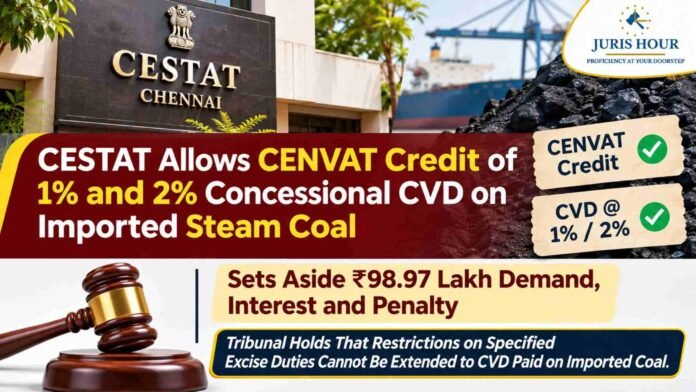
The Customs, Excise and Service Tax Appellate Tribunal (CESTAT), Chennai Bench has held that restrictions applicable to specified duties of excise on domestic coal cannot be extended to Additional Duty of Customs (CVD) paid on imported coal.
The Ajayan T.V. (Judicial Member) and Vasa Seshagiri Rao (Technical Member) has dismissed the department’s appeal and upheld the admissibility of CENVAT credit of Countervailing Duty (CVD) paid at concessional rates of 1% and 2% on imported steam coal, holding that restrictions applicable to specified duties of excise on domestic coal cannot be extended to additional duty of customs leviable under Section 3 of the Customs Tariff Act, 1975.
Buy Now: All 200+ GSTAT Judgements Till November 2026 | Comprehensive E-Magazine
The appellant/assessee is engaged in the manufacture of sugar and molasses, had purchased imported steam coal from M/s. Seshasayee Paper and Boards Ltd. (SPB).
The imported steam coal had suffered Countervailing Duty (CVD) at concessional rates of 1% and 2% under Customs Notification No. 12/2012-Cus. dated 17 March 2012, as amended by Notification No. 12/2013-Cus. dated 1 March 2013.
Ponni Sugars availed the corresponding CENVAT credit under Rule 3(6) of the CENVAT Credit Rules, 2004, on the basis that SPB had paid the amount attributable to the coal cleared as such under Rule 3(5) of the said Rules.
However, the Department disputed the admissibility of such credit and issued a Show Cause Notice dated 28 April 2017 proposing recovery of ₹98,97,820 along with applicable interest and penalty.
The adjudicating authority confirmed the demand through Order-in-Original dated 27 October 2017 and imposed an equivalent penalty under Rule 15(2) of the CENVAT Credit Rules, 2004, read with Section 11AC of the Central Excise Act, 1944.
On appeal, the Commissioner (Appeals), through Order-in-Appeal No. 139/2018-SLM-C.EX. dated 24 August 2018, set aside the demand, interest and penalty. Aggrieved by the decision, the Department approached CESTAT Chennai.
The Department contended that the Commissioner (Appeals) had wrongly allowed CENVAT credit of CVD paid at concessional rates of 1% and 2% on imported steam coal.
According to the Revenue, the expression “equivalent to the duty of excise” appearing in Rule 3(1)(vii) of the CENVAT Credit Rules, 2004, had to be interpreted in conjunction with the duties specified under the other clauses of Rule 3(1).
The Department argued that the effective rate of duty on domestic steam coal was governed by Central Excise Notification No. 1/2011-CE dated 1 March 2011 and Notification No. 12/2012-CE dated 17 March 2012, which contained restrictions on the availment of CENVAT credit.
It was therefore submitted that importers availing concessional CVD under the corresponding Customs notifications could not be placed in a more favourable position than domestic manufacturers.
The Department accordingly sought restoration of the Order-in-Original confirming the disputed demand.
The assessee argued that Rule 3(1)(vii) of the CENVAT Credit Rules, 2004, specifically permits credit of additional duty leviable under Section 3 of the Customs Tariff Act, 1975.
The assessee submitted that the restriction contained in the proviso to Rule 3(1)(i) was confined to specified duties of excise and could not be extended to CVD, which is an additional duty of customs.
It was further argued that the applicable Customs notifications did not contain any condition prohibiting the availment of CENVAT credit.
Examining the statutory provisions, the Tribunal observed that Section 3(1) of the Customs Tariff Act, 1975, creates a levy of additional duty of customs on imported goods.
Although the measure of such levy is linked to the excise duty leviable on like goods manufactured in India, the levy itself continues to retain its character as an additional duty of customs under the Customs Tariff Act.
The Tribunal noted that Rule 3(1)(vii) expressly recognises additional duty leviable under Section 3 of the Customs Tariff Act as eligible for CENVAT credit.
Importantly, the provision does not stipulate that credit would be available only when CVD is paid at the tariff rate or at a rate identical to the effective rate of excise duty applicable to domestically manufactured goods.
The Tribunal rejected the Department’s interpretation that the expression “equivalent to the duty of excise” automatically incorporates every restriction contained in the Central Excise exemption notifications.
It held that such an interpretation would require reading into Rule 3(1)(vii) a restriction that the provision itself does not contain.
The Tribunal specifically observed that the proviso to Rule 3(1)(i) is expressly confined to specified duties of excise and benefits availed under the relevant Central Excise notifications.
The said restriction cannot be extended to additional duty of customs covered under Rule 3(1)(vii).
It further noted that Customs Notification No. 12/2012-Cus. dated 17 March 2012, as amended by Notification No. 12/2013-Cus. dated 1 March 2013, did not prescribe any condition prohibiting CENVAT credit of the CVD paid.
The Tribunal emphasised that restrictions contained in Central Excise notifications cannot be imported into separate Customs notifications when no such condition is prescribed therein.
In this regard, the Tribunal relied upon the principle laid down by the Supreme Court in Hansraj Gordhandas v. H.H. Dave, AIR 1970 SC 755, that an exemption notification must be applied according to its language and a condition not contained therein cannot be added by implication.
The Tribunal placed particular reliance on its earlier decision in Seshasayee Paper and Boards Ltd. v. Commissioner of GST and Central Excise, 2026 (1) TMI 508 (CESTAT Chennai), Final Order Nos. 40021–40022/2026 dated 8 January 2026.
In that case, the Tribunal had already held that CENVAT credit of 1%/2% Additional Duty of Customs paid on imported coal under Notifications No. 12/2012-Cus. and 12/2013-Cus. was admissible.
The Tribunal also considered its subsequent decision in The India Cements Ltd., wherein the admissibility of CENVAT credit of concessional CVD on imported coal was reaffirmed.
It observed that the fact that SPB was the importer and supplier in the earlier proceedings, whereas the assessee was the purchaser in the present case, did not alter the character of the levy or the interpretation of the statutory provision.
The Revenue’s reliance on earlier adjudication orders passed in the cases of SPB and JSW Steel Ltd. was also rejected, particularly since the adjudication order relating to SPB had subsequently been set aside by the Tribunal.
The Tribunal separately examined whether the assessee was entitled to the corresponding credit of the amount paid by SPB under Rule 3(5) of the CENVAT Credit Rules, 2004.
It observed that Rule 3(6) permits the recipient of inputs cleared as such to avail credit of the amount paid under Rule 3(5), as if such amount were duty paid by the person removing the goods.
The Tribunal noted that the assessees’ claim was supported by particulars of clearances and payments disclosed by SPB in its periodical ER-1 returns.
Since the underlying CVD was itself eligible for credit under Rule 3(1)(vii), the corresponding amount paid by SPB under Rule 3(5) was also admissible to the assessee under Rule 3(6), subject to fulfilment of the prescribed requirements.
The objection relating to documents under Rule 9 was also rejected, as the Commissioner (Appeals) had already examined and rejected the allegation of documentary deficiencies, and the Revenue had not specifically challenged that finding in its appeal.
Having decided the substantive issue in favour of the assessee, the Tribunal held that the very basis of the demand failed.
It therefore did not consider it necessary to examine the separate plea of limitation raised in the cross-objection.
Since the disputed CENVAT credit was legally admissible, the consequential demand of interest and imposition of penalty could not survive.
CESTAT Chennai held that CVD paid on imported steam coal at concessional rates of 1% and 2% is eligible for CENVAT credit under Rule 3(1)(vii) of the CENVAT Credit Rules, 2004.
The restriction contained in the proviso to Rule 3(1)(i) cannot be extended to additional duty of customs leviable under Section 3 of the Customs Tariff Act, 1975.
The corresponding credit of the amount paid by SPB under Rule 3(5) was also held admissible to the assessee under Rule 3(6), subject to fulfilment of the prescribed requirements.
Accordingly, the Tribunal dismissed the Revenue’s appeal, upheld the Order-in-Appeal dated 24 August 2018 and set aside the demand of ₹98,97,820 along with interest and penalty.
Membership Required to Access Case Details & Order Copy
To view the complete Case Details and Download Order Copy, you must have an active membership. Please subscribe to continue.

