
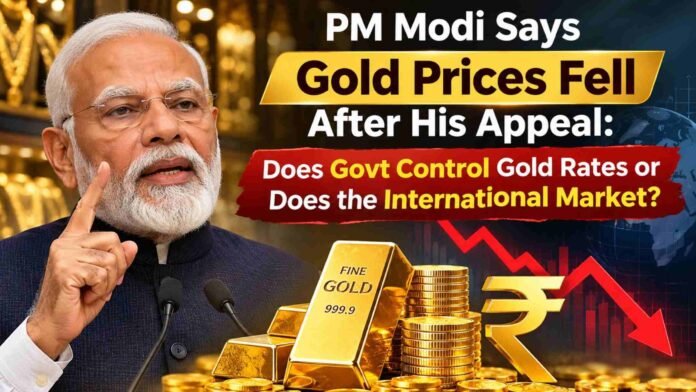
Prime Minister Narendra Modi has credited Indian citizens for the decline in gold prices, stating that his appeal to avoid unnecessary gold purchases for one year helped bring down prices. But does the Prime Minister or the Central Government actually have the power to determine gold prices in India? Or are gold rates primarily governed by international bullion markets?
An examination of the gold pricing mechanism, customs duties, international benchmarks, currency fluctuations and the Government’s regulatory powers reveals how gold prices are actually determined.
Buy Now: Complete Tax & Supreme Court Judgments E-Magazine Combo – October 2026
Background: What Did Prime Minister Narendra Modi Say About Gold Prices?
Prime Minister Narendra Modi recently attributed the decline in gold prices to the public’s response to his appeal to avoid unnecessary gold purchases.
On November 21, 2026, while addressing the fifth National Skill Convocation Ceremony at the Indira Gandhi Pratishthan in Lucknow, the Prime Minister recalled that he had appealed to citizens in May 2026 to avoid purchasing gold for one year unless it was necessary.
He expressed satisfaction that people had responded positively to his appeal and purchased less gold, which, according to him, contributed to the fall in gold prices.
The Prime Minister also compared the public’s response to his appeal with the response to former Prime Minister Lal Bahadur Shastri’s call to citizens to skip one meal during the food shortage in 1965.
According to reports, gold prices declined from approximately ₹15,250 per gram on May 9, 2026, to ₹12,523 per gram on November 21, 2026.
NDTV+1
The statement, however, raises an important economic and regulatory question: Can an appeal by the Prime Minister or a decision by the Central Government directly reduce gold prices, or does the actual price depend on international market forces?
Are Gold Prices Regulated by the Indian Government?
The Government of India does not directly fix the daily selling price of gold in the domestic market. Gold prices are market-determined. However, the Government can influence the final price through customs duties, taxation, import restrictions and other policy measures.
This distinction is extremely important.
The Central Government does not announce a fixed price at which every jeweller must sell gold every morning. Instead, the price is influenced by international bullion rates, domestic demand and supply, the rupee-dollar exchange rate, import duties and other applicable costs.
The position was also clarified by the Ministry of Finance in a parliamentary reply, as reported by The Financial Expresson December 15, 2025.
The Government stated that precious metal prices are determined by the market and that it is not involved in their price fixation.
The Ministry nevertheless explained that the Government can use customs duty and other policy instruments to influence domestic prices and gold imports.
Therefore, the correct position is:
- The Government does not directly determine the daily market price of gold.
- International markets have a substantial influence on gold prices.
- The Government can increase or decrease the landed cost of imported gold through customs duties.
- The Government can influence domestic demand through policy measures and public appeals.
- Domestic bullion dealers and jewellers operate within the prevailing market and regulatory framework.
How Are Gold Prices Actually Determined in India?
Gold pricing in India is connected to the international bullion market. The domestic price is not independent of the price prevailing in global markets.
There are several important components involved.
A. International Gold Prices – The Primary Market Influence
Gold is traded internationally, primarily in US dollars per troy ounce.
The international bullion market operates through global trading centres, with London and other major financial centres playing an important role in price discovery.
The LBMA Gold Price is one of the principal international benchmarks for physical gold.
When international gold prices increase, Indian gold prices generally increase as well, assuming other factors remain unchanged.
Similarly, when international gold prices decline, domestic gold prices generally face downward pressure.
International gold prices are influenced by:
- Global inflation and expectations regarding inflation.
- Interest rate decisions of the US Federal Reserve.
- Strength or weakness of the US dollar.
- Geopolitical tensions and international conflicts.
- Purchases by central banks across the world.
- Investment demand for gold ETFs and bullion.
- Global economic uncertainty and recession concerns.
- Gold mining supply and recycling of existing gold.
For example, during periods of geopolitical uncertainty, investors often purchase gold as a safe-haven asset. This can increase global demand and push international prices upwards.
Consequently, even if demand for gold falls in India, international factors can continue to push gold prices upwards.
Rupee-Dollar Exchange Rate
This is one of the most important factors for Indian gold buyers.
India imports a substantial quantity of its gold requirements. Since international gold transactions are largely denominated in US dollars, the rupee-dollar exchange rate directly affects the domestic landed cost.
Consider the following simplified illustration:
| Particulars | Scenario A | Scenario B |
| International gold price | $4,000/oz | $4,000/oz |
| USD-INR exchange rate | ₹85 | ₹90 |
| Approx. rupee value per ounce | ₹3,40,000 | ₹3,60,000 |
Illustrative calculation only; excludes import duties, taxes, conversion costs and other charges.
Even though the international gold price remains unchanged, Indian gold becomes more expensive when the rupee depreciates against the US dollar.
Conversely, if the rupee strengthens against the dollar, domestic gold prices may decline even when international prices remain stable.
This means that international gold prices alone do not determine the price paid by Indian consumers. The rupee-dollar exchange rate is equally important.
Customs Duty Imposed by the Central Government
This is where the Government has a direct policy instrument to influence gold prices.
India imports gold from international markets. Imported gold attracts applicable customs duties and other levies under the prevailing tariff structure.
An increase in customs duty increases the landed cost of imported gold, potentially making gold more expensive in India.
A reduction in customs duty can reduce the landed cost and provide relief to domestic buyers.
An important example is the July 2024 Budget decision, when the Government reduced customs duty on gold imports from 15% to 6%.
However, the policy subsequently changed.
According to the World Gold Council’s India Gold Market Update dated May 22, 2026, the Government increased gold import duty from 6% to 15%, effective May 13, 2026.
The World Gold Council observed that this was a significant policy change intended, among other things, to moderate gold imports amid pressure on India’s foreign exchange position.
World Gold Council+1
This demonstrates that although the Government does not fix the market price of gold, it has the power to influence the domestic price through taxation.
GST on Gold
GST is another component of the final price paid by consumers.
Under the prevailing GST framework:
- Gold attracts GST at 3%.
- Making charges on jewellery, when separately charged under the applicable job-work treatment, can attract GST at 5%.
Thus, the consumer’s final bill may include the underlying gold value, applicable GST, making charges and other applicable components.
GST is not a mechanism through which the Government fixes the international price of gold. It is a tax imposed on the relevant supply.
Domestic Bullion Market and MCX Prices
Domestic gold prices are also influenced by trading activity in India.
Two important institutions in this context are:
1. Multi Commodity Exchange (MCX)
Multi Commodity Exchange of India provides a platform for trading gold futures contracts.
MCX gold futures reflect market expectations and are influenced by international bullion prices, currency movements, domestic demand and supply, and trading activity.
It is important to understand that a futures price is not necessarily identical to the immediate physical delivery price.
2. Indian Bullion and Jewellers Association (IBJA)
India Bullion and Jewellers Association publishes indicative benchmark bullion rates based on market information.
These rates are commonly used as a reference by bullion dealers and jewellers.
However, IBJA does not exercise governmental price-control powers. Nor does it have the authority to impose a compulsory uniform retail selling price on every jeweller.
The final retail price can vary depending on purity, location, dealer margins, making charges and other applicable costs.
Aditya Birla Capital
Can Narendra Modi’s Appeal Actually Reduce Gold Prices?
The Prime Minister’s appeal can influence gold prices, but it is important to distinguish between an impact on domestic demand and an impact on international bullion prices.
India is one of the world’s largest gold-consuming countries. A substantial reduction in Indian demand can affect domestic bullion premiums, imports and the global supply-demand balance.
The possible economic chain is:
Prime Minister appeals to citizens to avoid unnecessary gold purchases
Consumers reduce gold purchases
Domestic demand and bullion imports may decline
Domestic supply-demand imbalance and premiums may soften
Potential downward pressure on domestic gold prices
However, this is an economic possibility, not an automatic consequence.
A reduction in Indian gold purchases does not necessarily mean that international gold prices will fall.
For instance, if India reduces its gold imports but central banks in other countries increase their purchases, or international investors increase their investment in gold, global prices may continue rising.
Therefore, the Prime Minister’s appeal can influence demand, but it cannot independently determine the international price of gold.
What Actually Happened After Modi’s Appeal in May 2026?
The figures reported following the Prime Minister’s appeal are significant.
According to News on AIR, 24-carat gold prices declined from approximately ₹15,250 per gram on May 9, 2026, to ₹12,523 per gram on November 21, 2026.
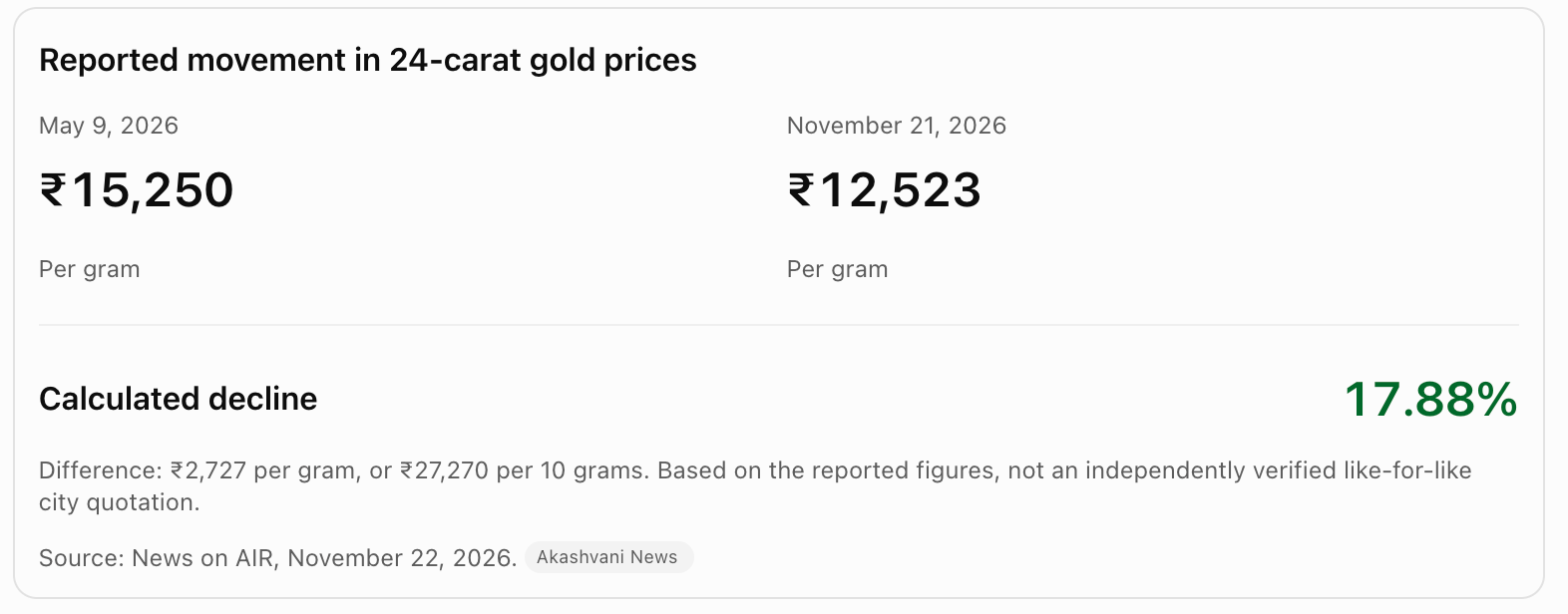
Difference: ₹2,727 per gram, or ₹27,270 per 10 grams. Based on the reported figures, not an independently verified like-for-like city quotation.
News on AIR also reported that India’s gold imports fell by nearly 40% during April–October 2026.
This is relevant because a decline in imports can reflect reduced domestic demand, particularly in a country that depends significantly on imported gold.
However, it would be economically inaccurate to attribute the entire decline in gold prices to the Prime Minister’s appeal.
The decline must be examined alongside international price movements, currency fluctuations, changes in import duties, investment demand and other market developments.
In particular, the World Gold Council documented the May 2026 increase in import duty from 6% to 15%, which would ordinarily increase the landed cost of imported gold rather than reduce it.
The Council also noted that weak physical demand and additional supply were affecting the extent to which the duty increase translated into domestic prices.
World Gold Council
Thus, the reported fall in gold prices and the reduction in imports are relevant indicators, but they do not establish that the public appeal alone caused the decline.
Why Can Gold Prices Fall Even When the Government Does Not Reduce Taxes?
This is perhaps the most important part of the entire discussion.
Gold prices can fall even when customs duty and GST remain unchanged.
For example, suppose international gold prices decline by 10%, while the rupee-dollar exchange rate and applicable taxes remain broadly stable.
The domestic price of gold may also decline, although the Government has not announced any tax reduction.
Similarly, gold prices may increase despite reduced Indian demand if international prices rise substantially.
The following table explains the possible impact of different factors:
| Factor | Likely impact on Indian gold prices |
| International gold prices increase | Increase |
| International gold prices decrease | Decrease |
| Rupee depreciates against USD | Increase |
| Rupee appreciates against USD | Decrease |
| Customs duty increases | Increase |
| Customs duty decreases | Decrease |
| Domestic demand declines | Downward pressure |
| Central bank gold purchases increase globally | Upward pressure |
| Global geopolitical uncertainty increases | Often upward pressure |
| US interest rates rise | Can create downward pressure |
These are general relationships. The actual impact depends on the interaction of multiple factors.
Why Does the Government Want Indians to Reduce Gold Purchases?
There is also an important economic reason behind the Prime Minister’s appeal.
India is a major importer of gold. When domestic consumption is met through imported gold, India has to spend foreign currency, primarily US dollars, to pay international suppliers.
Gold imports therefore contribute to India’s import bill and affect the country’s external-sector position.
When the rupee is under pressure, crude oil prices rise or foreign exchange requirements increase, reducing unnecessary imports can help manage external vulnerabilities.
The Government’s concern is not necessarily that Indians should stop investing in gold permanently.
Rather, the objective behind the 2026 appeal was to encourage restraint in discretionary gold purchases and conserve foreign exchange during a period of economic uncertainty.
The World Gold Council’s May 2026 assessment also identified the pressure on the Indian rupee, geopolitical uncertainty and gold’s importance in India’s merchandise imports as important reasons behind the policy tightening.
Can the Government Legally Regulate Gold Prices?
The Government has several legal and fiscal instruments through which it can influence the gold market.
However, these powers should not be confused with direct price fixation.
| Government instrument | How it affects the gold market |
| Customs Act, 1962 and customs tariff framework | Governs import duties and customs procedures |
| Customs duty notifications | Can increase or decrease the landed cost of imported gold |
| CGST Act, 2017 | Governs GST on taxable supplies of gold and jewellery |
| Foreign Trade Policy and import regulations | Can regulate the import of gold through applicable restrictions and conditions |
| RBI regulatory framework | Regulates relevant banking, foreign exchange and bullion-import activities |
| Gold Monetisation Scheme | Seeks to mobilise idle household and institutional gold |
The Government can also introduce measures to discourage physical gold imports or encourage alternative gold investment avenues.
However, none of these measures means that the Government automatically fixes the daily price at which gold must be sold by jewellers.
The distinction is between regulating the gold trade and fixing the price of gold. The former is within the Government’s regulatory and fiscal powers; the latter is not the normal mechanism of India’s gold market.
Will Gold Prices Continue to Decline?
It is difficult to predict the future movement of gold prices merely on the basis of the Prime Minister’s appeal.
Several international developments will remain important.
First, US Federal Reserve policy: Interest rate increases can make interest-bearing assets relatively more attractive than gold, which does not generate interest. This can put downward pressure on gold.
Second, geopolitical developments: International conflicts and economic uncertainty can increase demand for gold as a safe-haven investment.
Third, central bank purchases: Gold purchases by central banks can provide substantial support to international prices.
Fourth, the rupee-dollar exchange rate: Even if international gold prices decline, depreciation of the rupee can limit the reduction in Indian gold prices.
Fifth, Indian customs policy: Any further increase or reduction in import duties can materially influence domestic gold prices.
Recent market reporting also demonstrates how international monetary expectations affect bullion prices. On November 25, 2026, Business Standard reported that gold and silver prices were trading lower amid stronger expectations of US Federal Reserve rate increases.
Business Standard
Accordingly, any prediction that gold prices will necessarily continue declining because Indians have reduced purchases would be premature.
Final Conclusion: Who Actually Controls Gold Prices in India?
The answer is that no single authority controls the daily price of gold in India.
The international bullion market provides the principal price benchmark. The rupee-dollar exchange rate converts that international value into its domestic currency equivalent. Customs duties and GST influence the final cost, while domestic demand, supply, market premiums and jeweller margins determine the price ultimately paid by consumers.
Prime Minister Narendra Modi’s appeal can influence consumer behaviour and reduce domestic demand. Such a reduction can have an impact on imports and potentially influence market prices.
However, the Prime Minister cannot independently direct international gold prices to fall.
The Government can influence the domestic gold market through taxation, import regulations and other policy measures, but it does not ordinarily fix the daily retail selling price of gold.

