
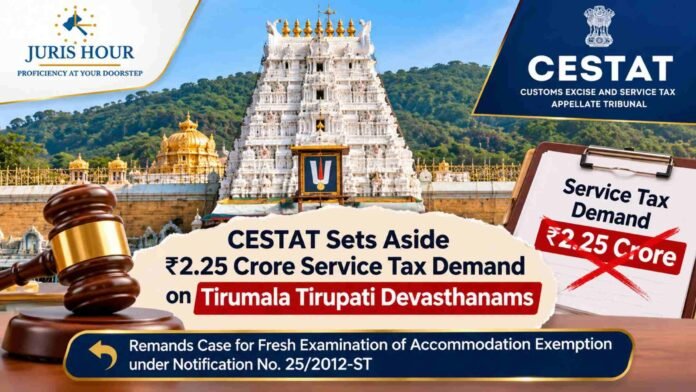
The Customs, Excise and Service Tax Appellate Tribunal (CESTAT), Hyderabad has directed the Department to independently examine whether guest houses and accommodation facilities operated by religious and charitable institution qualify for exemption under Notification No. 25/2012-ST, taking into account their location within or near religious precincts and the applicable room tariffs.
The Customs, Excise and Service Tax Appellate Tribunal (CESTAT), Hyderabad, has set aside a service tax demand of ₹2,25,81,935 imposed on religious and charitable institution for the period April 2013 to March 2014 and remanded the matter to the Adjudicating Authority for fresh adjudication.
The dispute concerned the service taxability of accommodation facilities provided by assessee to pilgrims through its guest houses, choultries and rest houses at Tirumala and Tirupati. The Department had demanded service tax on the gross consideration of ₹30,45,02,900 received from such accommodation facilities, treating the activity as taxable short-term accommodation services under the Finance Act, 1994.
The appellant/assessee is a religious and charitable institution constituted under the Andhra Pradesh Charitable and Hindu Religious Institutions and Endowments Act, 1987. It is entrusted with the administration and management of the temple of Lord Shri Venkateswara and associated religious institutions.
In furtherance of its statutory obligations, assessee provides accommodation facilities to pilgrims visiting Tirumala and Tirupati against certain charges.
The Department issued a show cause notice dated February 11, 2015, demanding service tax of ₹2,25,81,935 on the accommodation receipts of ₹30,45,02,900 for the period April 2013 to March 2014.
The Commissioner confirmed the demand along with applicable interest under Section 75 and penalties under Sections 76 and 77 of the Finance Act, 1994. Aggrieved by the order dated December 7, 2015, assessee approached the Tribunal.
The assessee contended that the accommodation facilities were provided exclusively to pilgrims as part of its statutory religious obligations and were not operated with any commercial or profit-making motive. The charges collected were primarily intended to meet maintenance expenditure.
It was argued that the services were covered under Serial No. 5(a) of Notification No. 25/2012-ST dated June 20, 2012, which exempted services by way of renting of precincts of a religious place meant for the general public.
The assessee also relied upon CBEC Circular No. 200/10/2016-ST dated September 6, 2016, which clarified that the expression ‘precincts’ should not be interpreted restrictively.
The circular clarified that immovable properties situated within the outer boundary walls of a religious complex, as well as properties in its immediate vicinity and surrounding areas owned by or under the same management as the religious place, may be considered to fall within its precincts.
The assessee sought the benefit of cum-tax valuation under Section 67(2) of the Finance Act, 1994, and challenged the imposition of interest and penalties on the ground of its bona fide belief regarding non-taxability.
The Department opposed the appeal, contending that the assessee was providing short-term accommodation in guest houses, rooms and choultries for consideration and that such activities constituted taxable accommodation services.
The Revenue relied upon the Andhra Pradesh High Court judgment in Tirumala Tirupati Devastanams v. Superintendent of Customs, Central Excise and Service Tax, reported in 2013 (30) STR 27 (AP), wherein the Department’s direction requiring the assessee to obtain service tax registration was upheld.
The Department also relied upon the Supreme Court’s Constitution Bench judgment in Commissioner of Customs (Import), Mumbai v. Dilip Kumar and Company [2018 (361) ELT 577 (SC)], submitting that exemption notifications must be strictly construed and the burden of establishing eligibility rests upon the assessee.
The Tribunal observed that the religious and charitable character of the assessee was not seriously disputed. However, merely because an institution is established for religious or charitable purposes, every service provided by it does not automatically become exempt from service tax.
The taxability of a particular activity must be determined with reference to the statutory provisions and exemption notifications applicable during the relevant period.
Examining Serial No. 5(a) of Notification No. 25/2012-ST, the Tribunal held that the decisive consideration was whether the accommodation facilities constituted premises falling within the precincts of a religious place and satisfied the conditions prescribed under the notification.
The Tribunal found considerable force in the assessee’s reliance upon CBEC Circular No. 200/10/2016-ST dated September 6, 2016.
It observed that the Board had clarified that the expression ‘precincts’ should not receive a restricted interpretation and that properties situated within the religious complex, as well as properties in the immediate vicinity and surrounding areas owned by or under the same management as the religious place, may qualify for the exemption.
The Tribunal further observed that the circular, being a clarification of the scope of an existing expression, deserved consideration while examining eligibility for the disputed period.
The Tribunal distinguished the earlier Andhra Pradesh High Court judgment in the assessee’s own case, reported in 2013 (30) STR 27 (AP).
It noted that the earlier judgment arose from proceedings concerning a Departmental direction issued in May 2011, whereas the present dispute related to April 2013 to March 2014, when Notification No. 25/2012-ST was in operation.
Accordingly, the earlier judgment could not dispense with the requirement of independently examining the assessee’s exemption claim under the subsequently applicable notification.
A significant aspect of the Tribunal’s ruling was its observation that the Department had computed the demand on the aggregate consideration received from various accommodation facilities without properly examining the eligibility of each facility.
The facilities included:
- Madhavam Guest House
- Srinivasam Guest House
- Shri Padmavathi Guest House
- Vishnu Nivasam Guest House
The Tribunal observed that the records did not establish that the location and eligibility of each accommodation facility had been separately examined with reference to Serial No. 5(a) of Notification No. 25/2012-ST.
It held that exemption could not be granted to the entire accommodation activity merely because assessee was a religious institution. Equally, the exemption could not be denied altogether without examining the location and nature of the respective facilities.
The Tribunal further directed the Adjudicating Authority to examine the applicability of the exemption relating to accommodation having a declared tariff below ₹1,000 per day under the relevant notification.
It clarified that where an accommodation facility independently qualifies for exemption under the applicable provision, the corresponding consideration cannot be subjected to service tax merely because the assessee also operates other accommodation facilities attracting higher tariffs.
The Tribunal also considered the assessees alternative claim for cum-tax benefit under Section 67(2) of the Finance Act, 1994.
It observed that where the amount charged represents the entire consideration and service tax has not been charged separately, the applicability of the cum-tax benefit must be examined while determining the taxable value.
On the issue of penalties, the Tribunal noted that the dispute involved the interpretation of statutory provisions and exemption notifications in the context of accommodation facilities provided by a religious institution.
It also took note of the fact that the assessee had been contesting the levy before constitutional courts. These circumstances were relevant while determining whether the necessary ingredients for imposing penalties were established.
Accordingly, the Tribunal directed the Department to reconsider the applicability of Section 80 of the Finance Act, 1994, as it stood during the relevant period, along with the existence of reasonable cause for the alleged contraventions.
In view of the above findings, CESTAT held that the impugned order confirming the entire service tax demand without properly examining eligibility under the relevant exemption provisions in respect of individual accommodation facilities could not be sustained.
The Tribunal accordingly set aside the Order-in-Original dated December 7, 2015, and remanded the matter to the Adjudicating Authority with the following directions:
1. Examine the eligibility of individual accommodation facilities under Serial No. 5(a) of Notification No. 25/2012-ST dated June 20, 2012, considering CBEC Circular No. 200/10/2016-ST dated September 6, 2016.
2. Examine the applicability of the exemption relating to accommodation having a declared tariff below ₹1,000 per day.
3. Determine the taxable value, if any, after considering the claim for cum-tax benefit and other admissible statutory benefits.
4. Reconsider the liability towards interest and penalties, including the applicability of Section 80 of the Finance Act, 1994.
5. Provide a reasonable opportunity of personal hearing and pass a reasoned and speaking order.
The Tribunal further clarified that all issues must be decided in accordance with its observations and applicable law, without being influenced by the conclusions recorded in the earlier adjudication order.
The appeal was accordingly allowed by way of remand.
Membership Required to Access Case Details & Order Copy
To view the complete Case Details and Download Order Copy, you must have an active membership. Please subscribe to continue.

