
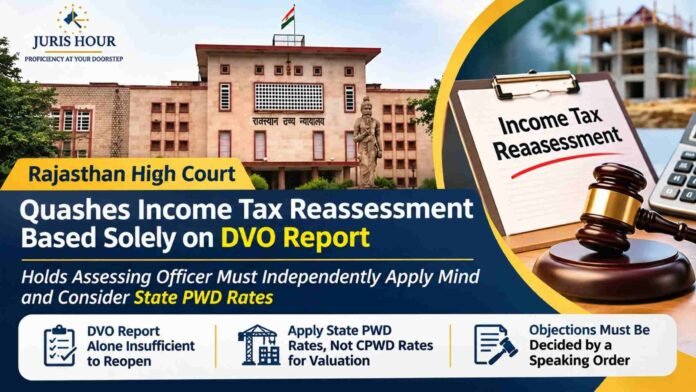
The Rajasthan High Court, Jaipur Bench, has quashed reassessment proceedings initiated under Sections 148A(d) and 148 of the Income-tax Act, 1961, holding that reassessment cannot be sustained merely on the basis of a Departmental Valuation Officer (DVO) report without independent application of mind by the Assessing Officer.
The Bench of Chief Justice Sanjay K. Agrawal and Justice Sameer Jain has observed that the Departmental Valuation Officer (DVO) report, by itself, cannot constitute sufficient information for reopening an assessment and directs tax authorities to comply with binding Supreme Court precedents while initiating reassessment proceedings.
Buy Now: Direct tax (Income Tax) Judgments E-Magazine October 2026
The bench held that the Income Tax Department cannot mechanically initiate reassessment proceedings on the basis of a valuation report while disregarding binding judicial precedents and substantive objections raised by the assessee concerning jurisdiction, valuation methodology and limitation.
The dispute arose from reassessment proceedings initiated against the petitioners for different assessment years, including AY 2013-14, AY 2014-15 and AY 2015-16.
In the lead matter, the assessee had filed her return of income, pursuant to which assessment proceedings were completed under Section 153A read with Section 143(3) of the Income-tax Act, 1961, vide assessment order dated December 24, 2019.
During the original assessment proceedings, additions were made on account of alleged unexplained investment in the construction of a residential property based on a report furnished by the Departmental Valuation Officer.
However, the Commissioner of Income Tax (Appeals)-4, Jaipur, vide order dated November 30, 2023, deleted the additions, observing that no incriminating material supporting the additions had been found during the search proceedings. The appellate authority relied upon the Supreme Court judgment in PCIT v. Abhisar Buildwell Pvt. Ltd.
Subsequently, the Income Tax Department initiated fresh reassessment proceedings by issuing a notice under Section 148A(b) dated March 13, 2024, relying upon the DVO report.
An order under Section 148A(d) and consequential notice under Section 148 were issued on April 29, 2024.
The assessee challenged the reassessment proceedings, contending that the reopening was without jurisdiction, time-barred and based exclusively on the DVO report without any independent tangible material.
Before the High Court, the petitioners challenged the validity of reassessment proceedings on several grounds.
Tanuj Agrawal, the counsel appearing on behalf of the petitioners contended that assessments can be reopened under section 148 pursuant to judgment of Hon’ble Supreme Court in the case of PCIT Vs. Abhisar Buildwell Pvt. Ltd. (2023) 459 ITR 212 (SC) subject to the provisions of law only and in order to validly assume jurisdiction for the reassessment proceedings the Assessing Officer must have issued a valid notice under section 148 as per the provisions of law.
The main objection of the Petitioner that solely on the basis of DVO valuation report the provisions of section 148 cannot be invoked alongwith other objections were arbitrary rejected by the assessing officer by way of a non-speaking order and without application on mind which is against the settled law laid down by the Supreme Court. The respondents placed reliance upon the judgment of the Supreme Court in Commissioner of Income Tax & Ors. v. Chhabil Das Agarwal 11 (2014) 1 SCC 603, wherein it was held that where the statute provides a complete machinery for assessment and reassessment, the assessee ought not to bypass the same and invoke the writ jurisdiction, particularly when an efficacious alternative remedy is available. It was further submitted that the present matter involved disputed factual issues relating to valuation, which could appropriately be examined by the statutory authorities. It was further contended that the respondents had acted bona fide and strictly in accordance with the statutory provisions.
The Income Tax Department argued that the reassessment proceedings had been initiated in accordance with the statutory provisions.
The Department contended that the petitioners had an effective alternative statutory remedy available under the Income-tax Act and could raise all factual and legal objections before the Assessing Officer, followed by an appeal before the Commissioner of Income Tax (Appeals) and thereafter before the Income Tax Appellate Tribunal.
Reliance was placed on the Supreme Court judgment in Commissioner of Income Tax v. Chhabil Das Agarwal to contend that the writ jurisdiction of the High Court should ordinarily not be invoked where an alternative statutory remedy is available.
The Revenue also relied upon the Rajasthan High Court’s decision in Sachin Panchal v. Deputy Commissioner of Income Tax, concerning the interpretation of limitation provisions under Section 149 in the context of search-related proceedings.
The High Court rejected the Revenue’s preliminary objection regarding the availability of an alternative statutory remedy.
Referring to the Supreme Court’s judgments in Whirlpool Corporation v. Registrar of Trade Marks and Radha Krishan Industries v. State of Himachal Pradesh, the Court reiterated that the rule requiring exhaustion of alternative remedies is a rule of policy, convenience and discretion rather than an absolute restriction on constitutional jurisdiction.
The Court observed that where proceedings are challenged on grounds of lack of jurisdiction, violation of natural justice or other recognized exceptions, the High Court can exercise its jurisdiction under Article 226 of the Constitution.
In the present case, the challenge concerned the very assumption of jurisdiction by the Assessing Officer, the alleged violation of limitation requirements and failure to consider material objections.
Consequently, the Court held that the petitions were maintainable despite the availability of an alternative statutory remedy.
One of the most significant findings concerned the reliance placed by the Income Tax Department on the DVO report for initiating reassessment proceedings.
The High Court relied upon the Supreme Court’s judgment in ACIT v. Dhariya Construction Co., (2010) 328 ITR 515 (SC).
The Supreme Court had categorically held:
“Opinion of the DVO per se is not an information for the purposes of reopening assessment under section 147 of the Income Tax Act, 1961. The A.O. has to apply his mind to the information, if any, collected and must form a belief thereon.”
Following this principle, the High Court observed that a valuation report cannot automatically substitute the statutory requirement of independent application of mind by the Assessing Officer.
The Assessing Officer is required to independently examine the available material and arrive at a legally sustainable conclusion regarding escapement of income.
The Court found that the respondents had failed to demonstrate such independent examination and had sought to justify the reassessment proceedings primarily on the basis of the DVO report.
Accordingly, the reassessment proceedings could not be sustained merely on the basis of the valuation report.
The High Court also examined the petitioners’ objection regarding the valuation methodology adopted by the DVO.
The petitioners had specifically challenged the adoption of CPWD rates instead of the applicable local State PWD rates for determining the cost of construction.
The Court relied upon the Supreme Court’s decision in CIT, Ajmer v. Sunita Mansingha, (2017) 393 ITR 121 (SC).
In the said judgment, the Supreme Court upheld the application of local PWD rates in place of CPWD rates for determining the cost of construction.
The High Court observed that the adoption of CPWD rates could result in inflated valuation and an incorrect computation of the alleged income escaping assessment.
Importantly, the petitioners had contended that applying State PWD rates would bring the alleged escaped income below ₹50 lakh, which would materially affect the applicability of the extended limitation period under Section 149.
The Court held that the objection concerning the applicable valuation rates was not merely technical but directly affected the jurisdiction of the Assessing Officer.
Where the assumption of jurisdiction depends upon satisfaction of a statutory monetary threshold, the Assessing Officer must carefully examine the valuation methodology and its consequential effect on limitation.
The High Court further examined whether the Income Tax Department had properly considered the objections raised by the petitioners.
Relying upon the Supreme Court judgment in GKN Driveshafts (India) Ltd. v. Income Tax Officer, (2003) 259 ITR 19 (SC), the Court reiterated that objections raised by an assessee against reassessment proceedings must be disposed of through a reasoned and speaking order before proceeding further with reassessment.
The Court emphasized that passing a speaking order is not an empty formality. It ensures that the Assessing Officer has genuinely considered the objections and applied his mind to the jurisdictional requirements.
In the present case, the petitioners had raised specific objections concerning:
- Initiation of reassessment solely on the basis of the DVO report.
- Applicability of the Supreme Court’s decision in Dhariya Construction Co.
- Adoption of CPWD rates instead of State PWD rates.
- Consequential impact of the valuation methodology on the limitation period under Section 149.
- Validity of the reassessment proceedings and assumption of jurisdiction.
However, the impugned order did not demonstrate meaningful consideration of these objections in the light of binding Supreme Court judgments.
The Court held that rejection of substantial jurisdictional objections in a mechanical manner rendered the order unsustainable.
The Court also referred to Kranti Associates Pvt. Ltd. v. Masood Ahmed Khan, (2010) 9 SCC 496, emphasizing that recording reasons is an essential component of natural justice and reflects application of mind by the authority concerned.
The High Court also examined the Revenue’s reliance upon the judgment in Sachin Panchal v. Deputy Commissioner of Income Tax.
It clarified that the said judgment, dealing with the interpretation of amended Section 149 read with the erstwhile provisions of Sections 153A and 153C, did not dispense with compliance with the statutory conditions governing reassessment.
The Court observed that the applicability of limitation provisions must be examined with reference to the facts of each case and satisfaction of the conditions prescribed under the Act.
The respondents were required to establish that reassessment proceedings were within the prescribed limitation period and founded upon legally sustainable information.
The availability of an extended limitation period cannot cure the absence of a valid jurisdictional foundation for reassessment.
Allowing the batch of writ petitions, the Rajasthan High Court held that the reassessment proceedings could not be sustained merely on the basis of the DVO report, particularly when the Income Tax Department had failed to demonstrate independent application of mind.
The Court further held that the objections concerning the applicability of State PWD rates and the consequential effect on limitation were required to be considered in a reasoned manner, which had not been done.
Membership Required to Access Case Details & Order Copy
To view the complete Case Details and Download Order Copy, you must have an active membership. Please subscribe to continue.
Read More: S. 72A Inapplicable to Current-Year Losses Arising from Restructuring: ITAT

