
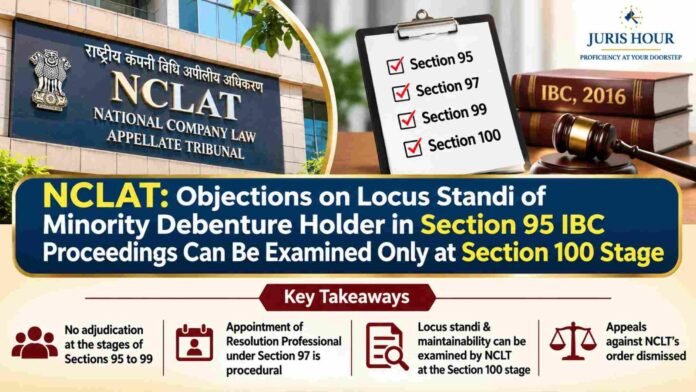
The National Company Law Appellate Tribunal (NCLAT), Principal Bench New Delhi has held that questions concerning locus standi and maintainability of an application under Section 95 of the Insolvency and Bankruptcy Code, 2016, cannot be adjudicated at the stage of appointment of a Resolution Professional under Section 97. Such objections can be examined by the Adjudicating Authority at the stage of Section 100 after receiving the Resolution Professional’s report.
The Bench bench of Justice Yogesh Khanna (Officiating Chairperson), Barun Mitra (Technical Member) and Ajai Das Mehrotra (Technical Member) has dismissed two appeals challenging the appointment of a Resolution Professional in insolvency proceedings initiated against a personal guarantor under Section 95 of the Insolvency and Bankruptcy Code, 2016 (IBC).
Buy Now: 210+ GST Judgments E-Magazine – October 2026
The central issue before the Appellate Tribunal was whether a minority debenture holder, without obtaining the requisite instructions from the Debenture Trustee or the requisite approval of the majority debenture holders under the Debenture Trust Deed, could initiate insolvency proceedings under Section 95 of the IBC against a personal guarantor.
The appeals arose from orders dated June 19, 2026, passed by the National Company Law Tribunal (NCLT), Mumbai Bench, in proceedings initiated under Section 95 of the IBC by IIFL One Value Fund – Series B, a scheme under IIFL Alternative PE Fund.
The NCLT had appointed a Resolution Professional under Section 97 of the IBC, imposed the interim moratorium under Section 96 and directed the Resolution Professional to examine the application, including issues relating to limitation and invocation of the personal guarantee, and submit a report under Section 99 of the Code.
The appellants challenged these orders before the NCLAT, contending that the proceedings had been initiated without the requisite authority under the Debenture Trust Deed.
The appellants argued that no personal guarantee had been executed directly in favour of IIFL One Value Fund – Series B. Instead, the personal guarantees dated October 14, 2021 and May 12, 2022 had been furnished in favour of IDBI Trusteeship Services Limited, acting as the Debenture Trustee for the benefit of all debenture holders.
It was contended that under the Debenture Trust Deed, the authority to declare an event of default, accelerate redemption, invoke the personal guarantee and initiate enforcement proceedings vested in the Debenture Trustee, acting on the instructions of the requisite majority debenture holders.
According to the appellants, IIFL One Value Fund – Series B held only 24.51% of the outstanding debentures, whereas Rare Asset Reconstruction Limited held 65.77% and Renaissance Fiscal Services Pvt. Ltd. held 4.49%.
Consequently, IIFL, being a minority debenture holder, could not independently exercise the rights reserved for the Debenture Trustee acting on the instructions of the Majority Debenture Holders.
The appellants further submitted that the Debenture Trust Deed required approval of debenture holders representing at least 75% of the outstanding debentures for decisions requiring majority approval.
It was also pointed out that the meeting of debenture holders was required to satisfy a quorum of 51% in value before the requisite resolution could be passed.
According to the appellants, no such meeting or resolution had been convened or passed before the personal guarantee was invoked.
The appellants placed reliance on Clause 2.1 of the Debenture Trust Deed dated March 22, 2018, which required the Debenture Trustee to obtain written instructions from the Debenture Holders’ Nominee before initiating action or exercising rights under the Trust Deed, subject to the exceptions specified therein.
Reference was also made to Clause 9.2(a) of the Trust Deed, which contemplated the exercise of rights by the Debenture Trustee acting on the instructions of the Debenture Holders’ Nominee.
Further, the appellants relied upon the Supplementary Debenture Trust Deed dated June 24, 2021, under which references to the Debenture Holders’ Nominee were replaced with Majority Debenture Holders.
The definition of Majority Debenture Holders required holders representing not less than 75% of the nominal value of the outstanding debentures.
It was therefore argued that the invocation of the personal guarantee by an individual financial creditor, without the requisite authorization, was not legally sustainable.
The appellants argued that their objection was not merely regarding the merits of the debt but concerned the fundamental authority and locus standi of the financial creditor to initiate proceedings under Section 95 of the IBC.
They relied upon the Supreme Court’s decision in Dilip B. Jiwrajka v. Union of India & Ors., (2024) 5 SCC 435, and other NCLAT decisions to contend that an application can be rejected at the threshold where maintainability is established to be defective on admitted facts.
Reliance was also placed on Malvika Hegde v. IDBI Trusteeship Services Limited and Another, 2025 SCC OnLine NCLAT 422, wherein the Tribunal had dismissed insolvency proceedings on the ground that the action was not initiated in accordance with the terms of the Debenture Trust Deed.
After considering the rival submissions, the NCLAT held that the issue of locus standi and maintainability could not be adjudicated before the stage contemplated under Section 100 of the IBC.
The Tribunal relied upon the Supreme Court’s judgment in Dilip B. Jiwrajka v. Union of India & Ors., wherein the Supreme Court clarified that no judicial adjudication takes place at the stages contemplated under Sections 95 to 99 of the IBC.
The NCLAT specifically referred to paragraph 86.6 of the Supreme Court judgment, which provides:
“No adjudication is involved at the stages envisaged in Section 95 to Section 99 of the IBC” and “no judicial determination takes place until the adjudicating authority decides under Section 100 whether to accept or reject the application.”
The Tribunal further relied upon Bank of Baroda v. Farooq Ali Khan, 2025 SCC OnLine SC 374, wherein it was held that objections concerning limitation and waiver of guarantee could be considered after the Resolution Professional submits the report.
The NCLAT observed that appointment of a Resolution Professional under Section 97 is part of the statutory procedure and that jurisdictional questions concerning the application need not be adjudicated before such appointment.
The Appellate Tribunal also considered several judicial precedents, including:
- Canara Bank v. Uma Kumari Singh, 2025 SCC OnLine NCLAT 1514, wherein a three-member bench reiterated that no judicial adjudication is contemplated at the stages of Sections 95 and 99 of the IBC.
- C.L. Sharma v. Bank of Maharashtra, 2024 SCC OnLine NCLAT 279, concerning consideration of jurisdictional facts at the stage of Section 100.
- Central Bank of India v. Deepen Arun Parekh, wherein the Tribunal held that adjudicatory issues arising from a Section 95 application are to be considered at the stage of hearing under Section 100.
- Prabhaben Ravjibhai Harkani v. Bank of Baroda, Company Appeal (AT) (Ins) No. 1002/2025, decided on August 7, 2026, distinguishing proceedings under Section 94 from those under Section 95 of the IBC.
The NCLAT noted that the decision in Prabhaben Ravjibhai Harkani concerned an application under Section 94 and would not govern proceedings under Section 95, which involve applications filed by creditors against personal guarantors.
In view of the law laid down by the Supreme Court and the consistent position taken by the NCLAT, the Appellate Tribunal declined to interfere with the impugned NCLT orders.
The Tribunal held that the adjudicatory process would commence only after the Resolution Professional submits the report under Section 99 and the Adjudicating Authority considers the application under Section 100 of the IBC.
Membership Required to Access Case Details & Order Copy
To view the complete Case Details and Download Order Copy, you must have an active membership. Please subscribe to continue.
Read More: Cite This CBIC Circulars To Prevent GST Officials To Act arbitrarily In GST Assessments

