
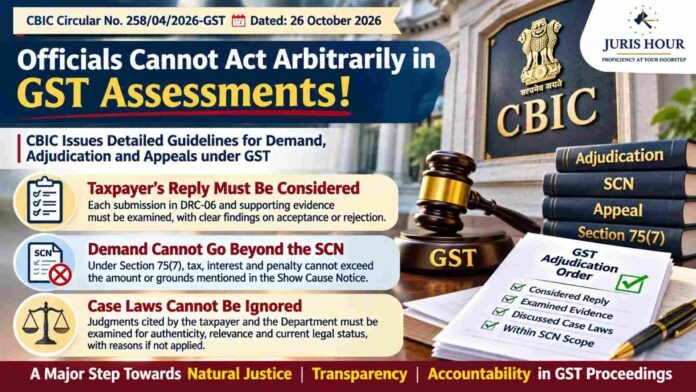
The Central Board of Indirect Taxes and Customs (CBIC), vide Circular No. 258/04/2026-GST dated October 26, 2026, has issued important clarifications concerning demand, adjudication and appeal proceedings under the Central Goods and Services Tax Act, 2017.
The Circular seeks to address concerns relating to vague, non-speaking and inadequately reasoned adjudication orders, particularly those in which the submissions and documentary evidence furnished by taxpayers are not properly examined.
It reiterates that GST adjudication is a quasi-judicial function and that adjudicating authorities are required to independently apply their minds, examine the material available on record and record clear findings on every material issue arising in the proceedings.
Buy Now: 210+ GST Judgments E-Magazine – October 2026
The Circular has particular significance for taxpayers and GST practitioners because it expressly emphasises that merely mentioning that the taxpayer’s reply has been considered will not satisfy the requirements of a legally sustainable adjudication order.
It also reiterates the statutory restriction under Section 75(7) of the CGST Act, 2017, which prevents authorities from confirming demands exceeding the amounts specified in the Show Cause Notice or relying upon grounds that were never mentioned in the notice.
1. Taxpayer’s Reply in FORM GST DRC-06 Must Be Examined Point by Point
One of the most significant aspects of the Circular is the requirement that adjudicating authorities must independently examine the written submissions and additional evidence furnished by taxpayers.
Under Paragraph 11.5 of the Circular, every adjudication order must specifically deal with the submissions made through FORM GST DRC-06 and those presented during personal hearings.
The authority is expected to examine:
- The relevance of each submission made by the taxpayer.
- The credibility and evidentiary value of documents produced.
- Whether the taxpayer’s explanation is supported by the records.
- Whether the arguments and evidence are accepted, partially accepted or rejected.
- The reasons for accepting or rejecting each material submission.
The Circular expressly cautions officers against using generic expressions such as “Reply has been considered” without actually demonstrating that the defence has been examined.
For example, where a taxpayer disputes an ITC demand by producing tax invoices, payment proofs, GSTR-2B records, e-way bills and reconciliation statements, the adjudicating authority cannot simply reproduce the allegations in the SCN and confirm the demand.
The authority must examine the documents in the context of the allegations and record specific findings explaining why the evidence establishes or fails to establish the taxpayer’s claim.
Impact: A mechanical adjudication order that does not address material submissions and evidence would be inconsistent with the standards prescribed by the Circular.
2. Demand Cannot Exceed the Amount or Grounds Specified in the SCN – Section 75(7)
The second major clarification concerns the scope of adjudication proceedings under Section 75(7) of the CGST Act, 2017.
Section 75(7) imposes two important restrictions on the adjudicating authority:
First: The amount of tax, interest and penalty determined in the order cannot exceed the amounts specified in the Show Cause Notice.
Second: No demand can be confirmed on grounds other than those specified in the Show Cause Notice.
The Circular reiterates that the adjudicating authority must confine its findings to the allegations and grounds contained in the SCN.
Can an officer introduce a new ground while passing the final order?
No. The adjudicating authority cannot travel beyond the grounds forming the foundation of the Show Cause Notice and confirm a demand on an entirely new allegation without following the prescribed procedure.
For instance, suppose an SCN proposes a GST demand of ₹10 lakh alleging wrongful availment of Input Tax Credit on account of alleged non-fulfilment of statutory conditions.
During adjudication, the officer discovers another alleged discrepancy relating to outward supplies and seeks to confirm an additional demand of ₹5 lakh on that basis.
The officer cannot simply incorporate this new allegation into the adjudication order and confirm an additional demand.
The Circular clarifies that any new issue identified by the authority may be pursued through a separate Show Cause Notice, in accordance with the applicable statutory provisions.
This ensures that the taxpayer receives an appropriate opportunity to understand the new allegation and submit a defence before any adverse determination is made.
Impact: The Show Cause Notice remains the foundation of adjudication. The final order cannot become a vehicle for introducing fresh allegations that the taxpayer was never called upon to answer.
blog.saginfotech.com+1
3. Judicial Precedents Cited by Taxpayers Cannot Be Ignored
The Circular also addresses an important concern frequently encountered in GST adjudication: failure to discuss judgments relied upon by taxpayers in support of their defence.
Under Paragraph 11.7, CBIC has clarified that adjudicating authorities must examine judicial pronouncements cited by both the Department and the taxpayer.
The authority must verify:
- Whether the judgment has been correctly cited.
- Whether the judgment is relevant to the dispute.
- Whether the judgment has been overruled or modified by a higher judicial forum.
- Whether the judgment is applicable to the facts and circumstances of the case.
- Whether the legal position has subsequently changed.
The Circular further emphasises that preference may be given to decisions of the Supreme Court and the jurisdictional High Court while undertaking such an exercise.
Importantly, if the adjudicating authority finds that a judgment relied upon by the taxpayer is not applicable, the order must specifically record the reasons for arriving at that conclusion.
This is particularly relevant in disputes involving:
- Eligibility and availment of Input Tax Credit.
- Classification of goods and services.
- Interpretation of exemption notifications.
- Valuation of taxable supplies.
- Limitation for issuance of Show Cause Notices.
- Invocation of extended limitation.
- Imposition of penalties.
- Refund and export-related disputes.
An adjudicating authority cannot merely reproduce the Department’s interpretation of the law while ignoring binding judicial precedents or relevant judgments cited by the taxpayer.
Impact: The Circular reinforces the obligation to undertake judicial analysis rather than pass orders based exclusively on the Department’s interpretation of the statutory provisions.
blog.saginfotech.com+1
4. Evidence Must Be Analysed, Not Merely Reproduced
Paragraph 11.4 of the Circular deals with the examination of evidence vis-à-vis the allegations contained in the SCN.
CBIC has clarified that merely referring to documents or reproducing their contents in the adjudication order is not sufficient.
The adjudicating authority must undertake a careful and reasoned examination of the evidence and evaluate its relevance and reliability.
Where documents do not support the allegations or are inconclusive, the authority should record appropriate findings with reasons.
This requirement is particularly important in GST investigations involving extensive documentary evidence, including:
- Tax invoices and debit notes.
- E-way bills and transportation documents.
- GSTR-1, GSTR-3B and GSTR-2B data.
- Books of accounts and financial statements.
- Bank statements and payment records.
- Reconciliation statements.
- Contracts and purchase orders.
- Statements recorded during investigation.
For example, where the Department alleges that goods were not actually supplied despite the availability of invoices and e-way bills, the authority must examine the evidence relied upon by both sides instead of mechanically accepting the investigation report.
The ultimate findings must demonstrate how the evidence supports or contradicts the allegations.
5. Personal Hearing and Natural Justice: Virtual Hearings Also Encouraged
The Circular places considerable emphasis on compliance with the principles of natural justice, particularly the rule of audi alteram partem, which means that no person should be condemned without being heard.
Section 75(4) of the CGST Act provides for an opportunity of personal hearing where a request is received in writing from the person chargeable with tax or penalty, or where an adverse decision is contemplated against such person.
CBIC has provided several guidelines concerning the conduct of personal hearings.
| Requirement | CBIC clarification |
| Personal hearing opportunities | Maximum four opportunities, consistent with Section 75(5) |
| Adjournment | Requests must be considered judiciously and rejection reasons recorded |
| Authorised representative | Appearance under Section 116 must be duly considered |
| Virtual hearing | May be provided and encouraged |
| Hearing records | Date, time and details of attendees must be maintained |
| Communication of order | Preferably within one month after the hearing |
| Change of adjudicating officer | Fresh hearing is required before the succeeding authority |
The Circular also clarifies that where the adjudicating authority is transferred during the proceedings, the succeeding adjudicating authority should provide a fresh hearing.
These instructions are intended to ensure that the taxpayer receives a meaningful opportunity to present the case and that the adjudication is not reduced to a mere formality.
blog.saginfotech.com
6. Fraud, Wilful Misstatement and Suppression Cannot Be Invoked Mechanically
Another important aspect of the Circular concerns invocation of the extended limitation and stringent demand provisions involving fraud, wilful misstatement or suppression of facts.
Under Section 74 and Section 74A(5)(ii), the invocation of the fraud-related provisions requires the requisite intent to evade tax.
CBIC has clarified that merely alleging non-payment of GST or identifying a discrepancy during scrutiny does not automatically establish fraud, wilful misstatement or suppression.
The Show Cause Notice must disclose the specific facts, circumstances and supporting evidence forming the basis for such allegations.
The Circular refers to the Supreme Court judgment in G.R. Infra Project Ltd. v. State of Madhya Pradesh, dated August 19, 2026, reported at (2026) 45 Centax 331 (S.C.).
The judgment emphasises that merely reproducing expressions such as fraud, wilful misstatement or suppression of facts without explaining the material supporting those allegations is insufficient.
The Circular also refers to Sriba Nirman Company v. Commissioner (Appeals), (2025) 29 Centax 206 (A.P.), concerning the requirement of deliberate conduct for establishing wilful misstatement or suppression in the relevant context.
Accordingly, where a taxpayer specifically disputes the invocation of fraud-related provisions, the adjudicating authority must examine the evidence and record reasons for accepting or rejecting the taxpayer’s defence.
If the SCN does not establish the requisite ingredients, the authority must record appropriate findings and confine the demand to the applicable non-fraud provisions, including Section 73 or Section 74A(5)(i), as applicable.
This clarification is significant because it discourages the mechanical invocation of stringent provisions merely because a tax discrepancy has been identified.
blog.saginfotech.com+1
7. Adjudication Orders Must Contain Proper Quantification of Tax, Interest and Penalty
The Circular further provides that adjudication orders should contain clear, accurate and issue-wise quantification of the tax liability.
The authority must not leave the amount of demand open-ended or based on estimates.
Wherever possible, the computation should be presented financial year-wise and issue-wise, with separate identification of CGST, SGST, IGST and UTGST.
The order should clearly indicate:
- Original amount proposed in the SCN.
- Amount confirmed after adjudication.
- Amount of demand dropped.
- Interest payable.
- Penalty imposed.
- Payments or pre-deposits already made.
- Balance amount payable or refundable.
Where a demand is partly dropped, the order must clearly distinguish between the original proposed demand and the amount ultimately confirmed.
CBIC has also clarified that interest on unpaid or short-paid tax continues until the actual date of payment, in accordance with Section 75(9).
Penalty cannot be imposed mechanically
Paragraph 11.10 further requires the adjudicating authority to record clear and reasoned findings before imposing a penalty.
The authority must establish the nature of the default and the applicable legal provision. The general disciplines relating to penalties under Section 126 of the CGST Act must also be followed.
Thus, penalty should not be imposed merely because a tax demand has been confirmed. Its statutory basis and applicability must be examined.
blog.saginfotech.com
8. Rectification Under Section 161 Cannot Be Used as a Substitute for Appeal or Review
The Circular also clarifies the scope of rectification powers under Section 161 of the CGST Act.
An application for rectification may be filed within three months from the date of issue of the relevant decision, order, notice, certificate or other document. The rectification order is generally required to be passed within six months, subject to the statutory exception for purely clerical or arithmetical errors arising from an accidental slip or omission.
CBIC has clarified that rectification must be undertaken by the authority that issued the original document.
More importantly, the power under Section 161 is restricted to errors apparent on the face of the record.
It cannot be used to:
- Reopen the merits of an adjudication order.
- Reappreciate factual findings.
- Review the legality of the original decision through a detailed reconsideration.
- Correct disputed legal interpretations requiring extensive reasoning.
- Substitute the statutory appellate mechanism.
The Circular refers to the Supreme Court judgment in Arun Dev Upadhyaya v. Integrated Sales Service Ltd., (2023) 8 SCC 11, concerning the scope of an error apparent on the face of the record.
Rectification orders are required to be issued through FORM GST DRC-08.
This clarification seeks to prevent the limited rectification jurisdiction from being used as an indirect review mechanism.
blog.saginfotech.com
9. Important Clarifications Relating to First Appeal Proceedings
The Circular is not restricted to adjudication proceedings. It also provides guidelines for authorities dealing with first appeals under Section 107 of the CGST Act.
Some significant clarifications include:
Examination of maintainability: The Appellate Authority must undertake preliminary scrutiny of the appeal, including limitation, prescribed forms, pre-deposit, supporting documents and jurisdiction.
Merits of appeal: Disputes concerning the merits should ordinarily be considered during adjudication of the appeal and should not be summarily rejected at the registration stage.
Limitation: The question of limitation must be examined separately. An appeal filed beyond the statutory period, where the delay is not condonable, should not be decided on merits.
Withdrawal of appeal: Applications for withdrawal requiring approval after issuance of the final acknowledgement in FORM GST APL-02 should be decided within seven days.
Additional grounds and evidence: The Appellate Authority must record reasons for accepting or rejecting additional grounds and evidence, in accordance with the applicable statutory provisions.
Disposal of appeals: As far as possible, appeals should be heard and decided within one year from the date of filing, excluding the period during which proceedings remain stayed by a Court or Tribunal.
Cross-appeals: Where both the taxpayer and the Department have filed appeals against the same order, the appeals should be processed together and disposed of through a common, composite order.
The summary of the appellate order must also be uploaded electronically in FORM GST APL-04.
blog.saginfotech.com
10. Important: CBIC Also Addresses the Use of Artificial Intelligence in GST Adjudication
An interesting and forward-looking aspect of the Circular is Paragraph 11.7.1, which deals with the use of Artificial Intelligence and other technological tools in adjudication proceedings.
CBIC has clarified that where AI or other technological tools are used to improve efficiency, appropriate human oversight must be maintained.
Information generated through AI tools must be independently verified for accuracy before being relied upon or incorporated into an adjudication order.
The ultimate responsibility for the correctness of the order remains with the officer issuing it.
This is particularly relevant as tax administrations increasingly use data analytics and technology-assisted systems to identify discrepancies and process information.
Technology may assist an officer in examining records, but it cannot replace the independent application of mind required in a quasi-judicial proceeding.
11. Important Judicial Principles Reiterated by CBIC
The Circular draws upon several judicial pronouncements to reinforce the importance of reasoned adjudication.
| Judicial pronouncement | Principle highlighted |
| G.R. Infra Project Ltd. v. State of Madhya Pradesh (2026) 45 Centax 331 (S.C.) | SCN must contain the necessary allegations and particulars; deficiencies cannot subsequently be cured |
| Sriba Nirman Company v. Commissioner (Appeals) (2025) 29 Centax 206 (A.P.) | Wilful misstatement and suppression require consideration of deliberate conduct and intent |
| Armour Security (India) Ltd. v. Commissioner, CGST (2025) 33 Centax 222 (S.C.) | Avoidance of parallel proceedings by Central and State tax authorities |
| Joint Commissioner of Income Tax, Surat v. Saheli Leasing & Industries Ltd. 2010 (253) E.L.T. 705 (S.C.) | Importance of clear, structured and reasoned orders |
| Maneka Gandhi v. Union of India (1978) 1 SCC 248 | Fairness in administrative action and principles of natural justice |
| Arun Dev Upadhyaya v. Integrated Sales Service Ltd. (2023) 8 SCC 11 | Scope of an error apparent on the face of the record |
These judicial references reinforce the broader objective of ensuring that quasi-judicial authorities act fairly, independently and in accordance with the law.
12. What Should Taxpayers and GST Practitioners Do Now?
The Circular has practical implications for taxpayers who are currently facing GST demand proceedings and for professionals representing them before adjudicating authorities.
Taxpayers and their representatives should ensure that their replies are properly structured and supported by documentary evidence.
In particular, the following practices become important:
1. Prepare comprehensive DRC-06 replies: Address every allegation in the SCN separately and provide supporting statutory provisions and judicial precedents.
2. Maintain documentary evidence: Submit relevant invoices, payment proofs, reconciliations, ledgers, returns and other supporting documents.
3. Seek personal hearing: Where required, specifically request a personal hearing under Section 75(4).
4. Place judicial precedents on record: Cite relevant judgments with accurate case details and explain their applicability to the dispute.
5. Examine the final adjudication order: Verify whether each material defence has been considered and whether the authority has recorded reasons for rejecting it.
6. Check the scope of the demand: Compare the tax, interest and penalty confirmed in the order with the amounts and grounds specified in the SCN.
7. Examine limitation and penalty: Verify whether the statutory provisions invoked are supported by the necessary facts and evidence.
8. Preserve the hearing record: Maintain copies of written submissions, acknowledgements, hearing communications and documents furnished during the proceedings.
These steps can help taxpayers identify procedural and legal deficiencies in adjudication orders and take appropriate recourse under the statutory appellate framework.
13. An Important Procedural Clarification: The Circular Is an Administrative Guideline
The Circular has been issued by CBIC in exercise of powers under Section 168(1) of the CGST Act, 2017, with the objective of providing a uniform reference framework for officers involved in demand, adjudication and appeal proceedings.
However, Paragraph 17 specifically clarifies that these guidelines are illustrative and non-exhaustive. It also directs that the guidelines themselves must not be cited by proper officers in Show Cause Notices, final orders or appellate orders.
This is an important distinction. The Circular provides administrative guidance to officers; the underlying statutory provisions and applicable judicial precedents continue to govern the legal determination of disputes.
Conclusion: A Significant Step Towards Fair and Transparent GST Adjudication
CBIC Circular No. 258/04/2026-GST dated October 26, 2026, reinforces the fundamental principle that GST adjudication must be based on the independent application of mind, proper appreciation of evidence and compliance with the principles of natural justice.
The Circular sends a clear message that adjudication is not a mechanical exercise of confirming demands proposed by the Department.
An adjudicating authority must examine the taxpayer’s defence, evaluate the evidence, consider relevant judicial precedents and explain the reasons supporting its conclusions.
The restrictions under Section 75(7) must also be respected, ensuring that the final demand does not exceed the amount specified in the SCN or travel beyond the grounds mentioned therein.
For taxpayers, GST practitioners and tax professionals, this Circular provides important guidance for examining the legality and quality of adjudication orders.

