
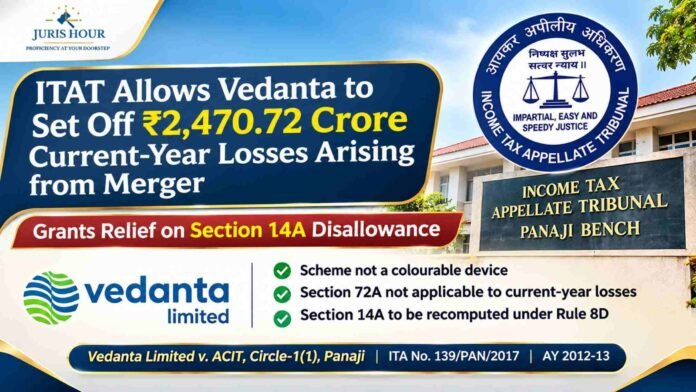
The Income Tax Appellate Tribunal (ITAT), Panaji Bench, has held that Section 72A of the Income Tax Act, 1961 is inapplicable to current-year losses arising from restructuring.
The bench of Vinay Bhamore (Judicial Member) and Dr. Manish Borad (Accountant Member) has rejects the department’s allegation that the amalgamation scheme was a colourable device to evade taxes; also directs fresh examination of transfer pricing adjustments involving management consultancy services and interest paid to Associated Enterprises.
The principal issue concerned the denial of set-off of current-year business losses amounting to ₹2,470.72 crore arising from the amalgamation and demerger arrangements involving Vedanta Aluminium Limited and Sterlite Energy Limited. The Assessing Officer had questioned the restructuring arrangement and alleged that it was a colourable device adopted to evade taxes.
Buy Now: Direct tax (Income Tax) Judgments E-Magazine October 2026
Vedanta Limited, formerly known as Sesa Goa Limited, had filed its original income-tax return for AY 2012-13 declaring income of approximately ₹2,253.24 crore. Following the implementation of a court-sanctioned restructuring scheme involving various group entities, the company filed a revised return on March 21, 2014, declaring a loss of approximately ₹1,179.40 crore.
The restructuring involved the amalgamation of Sterlite Energy Limited and the demerger and merger of the aluminium business undertaking of Vedanta Aluminium Limited, among other arrangements.
The Assessing Officer, however, refused to recognise the current-year losses arising from the restructuring and disallowed the set-off of ₹2,470.72 crore. The officer also invoked Sections 2(19AA) and 72A of the Income-tax Act, 1961, and questioned the commercial and tax-related purpose of the restructuring.
Consequently, the assessment determined income of approximately ₹2,034.97 crore under the normal provisions and book profit of approximately ₹1,109.96 crore under Section 115JB, against the loss declared in the revised return.
The Tribunal examined the provisions of Section 72A, which deal with the carry-forward and set-off of accumulated losses and unabsorbed depreciation in cases of amalgamation and demerger.
It observed that the case before it involved the set-off of current-year business losses against current-year income and not the carry-forward of accumulated losses of earlier years.
The Tribunal noted that the restructuring scheme had received approval from the Bombay High Court and Madras High Court after due examination. It further observed that the Revenue had not disputed the set-off of accumulated losses and unabsorbed depreciation in subsequent assessment years.
Accordingly, the Tribunal held that Section 72A had no application to the facts of the case and that the restructuring could not be treated as a colourable device merely because it resulted in a tax loss.
The Tribunal therefore reversed the findings of the Assessing Officer and DRP and allowed Vedanta’s grounds concerning the set-off of ₹2,470.72 crore in current-year losses.
Section 14A Disallowance: Tribunal Directs Recalculation Under Rule 8D
Another substantial issue concerned the disallowance of ₹547.04 crore under Section 14A read with Rule 8D.
Vedanta had earned dividend income of ₹1,049.87 crore and voluntarily offered a disallowance of ₹1.78 crore towards salary and administrative expenditure.
The Assessing Officer rejected the company’s computation and made a substantially higher disallowance by applying Rule 8D, including interest expenditure of ₹469.24 crore and indirect expenditure of ₹77.80 crore.
The Tribunal examined the Assessing Officer’s satisfaction under Section 14A(2). It observed that the Assessing Officer had examined the company’s balance sheet and the submissions concerning the voluntary disallowance before invoking Rule 8D.
Consequently, the Tribunal rejected Vedanta’s argument that the disallowance was invalid for want of proper satisfaction.
However, while examining the computation under Rule 8D(2)(iii), the Tribunal directed the Assessing Officer to verify the details furnished by the company, recompute the disallowance and provide credit for the suo motu disallowance already offered in the return.
Accordingly, the grounds relating to Section 14A were partly allowed for statistical purposes.
Copper Concentrate Provision: Issue Remanded for Verification
The company had also challenged the disallowance of ₹219.50 crore relating to the provision made towards the purchase of copper concentrate.
Vedanta explained that copper concentrate was purchased on provisional prices because of fluctuations in international copper prices. The final purchase price was determined at the end of the applicable quotation period.
Where the quotation period extended beyond the close of the financial year, the company recognised the liability based on the prevailing quotation price and subsequently adjusted the difference when the final price was determined.
Considering the earlier decision of the Coordinate Bench in the company’s case for AY 2010-11, the Tribunal restored the issue to the Assessing Officer for necessary verification in light of the judicial precedent.
The ground was accordingly allowed for statistical purposes.
Additional Depreciation on Iron Ore Mining Allowed Under Section 32(1)(iia)
The Assessing Officer had disallowed additional depreciation of ₹16.53 crore claimed by Vedanta on new plant and machinery installed in its iron ore division.
The Revenue’s contention was that extraction and processing of iron ore did not constitute manufacture or production for the purposes of Section 32(1)(iia).
The Tribunal relied upon the Supreme Court’s decision in CIT v. Sesa Goa Ltd., 271 ITR 331, wherein extraction and processing of iron ore were held to constitute production.
It also noted that the Tribunal had decided similar issues in Vedanta’s favour for earlier assessment years.
Following the judicial precedents, the Tribunal allowed the company’s claim for additional depreciation under Section 32(1)(iia).
Unexplained Stock Addition of ₹8.72 Crore: Matter Remanded to Assessing Officer
The Assessing Officer had made an addition of ₹8.72 crore on account of alleged unexplained stock after comparing Vedanta’s books of account with Form H-1 returns filed before the Indian Bureau of Mines (IBM).
The company explained that differences in stock figures could arise due to moisture content, crude ore, sub-grade ore, stock stored outside mining locations, handling losses, purchases of ore and loan cargo, among other factors.
It further submitted that the stock reflected in its balance sheet was higher than the quantity reported to IBM and, therefore, there was no loss to the Revenue.
The Tribunal found merit in the company’s submissions. However, considering the need to verify the reconciliation, it restored the issue to the Assessing Officer for the limited purpose of examining whether the company had actually disclosed excess closing stock in its books compared with the stock reported to IBM.
The Tribunal clarified that if the company’s contention was established, no addition on account of unexplained stock would be warranted.
This ground was allowed for statistical purposes.
Section 115JB: Section 14A Disallowance Cannot Be Added to Book Profit
The Tribunal also examined whether the disallowance made under Section 14A could be added while computing book profit under Section 115JB.
Relying upon the Special Bench decision in ACIT v. Bhushan Steel Limited, ITA No. 593/Del/2015, dated September 29, 2015, the Tribunal held that the disallowance under Section 14A was not required to be added while computing book profit under Section 115JB.
Accordingly, Vedanta’s ground challenging the addition of ₹547.04 crore to book profit was allowed.
The Tribunal also allowed the ground relating to the adjustment of additional depreciation while computing book profit, observing that the claim of additional depreciation itself had already been allowed.
Management Consultancy Fee: Transfer Pricing Issue Remanded for Fresh Examination
Vedanta had challenged a transfer pricing adjustment of ₹19.17 crore relating to management consultancy services received from its Associated Enterprise, Vedanta Resources PLC.
The services included strategic advice, financial and treasury advice, legal advice, marketing advice, IT support and human resource management.
The Transfer Pricing Officer had questioned the rendition of services and the tangible benefits received by the company, allowing only a portion of the consultancy expenditure.
The Tribunal observed that a similar issue for AY 2014-15 had already been remanded for fresh adjudication.
Considering the similarity of facts, the Tribunal restored the matter to the file of the TPO for fresh examination of the judicial precedents relied upon by Vedanta and verification of the company’s submissions regarding the actual rendition of services and benefits derived from the intra-group arrangements.
Ground Nos. 10 to 10.2 were accordingly allowed for statistical purposes.
Interest Paid to Associated Enterprises: LIBOR-Based Benchmarking to Be Examined
The final substantial issue concerned a transfer pricing adjustment of ₹2.58 crore relating to interest paid by Vedanta to its Associated Enterprises, namely Vedanta Resources Holdings Limited and Welter Trading Limited, Cyprus.
The company had paid interest on foreign currency loans and contended that the TPO had incorrectly benchmarked the transactions by applying domestic prime lending rates without properly considering the currency, credit rating and characteristics of the loans.
The Tribunal noted that in the company’s own case for AY 2014-15, the DRP had directed the TPO to determine the arm’s length price using LIBOR-based benchmarking rather than the prime lending rate of the respective currencies.
Following the same approach, the Tribunal restored the issue to the TPO for fresh examination after considering the relevant loan details and directions applicable to the earlier assessment year.
Membership Required to Access Case Details & Order Copy
To view the complete Case Details and Download Order Copy, you must have an active membership. Please subscribe to continue.

