
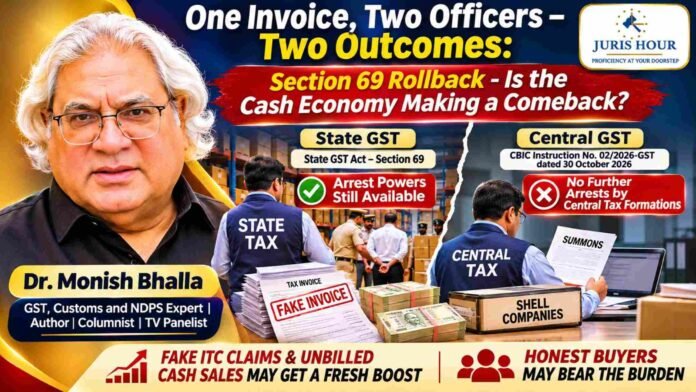
Eight years after Section 69 of the Central Goods and Services Tax Act armed GST officers with the power of arrest, the GST Council has recommended that the provision be deleted altogether. The 57th Council meeting of 8 October 2026 is being celebrated as the high point of trust-based tax administration. For the honest assessee, much of that relief is genuine. For the organised fake-invoice industry, it may prove an even bigger gift.
The Board has not waited for the legislature. By Instruction No. 02/2026-GST dated 30 October 2026, CBIC directed its field formations that “no further arrests may be carried out under GST”. The statutory amendments, including the omission of Section 69 and a higher threshold for prosecution under Section 132, are to take effect from 1 April 2027.
The question is simple. In a regime already struggling with record fake input tax credit and rampant cash sales without invoice, what happens when the one power the syndicates feared is withdrawn, and who pays for it?
Buy Now: 210+ GST Judgments E-Magazine – October 2026
Trust is a fine foundation for a tax system. But trust without fear is an open door.
A twist that has gone almost unnoticed
Instruction No. 02/2026-GST is an administrative instruction to Central Tax formations. It does not amend the CGST Act, and it does not bind State tax officers, who draw their powers from their own State GST Acts. Each of those Acts still carries its own Section 69. Until a State issues a similar direction, its officers remain free to act as before.
Picture two officers in the same city on the same day. A State tax officer intercepts a conveyance on the highway carrying goods on a fake invoice, or searches a godown under Section 67 of the State GST Act on specific intelligence, and unearths a racket of invoices issued without supply. If the case falls within Section 132(1)(b) or (c) above the monetary limits, the Commissioner of State Tax can still authorise arrest under Section 69 of the State GST Act, subject to the guidelines. A few kilometres away, a Central Tax officer uncovers exactly the same racket: the same shell firms, the same fake invoices, the same crores of credit. Paragraph 3.1 of the Instruction bars him from arresting anyone. All he can do is issue a summons under Section 70 and hope the man appears.
A fake intra-State invoice carries both CGST and SGST. The same document and the same fraud now expose the same person to arrest by one administration but not the other. Liability to arrest turns less on the offence than on which administration the taxpayer is assigned to, or which agency reaches the premises first. For the honest assessee, that is uncertainty. For the racketeer, it is one more gap to exploit. And this gap will last at least until April 2027, closing only if Parliament and every State legislature amend their laws in step.
One nation, one tax. But for now, one offence with two answers.
Fraud at its peak, and a silent amnesty
The timing is what troubles enforcement professionals most. In a reply in the Rajya Sabha on 28 July 2026, the Ministry of Finance disclosed that Central GST formations detected 30,162 cases of fraudulent input tax credit worth Rs 74,782 crore in 2025-26, against 15,283 cases the year before and 9,190 the year before that. Over these three years, 54,635 cases involving about Rs 1,69,928 crore were detected, yet only 718 persons were arrested. As many as 11,193 of the registrations behind the fraud were obtained on forged Aadhaar and PAN credentials.
Rs 1.7 lakh crore of fraud. 718 arrests in three years. And now, not one more.
A large part of this caseload is still under investigation, and many of those who planned and financed the fraud are still wanted. Some are evading summons; others have simply vanished. The Instruction draws no line between new and pending matters. No further arrests means none, whether the offence was committed yesterday or three years ago. Once Section 69 is omitted, the position becomes firmer still, because arrest is a procedural power. The General Clauses Act may save pending investigations, but it cannot keep alive a power the statute no longer confers. If the amended Section 132 also softens prosecution, the accused in pending cases will claim that benefit too. Unless the amending Act carries a clear saving clause, time may become the best defence counsel for the syndicates.
Investigation without arrest
It is argued that nothing is lost, since prosecution under Section 132, search under Section 67 and summons under Section 70 all survive. On paper, that is true. In practice, a fake-invoice investigation is a race against disappearance. The paper firm, registered on borrowed or forged KYC, vanishes the moment a summons is served, and the money moves through layered accounts within days. Arrest was the one tool that held the operator while the trail was followed upwards.
Section 122(1A) can penalise the person who retains the benefit and at whose instance the fraud was conducted. But he must first be identified, and a witness who knows he cannot be detained has little reason to name the financier above him. The proposed Rs 5 crore threshold for prosecution only compounds the problem. A syndicate need not change its business model. It simply spreads the same billing across more GSTINs, each comfortably below the limit.
A summons is an invitation, not a compulsion, to a man who has already decided to disappear.
Is the Cash Economy Making a Comeback?
Cash Sales and Valuation Fraud
Fake invoicing dominates the debate, but it is not the oldest form of evasion. Supply without invoice, clandestine removal from the factory and manipulation of value flourish wherever the buyer has no use for input tax credit. In plywood, laminates, tiles, sanitaryware and other building and household goods, the end consumer and the small contractor have no credit to claim. For them GST is a pure cost, and the “without bill” price is a standing temptation. Undervaluation cuts the tax on what is billed; overvaluation, particularly in exports, inflates credit and refunds.
Clandestine removal is hard to prove. It rests on parallel ledgers, transporters’ records, cash couriers and statements recorded before the network can align its story. The power to secure the key person was often what turned suspicion into a sustainable demand. Without it, a cash seller caught by a Central officer faces only tax, interest and penalty under Section 74, confiscation of goods in transit under Sections 129 and 130, and prosecution only above the raised threshold. If he is not caught, he keeps the tax. If he is caught, he pays it and carries on. Meanwhile his honest competitor, who invoices every sale, must match a price that is 18 per cent lower.
For the habitual evader, a capped risk is not a deterrent. It is a line item in his budget.
The cascade beyond GST
The cost of this reform cannot be measured in GST alone. Every unbilled cash sale is also unaccounted income, so the turnover that escapes GST escapes income tax with it. Every fake purchase invoice becomes a bogus expense that shrinks the profit offered to income tax. The cash finds its way into property, bullion, hawala and angadia channels, and into fresh shell entities. Circular trading inflates turnover, and inflated turnover is used to raise loans from banks, so a GST fraud today can become a banking fraud tomorrow.
Each of these is pursued by a different agency, but almost all of them begin at the same place: an invoice that should never have been issued, or a sale that was never invoiced. Weaken the deterrent at that first link, and every agency down the chain feels it.
Rs 1.7 lakh crore of GST fraud is only the first visible layer of a much larger leak.
The bill lands on the honest recipient
Revenue lost to a vanished supplier does not stay unrecovered for long. The administration turns to the only solvent and visible link in the chain: the recipient. Section 16(2)(c) makes his credit depend on the supplier actually paying the tax. A buyer who paid through the bank, received the goods and holds a valid invoice can still lose his credit, with interest and penalty, for a default he could neither detect nor prevent. Rule 86A allows that credit to be blocked even before he is heard, freezing his working capital while the fraudster’s money sits safely elsewhere.
A reform meant to free honest assessees from coercion may end up handing them the bill for someone else’s fraud.
Calibrate the power, do not abandon it
The choice is not between arrest for all and arrest for none. Until April 2027, there is time to keep a narrow power: arrest only for fake invoicing above a high threshold, and only on a Magistrate’s prior warrant. The syndicate stays within reach; the honest assessee stays outside it.
Omitting Section 69 without a calibrated substitute does not build trust. It hands the GST fraud industry a holiday.
The genuine buyer who paid through the bank needs a safe harbour, with recovery aimed first at the fraudster. Shell firms must be stopped at registration, trials must be time-bound, pending cases must be saved, and the Centre and the States must move as one.
Trust is the right goal, but it survives only while the dishonest still fear the law. Take away that fear without a substitute, and the fraudster gets his holiday while the honest taxpayer pays the bill.

