
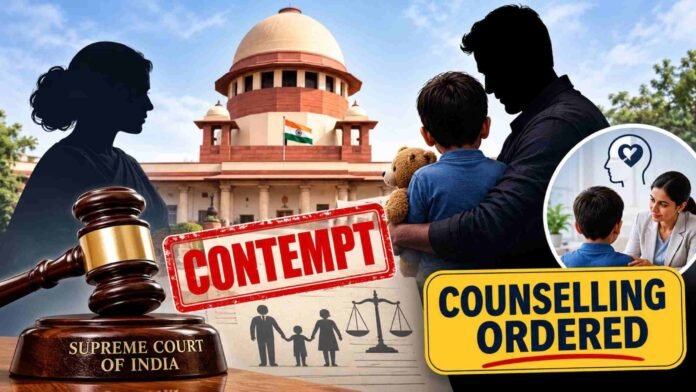
The Supreme Court has held a father in clear contempt of its earlier order after he retained the custody of his minor son in violation of a mutually agreed settlement that had placed the custody and guardianship of both children exclusively with their mother. However, considering the child’s psychological well-being and the possibility of further emotional trauma through an abrupt transfer, the Court has directed professional counselling before taking a final decision on restoration of custody to the mother.
A three-judge Bench comprising Justice Vikram Nath, Justice Sandeep Mehta and Justice Aparesh Kumar Singh directed the Family Court, Dholpur, Rajasthan, to engage a child counsellor and submit a report on the child’s emotional condition and readiness to return to the mother’s guardianship.
Buy Now: 90+ Supreme Court Judgments E-Magazine – October 2026
The dispute originated from a transfer petition filed by the wife seeking the transfer of Suit No. 149 of 2024, titled Saurav Gupta v. Poornima Gupta, pending before the Family Court, Dholpur, Rajasthan, to the Family Court, East Delhi District Court, Delhi.
During the pendency of the transfer petition, the parties participated in mediation and ultimately arrived at a mutual settlement dated November 13, 2025. The settlement was subsequently recorded by the Supreme Court in its order dated December 12, 2025.
Under the settlement, the parties agreed that their two minor children, a daughter and a son, would remain in the exclusive custody of the mother.
The father was granted visitation rights and permission to take the children to his parental home at Dholpur, Rajasthan, twice a year for four days on each occasion, subject to the agreed terms and conditions.
The parties also agreed that the father would pay Rs. 8,000 per month towards the children’s educational expenses. The amount was to be transferred electronically to the mother and continued until the children became gainfully employed or got married, whichever occurred earlier.
Further, the father had agreed that he would not claim custody of the children in any other manner except in accordance with the terms and conditions recorded in the compromise.
The settlement also recorded that the father would bear the premiums payable on investments made in the children’s names under Government bonds or schemes.
The mother subsequently approached the Supreme Court alleging that the father had violated the terms of the settlement and the directions contained in the December 12, 2025 order.
According to the allegations, on July 22, 2026, at approximately 1:57 p.m., the father went to the Kerala Education Society Senior Secondary School at Mayur Vihar, Phase III, Delhi, where the minor son was studying, ostensibly in exercise of his visitation rights, and took the child to Rajasthan.
The mother alleged that the father thereafter continued to retain the child’s custody and did not hand him back in accordance with the settlement recorded by the Supreme Court.
She further alleged that the father had previously violated the visitation arrangements.
The mother approached the Station House Officer of Police Station Ghazipur on July 26, 2026, complaining about the alleged illegal and contemptuous conduct. However, no action was forthcoming.
Thereafter, she served a contempt notice upon the father through her advocate and exchanged messages requesting the return of the child. Despite these efforts, the father continued to retain the minor son’s custody.
Consequently, the mother instituted the contempt proceedings before the Supreme Court.
During the contempt proceedings, the father did not deny that he had retained the custody of the minor son contrary to the terms of the settlement.
However, he sought to justify his conduct by contending that he shared a close and affectionate relationship with the child and that the child had consistently expressed his desire to remain with him.
The father further claimed that the child resisted attempts to send him back to his mother and had disclosed the physical and mental trauma allegedly caused to him by the mother’s family.
He also submitted that the child was staying comfortably with him and his parents at Dholpur and had been admitted to a school there.
According to the father, retaining the child at Dholpur was in the child’s best interests.
The Supreme Court took up the matter in Chambers on November 3, 2026. The Bench interacted with the minor child in the presence of the advocates representing the parties and also separately interacted with the parties.
After the interaction, the Court observed that the child’s mind appeared to have been severely tutored against his mother and sister.
The Bench noted that the child was not interested in returning to his mother or even interacting with her and insisted that he wanted to remain with his father.
The Court also considered the allegations and counter-allegations raised by both parties regarding each other’s conduct before and after the initiation of the contempt proceedings.
Importantly, the Court observed that, prima facie, based on its interaction with the father and his mannerisms, he appeared to be displaying clear signs of substance abuse.
After examining the circumstances, the Supreme Court concluded that the father was in clear contempt of its order dated December 12, 2025.
The Bench reiterated that the earlier settlement had placed the full custody and guardianship rights of the children exclusively with the mother, while granting limited visitation rights to the father.
Despite the clear terms of the settlement, the father had taken the minor son out of the mother’s custody and retained him for nearly four months.
The Court observed that there appeared to be a conscious attempt by the father to influence and poison the child’s mind against his mother as well as his sister.
However, the Bench was also conscious that an abrupt restoration of custody could create further complications and potentially leave a permanent psychological impact on the child.
It observed that directly transferring the child back to the mother’s custody at that stage could cause unnecessary complications and adversely affect his psychological well-being.
Accordingly, rather than directing an immediate transfer, the Court considered it appropriate to adopt a structured counselling mechanism to assess and address the child’s emotional condition.
In a significant direction, the Supreme Court directed the Family Court, Dholpur, to forthwith engage the services of a child counsellor to provide appropriate counselling to the minor.
The father has been directed to present the child before the Family Court for counselling sessions whenever required.
The Presiding Officer of the Family Court must ensure that the counsellor interacts with the child in an influence-free atmosphere.
The Court specifically identified the primary objective of counselling as restoring the child’s faith and trust in his mother and sister.
The Bench considered this intervention necessary because the continued separation of the child from his mother’s household could also lead to alienation from his sister.
The counselling sessions may initially be conducted twice a week or at such frequency as may be decided by the counsellor.
The mother has also been permitted to approach the Family Court, Dholpur, through an appropriate application if she wishes to participate in the counselling sessions. However, her participation will remain subject to the counsellor’s permission.
The Supreme Court further directed that the father would not be permitted to interfere in the counselling process.
The counselling sessions must be conducted in a separate room within the premises of the Family Court, Dholpur.
The expenses of the counsellor, as determined by the Family Court, will be borne by the father.
Until the counsellor’s report is received, the child may continue to reside at Dholpur.
The Supreme Court has prescribed a specific timeline for reviewing the child’s circumstances and determining the next course of action.
The counsellor’s report is required to be presented before the Supreme Court in a sealed cover on January 22, 2027.
On that date, both parties must remain present before the Court along with the child.
The Bench has further clarified that if the counsellor concludes that the child is ready to be handed back into the guardianship of the mother, a report to that effect may be forwarded through the Family Court for early listing of the matter before the Supreme Court.
The matter has accordingly been directed to be listed on January 22, 2027, at 1:00 p.m. in Chambers.
Membership Required to Access Case Details & Order Copy
To view the complete Case Details and Download Order Copy, you must have an active membership. Please subscribe to continue.
Read More: Members Have No Automatic Right to Join Charitable Society Suit U/s 92 CPC: Supreme Court

