
The Calcutta High Court cut the award by 50% after finding that the claim for additional dredging exceeded 70% of the original contract value and held that the size of the claim alone gave the High Court no ground to interfere under Section 37 of the Arbitration and Conciliation Act, 1996.
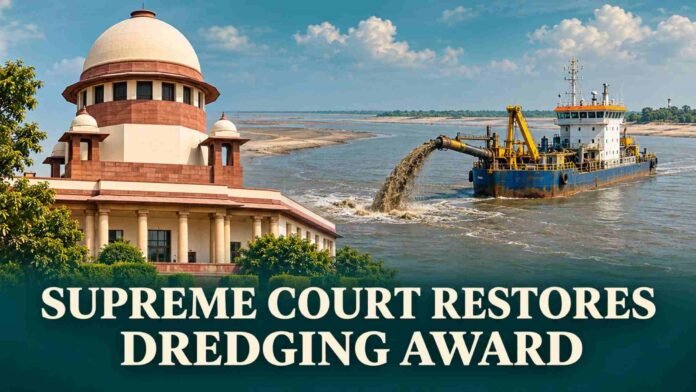
The bench of Justice J.B. Pardiwala and Justice K. Vinod Chandran restored an arbitral award for additional dredging at Sagar Island, setting aside a Calcutta High Court ruling that halved the amount payable by the Port of Kolkata and reduced interest to 6% on the principal from February 8, 2002.
Buy Now: 90+ Supreme Court Judgments E-Magazine – October 2026
The bench held that the High Court had exceeded its appellate jurisdiction when it cut an award supported by joint measurements and invoices on the ground that the amount shocked its conscience.
The Port Trust engaged the contractor to dredge an approach channel and basin for a shore-based pilot station at Sagar Island. The original contract was worth ₹2,86,56,200, of which the Port Trust had paid ₹2,79,32,865. The arbitration concerned payment for additional dredging.
Adverse weather and a mismatch between actual soil conditions and the data supplied by the Port Trust led to further dredging. A July 19, 2000 letter from the Port Trust documented the additional work. The Port Trust chairman inaugurated the pilot station on April 17, 2001, using the dredged channel. The arbitrator assessed the additional work using joint measurements, including levels before and after dredging, and the contractor’s invoices.
A Calcutta High Court single judge upheld the November 3, 2003 award under Section 34 of the Arbitration Act. On appeal under Section 37, the Division Bench acknowledged that the arbitrator had relied on relevant evidence and that the award was neither perverse nor patently illegal. It also found that the absence of a completion certificate, which the Port Trust had never issued, did not by itself defeat payment for work proved by the records.
Even so, the Division Bench considered the award contrary to basic notions of morality or justice because the claim for additional work exceeded 70% of the original contract value. Both parties moved the Supreme Court. The contractor sought restoration of the award, while the Port Trust asked the Court to set it aside in full or, alternatively, uphold the High Court’s reduction.
The Supreme Court held that interference on the ground that an award shocks the court’s conscience requires a substantive reason showing a conflict with the most basic notions of morality or justice. Here, the additional work involved the same kind of dredging as the original contract and was necessary to keep the channel and basin operational. The Court also held that the Port Trust’s status as a government entity did not justify special treatment in reviewing the amount awarded.
Applying the Constitution Bench ruling in Gayatri Balasamy v. ISG Novasoft Technologies Ltd., the Court explained that a court can set aside part of an award only if it can legally and practically separate that part from the valid portion. The joint measurements and invoices here covered one body of re-dredging work, leaving no distinct portion to sever. Reassessing those records to arrive at a different figure would have meant reviewing the merits of the award, which Section 37 did not permit.
The Supreme Court allowed the contractor’s appeal and restored the arbitral award. It disposed of the Port Trust’s appeal after setting aside the High Court judgment.
Membership Required to Access Case Details & Order Copy
To view the complete Case Details and Download Order Copy, you must have an active membership. Please subscribe to continue.
Read More: Supreme Court Finds Father in Contempt for Retaining Child in Violation of Custody Settlement

