
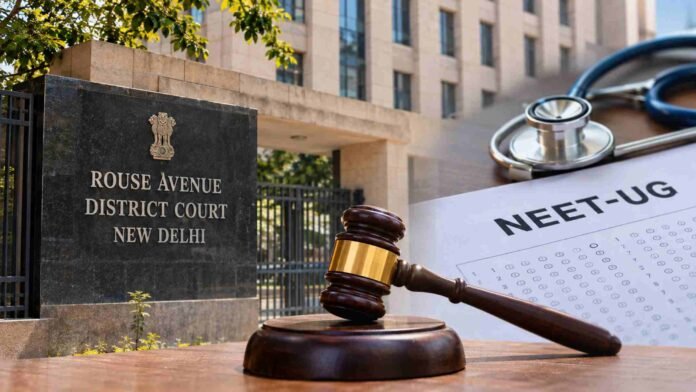
Court finds sufficient prima facie grounds to proceed over alleged leakage of confidential examination questions, cheating, criminal conspiracy and copyright infringement.
A special Central Bureau of Investigation (CBI) court at Delhi’s Rouse Avenue Courts has directed the framing of criminal charges against 14 accused persons, including three subject experts associated with the National Testing Agency (NTA), in connection with the alleged leakage of the NEET-UG 2026 examination questions.
Special Judge Ajay Gupta passed the order on November 18, 2026, after examining the CBI’s chargesheets, witness statements, documentary evidence and submissions advanced on behalf of the accused.
The court directed that the accused be produced on November 21 for the formal framing of charges. It also scheduled the recording of prosecution evidence to begin on November 25, with proceedings to continue on a day-to-day basis.
The prosecution involves allegations of criminal conspiracy, cheating, criminal breach of trust, destruction of evidence and violations of the Prevention of Corruption Act, 1988, and the Public Examinations (Prevention of Unfair Means) Act, 2024.
Buy Now: Complete Tax & Supreme Court Judgments E-Magazine Combo – October 2026
Significantly, the court also found grounds to proceed under Section 63 of the Copyright Act, 1957, concerning the alleged unauthorised use and circulation of examination questions belonging to the NTA.
Court Examines Alleged Breach of Confidentiality by NTA Experts
According to the CBI’s case, three subject experts engaged for examination-related assignments allegedly obtained confidential questions while working on the NEET-UG 2026 papers.
The accused experts were associated with Biology, Chemistry and Physics assignments. They were required to maintain confidentiality and had signed undertakings prohibiting the retention or disclosure of examination material.
The prosecution alleged that the experts misused their access to the confidential examination questions and subsequently shared the information with other persons involved in the alleged distribution network.
The investigation indicated that confidential questions were allegedly reproduced through handwritten notes, memorisation and references marked in textbooks.
The court examined these allegations alongside the confidentiality undertakings, witness statements and other material relied upon by the investigating agency.
Examination Cancelled After Allegations of Question Paper Leak
NEET-UG 2026 was conducted on May 3, 2026, with approximately 22 lakh candidates appearing for the examination.
Following allegations that a substantial number of questions had been leaked before the examination, the NTA cancelled the test on May 12.
A fresh examination was subsequently conducted on June 21, 2026.
The CBI registered its case on May 12, 2026, following a complaint from the Department of Higher Education under the Union Ministry of Education.
During the investigation, the agency identified persons allegedly involved in obtaining, transmitting and distributing confidential examination questions.
The CBI initially filed a chargesheet against 13 accused and subsequently filed a supplementary chargesheet against a fourteenth accused.
Court’s Findings on Copyright Protection of Examination Questions
An important legal issue considered by the court was whether confidential examination questions could constitute protected property and whether their unauthorised circulation could attract criminal liability under the Copyright Act.
The court examined the legal position governing copyright in examination question papers and the ownership of materials prepared under the direction and control of public examination authorities.
It considered Section 17 of the Copyright Act, which addresses the first ownership of copyright, alongside the confidentiality agreements executed by the experts.
The court concluded, for the purposes of framing charges, that the NEET-UG question papers prepared and translated under the NTA’s control were its exclusive property and that the alleged unauthorised commercial circulation of the questions provided grounds for prosecution under Section 63.
The court also rejected the argument that an alleged violation of the confidentiality undertaking could give rise only to civil proceedings. It reasoned that the existence of a contractual obligation does not, by itself, exclude criminal proceedings where the alleged conduct satisfies the ingredients of criminal offences.
Court Finds Prima Facie Material Supporting Criminal Conspiracy
The court also examined whether persons who allegedly received and circulated confidential questions through intermediaries could be prosecuted as members of the same criminal conspiracy, even without direct contact with the experts who initially obtained the material.
Referring to the Supreme Court’s decision in State of Maharashtra v. Som Nath Thapa, the court considered the legal principles applicable to a conspiracy involving several participants performing different functions.
It observed that a conspiracy may operate through a chain of persons, with each participant contributing to the common unlawful objective.
Applying this principle, the court found sufficient prima facie material to proceed against the private individuals who allegedly participated in the distribution and commercial exploitation of confidential examination material.
The court held that their status as private individuals did not, by itself, prevent charges connected with the larger conspiracy under the Bharatiya Nyaya Sanhita and the Prevention of Corruption Act.
Court Modifies Certain Charges Proposed by CBI
The order also contains important distinctions concerning the offences for which individual accused persons may face trial.
While examining the cheating allegations, the court found that the alleged conduct was covered by Section 318(3) of the Bharatiya Nyaya Sanhita rather than Section 318(4), which had been invoked in the chargesheets.
On the allegation of destruction of evidence, the court found sufficient grounds for charges under Section 238(b) of the BNS against the accused persons other than accused No. 6.
The court further held that the offence of receiving stolen property under Section 317(2) of the BNS was prima facie made out only against accused No. 1, Manisha Gurunath Mandhare, in connection with the alleged receipt of Physics questions from another accused.
These distinctions are significant because the court did not simply accept every proposed charge without examination. It separately assessed the statutory ingredients and the alleged involvement of the accused persons.
Trial to Begin on November 25
Following the order directing the framing of charges, the matter is scheduled for November 21, 2026, when the accused are to be produced before the court for the formal framing of charges.
The recording of prosecution evidence is scheduled to commence on November 25 and proceed on a daily basis.
The decision marks the transition of the case from consideration of charges towards trial. However, the order does not amount to a conviction. The prosecution must still establish its allegations through evidence, and the accused retain their right to contest the charges during trial.
Membership Required to Access Case Details & Order Copy
To view the complete Case Details and Download Order Copy, you must have an active membership. Please subscribe to continue.
Read More: GST E-Invoicing for RCM Self-Invoices Mandatory From January 1, 2027

