
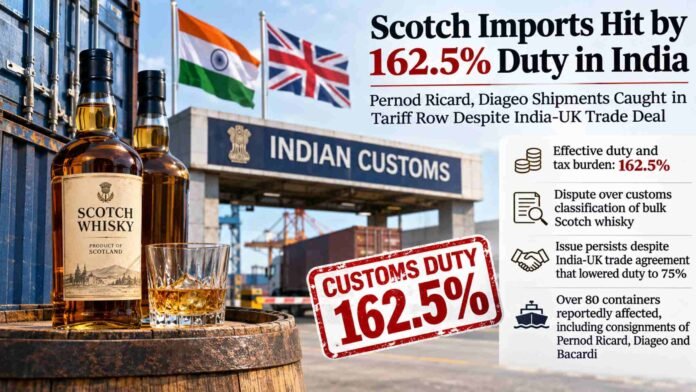
The controversy centres on whether bulk Scotch whisky used in manufacturing Indian liquor brands qualifies for the concessional 75% customs duty under the India-UK Free Trade Agreement or attracts a higher levy under a separate tariff classification.
A major customs classification dispute involving bulk Scotch whisky imports from the United Kingdom has created uncertainty for India’s alcoholic beverages industry, with an effective duty and tax burden of 162.5% being applied to certain consignments despite the concessional tariff framework introduced under the India-UK trade agreement.
The dispute has affected leading liquor manufacturers and importers, including Pernod Ricard, Diageo and Bacardi, whose bulk Scotch consignments have reportedly faced clearance difficulties at Indian ports.
According to a Reuters investigation published on November 18, customs authorities have taken the position that certain bulk Scotch imports used as inputs in manufacturing alcoholic beverages should be classified differently from finished Scotch whisky. This interpretation would subject the imports to a 150% customs tariff and an additional levy, resulting in an effective burden of 162.5%.
Buy Now: All 200+ GSTAT Judgements Till November 2026 | Comprehensive E-Magazine
Why Has the Customs Duty Increased to 162.5%?
The disagreement arises from the classification of bulk Scotch whisky imported for blending and manufacturing operations in India.
Under the India-UK trade agreement, which became operational on July 15, 2026, India agreed to reduce customs tariffs on eligible Scotch whisky imports from 150% to 75%, with further reductions scheduled over the following decade.
However, customs investigators have reportedly questioned whether the reduced rate extends to bulk Scotch concentrates or preparations imported for use in manufacturing Indian whisky brands.
The authorities contend that certain products should fall under the tariff classification covering compound alcoholic preparations used in beverage manufacturing, rather than the classification applicable to Scotch whisky eligible for preferential treatment.
This distinction is financially significant because the disputed classification attracts a 150% tariff. An additional consumption-related levy reportedly increases the effective burden to 162.5%.
Importers maintain that genuine bulk Scotch whisky should not lose its identity or preferential tariff eligibility merely because it is imported in large containers and subsequently used in blending operations.
More Than 80 Containers Reportedly Affected
The customs investigation has reportedly resulted in delays involving more than 80 shipping containers carrying bulk Scotch imports belonging to major international liquor companies.
These consignments are important for manufacturers that depend on imported Scotch as an ingredient in Indian-made whisky products.
The prolonged clearance difficulties have raised concerns about interruptions to production schedules, supply-chain management and the availability of raw materials.
Reports indicate that customs authorities have permitted provisional release of affected consignments during the investigation, subject to financial safeguards.
Under the reported arrangement, importers must pay duty equivalent to 75% of the assessable value upfront and provide bank guarantees covering the remaining disputed liability.
Pernod Ricard and Diageo have reportedly begun arranging the necessary guarantees to secure clearance of their shipments, while Bacardi was still considering its options as of November 18.
India-UK Trade Agreement: What Was the Intended Customs Duty Benefit?
The preferential tariff treatment for Scotch whisky was among the important commercial outcomes of the India-UK trade negotiations.
The agreement was expected to improve market access for British whisky producers while gradually reducing import costs for Indian businesses and consumers.
The tariff reduction framework provides for an immediate reduction from 150% to 75% on eligible imports, followed by a phased reduction to 40% over ten years.
However, the present controversy demonstrates that a preferential tariff rate does not automatically resolve disputes over the classification of imported goods.
Before an importer can claim a concessional rate, the goods must satisfy the applicable tariff classification, origin and other eligibility requirements.
Consequently, the central question is whether bulk Scotch whisky imported for blending retains the classification of Scotch whisky or should be treated as a preparation used in manufacturing beverages.
Directorate of Revenue Intelligence Raises Classification Concerns
The dispute reportedly intensified following investigations into the tariff classifications adopted by liquor importers.
According to earlier Reuters reporting, a November 4 memorandum issued by the Directorate of Revenue Intelligence directed customs authorities to examine the classification of certain bulk Scotch imports.
Investigators reportedly considered that some imported products were concentrates or preparations requiring further manufacturing and therefore did not qualify for the preferential tariff claimed by importers.
The authorities also expressed concern about the potential revenue implications of incorrect classification.
The industry’s opposing position is that bulk Scotch whisky remains a whisky product even when it is intended for subsequent blending or manufacturing.
The legal issue is therefore not simply the applicable rate of duty, but the correct customs identity of the imported product.
Why Customs Classification Is Crucial
Under Indian customs law, tariff classification determines the applicable rate of customs duty and can also affect eligibility for exemptions and preferential trade benefits.
In the present dispute, the relevant considerations may include the imported product’s composition, manufacturing process, commercial description, intended use and the wording of the applicable tariff headings.
A distinction may also arise between Scotch whisky imported in bulk packaging and a compound alcoholic preparation manufactured or formulated for subsequent use in beverages.
Whether a product undergoes further blending after importation may be relevant, but that fact alone does not conclusively establish its classification.
The determination must be made with reference to the actual characteristics of the goods and the applicable legal provisions.
Any final assessment will therefore depend on the precise product specifications, relevant customs tariff entries, preferential tariff conditions and evidence available to the authorities.
Indian Liquor Manufacturers Could Face Higher Costs
The consequences of the dispute extend beyond international brands.
Several Indian liquor manufacturers use imported Scotch in producing Indian-Made Foreign Liquor (IMFL), particularly blended whisky.
Industry estimates indicate that approximately 80% of Scotch whisky imported from Britain by volume arrives in bulk form.
Companies including Radico Khaitan, Allied Blenders and Distillers and Tilaknagar Industries have also reportedly come under scrutiny in connection with bulk Scotch imports.
A sustained higher duty burden could affect raw-material costs, working capital and production planning.
Even where goods are released provisionally, bank guarantees may impose additional financial obligations on importers.
Smaller manufacturers could be particularly affected because arranging guarantees may require collateral or additional banking facilities.
The dispute also raises a broader policy question: whether more favourable treatment for finished bottled Scotch than for bulk Scotch used by Indian manufacturers could discourage domestic blending and value addition.
UK Government Seeks Resolution With India
The controversy has also attracted attention from the British government, given the importance of Scotch whisky exports under the bilateral trade agreement.
British authorities have indicated that they are engaging with India to ensure that businesses receive the tariff benefits contemplated under the agreement.
India’s Commerce Ministry has also signalled its intention to resolve the matter.
On November 13, India’s Trade Secretary Rajesh Agrawal stated that India would honour the agreed duty reductions on Scotch imports, according to Reuters.
Nevertheless, the reported continuation of customs scrutiny and provisional clearance arrangements suggests that the classification issue had not been conclusively settled as of November 18.
Implications for Customs Law and Preferential Tariff Claims
The dispute highlights the practical challenges involved in implementing free trade agreements where questions arise over the scope of concessional tariff provisions.
For customs practitioners, the controversy raises several important legal considerations, including the relationship between tariff classification and preferential duty eligibility, the evidentiary requirements for identifying imported goods, and the treatment of goods released provisionally during investigations.
It also underscores the importance of consistency between trade policy commitments and their implementation at the customs assessment stage.
Where the classification adopted by importers differs from that asserted by customs authorities, the resulting dispute may lead to additional duty demands, financial guarantees and prolonged proceedings.
However, the reported investigation does not itself establish that the importers have misclassified their products. That question remains subject to the applicable legal process and final determination.
What Happens Next?
The immediate priority for affected companies is to secure the release of imported consignments and maintain manufacturing operations while the classification controversy is examined.
A resolution may require clarification of the relevant tariff provisions, the nature of the imported products and the scope of the preferential treatment available under the India-UK trade agreement.
Until a definitive position emerges, importers may continue to face uncertainty over the duty liability associated with bulk Scotch consignments.
The outcome could have wider implications for other industries relying on preferential tariffs under India’s free trade agreements, particularly where imported goods are used as manufacturing inputs rather than sold directly as finished products.
The central issue remains whether bulk Scotch whisky should receive the same concessional customs treatment as finished bottled Scotch under the India-UK trade agreement. The answer will determine whether affected importers can access the promised 75% tariff or must bear the substantially higher levy currently disputed.
Read More: Trust Can’t Be Reclassified From Charitable To Religious Without Any Change In Its Objects: ITAT

