
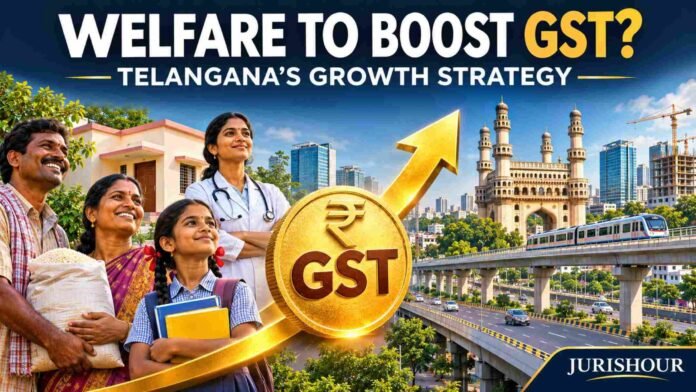
The Telangana government has defended its welfare programmes as investments in economic growth, arguing that spending on food security, healthcare, housing and education can improve productivity and strengthen goods and services tax (GST) collections.
Responding to concerns that welfare commitments could leave insufficient resources for infrastructure, the government cited a capital outlay of ₹47,267 crore in the 2026–27 Budget Estimates, against ₹36,481 crore in the 2025–26 Revised Estimates—an increase of approximately 29.6 per cent.
The administration maintained that social support and capital investment can work together, with welfare measures helping households participate more effectively in the economy and infrastructure spending creating opportunities for business expansion and employment.
Buy Now: Indirect Tax Judgments E-Compilation – October 2026
Welfare Spending Linked to Productivity and Revenue
According to the government, its welfare programmes are designed to build a healthier, more skilled and financially secure population. It argued that improved household well-being can encourage greater economic participation, supporting production, consumption and tax revenue.
The government said free fine rice is being supplied to approximately 1.006 crore families out of the state’s total 1.015 crore families. Each family member receives six kilograms, with the government placing the market value of the rice at ₹70–80 per kilogram.
Healthcare support includes medical insurance coverage of ₹10 lakh per family for treatment under the applicable scheme at private or corporate hospitals.
Under the Indiramma housing programme, eligible homeless beneficiaries receive assistance of ₹5 lakh. The government said eight lakh houses have been sanctioned as part of its objective of ensuring secure and dignified housing for eligible families.
Support for Farmers, Students and Women
The administration highlighted Rythu Bharosa as a key agricultural support programme and credited it with contributing to Telangana’s rice production performance.
According to the figures provided, 56 lakh families receive up to 200 units of free electricity, while 42 lakh families receive pensions.
The government also referred to free breakfast for students in government schools six days a week and scholarships covering approximately 18.9 lakh students, including those studying engineering and medicine.
It linked educational assistance to the development of a skilled workforce, arguing that the availability of talent strengthens Telangana’s appeal as an investment destination.
Free travel for women on state transport buses and bank-linked loans for women’s self-help groups were identified as additional measures supporting mobility and economic participation.
The government’s position is that these programmes can help people work more productively and participate more confidently in the economy. However, the responses did not provide a quantified assessment of the additional GST collections attributable to individual welfare schemes.
₹46,000 Crore Sanctioned for Hyderabad
On infrastructure spending, the government said ₹46,000 crore has been sanctioned for Hyderabad, covering a range of urban development projects.
The works outlined include flyovers, underpasses, road widening, circular and radial roads, and sewage treatment plants.
The administration also highlighted Hyderabad’s existing Outer Ring Road, plans for a Regional Ring Road and sector-specific industrial clusters intended to improve connectivity and facilitate investment.
These clusters would cater to industries such as pharmaceuticals, information technology, education and textiles. The government said better transport links would make industrial locations more accessible and reduce travel times.
A proposed Future City spread over 30,000 acres and the second phase of Hyderabad’s metro rail network also form part of the development programme described in the responses.
$1 Trillion Economy Target by 2034
Telangana has set an ambition to become a $1 trillion economy by 2034 and a $3 trillion economy by 2047.
While Hyderabad will continue to play a central role in technology, services and investment, the government said economic opportunities must expand beyond the capital.
Warangal, Karimnagar, Khammam, Nizamabad and Mahabubnagar were identified as potential regional growth centres, with industrial priorities to be determined by local strengths.
The government’s “Telangana Rising” strategy brings together urban services, manufacturing and rural enterprise through three development categories.
CURE focuses on core urban services, technology, research and innovation. PURE covers peri-urban industry, manufacturing and logistics. RARE centres on agriculture, rural processing and local enterprise.
The approach seeks to strengthen the connections between urban markets, industrial production and rural economic activity.
Operational Projects and Jobs to Determine Investment Success
The administration identified information technology, pharmaceuticals, life sciences, electronics, advanced manufacturing, clean energy and data infrastructure as priority sectors.
Reliable electricity and water, readily available land, transport connectivity, skilled workers and predictable approvals were described as essential conditions for attracting investment.
The government also indicated that the success of Telangana Rising would be measured through agreements becoming operational projects, actual capital deployment and jobs generated.
This places project execution and employment creation at the centre of the stated investment strategy.
Water Scarcity Preparations and Demand for Central Assistance
Addressing concerns over the southwest monsoon and El Niño, the government said it has assessed potential water shortages and the implications of reduced hydropower availability.
A ministerial subcommittee involving the agriculture, irrigation and rural development departments has been constituted to coordinate preparations.
The priorities outlined include protecting drinking water supplies, managing reservoirs and groundwater, scheduling irrigation, assisting farmers and planning crops according to water availability.
The government said reduced hydropower generation would also require arrangements for alternative electricity supplies.
It sought ₹20,000 crore in central assistance, an additional 1,500 megawatts of power and disaster-response support.
The administration also requested an increase in the fiscal deficit limit from 3 per cent to 3.5 per cent of Gross State Domestic Product under the applicable fiscal responsibility framework. The proposal was presented as a request for additional fiscal flexibility, rather than an approved relaxation.
Singareni Expansion Aimed at Sustaining Employment
On the Singareni Collieries Company, the government stressed the need to secure additional coal resources to sustain operations as existing reserves are depleted.
According to the workforce figures provided, the company has approximately 40,000 permanent employees and 35,000 outsourced workers.
The administration said it enabled participation in coal block auctions following discussions with workers about the company’s long-term resource requirements. It referred to a coal block secured through auction and progress concerning other allocations.
The government also stated that employees have been provided accident insurance coverage of ₹1 crore.
The responses set out a development agenda combining household assistance, infrastructure investment, industrial expansion and regional growth, with the government arguing that stronger social security can support both economic activity and future revenue generation.

