
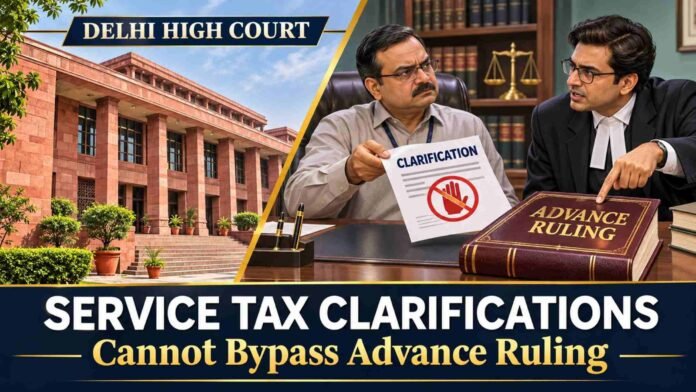
The Delhi High Court has disapproved of service tax authorities issuing clarifications without statutory authority to bypass the advance ruling mechanism under the Finance Act, 1994 and observed that deciding whether a service is taxable or whether an assessee requires registration involves adjudication and the discharge of quasi-judicial functions.
The Bench of Justice Avneesh Jhingan and Justice Shail Jain made these observations while disposing of a petition challenging a departmental communication that treated commission earned from mobilising fixed deposits as taxable under Business Auxiliary Services.
Buy Now: Indirect Tax Judgments E-Compilation – October 2026
The Court did not determine the company’s tax liability for the disputed period. Instead, it directed the Commissioner of Service Tax, Delhi, to treat the writ petition as a refund application and examine it independently in accordance with law.
The petitioner/assessee was engaged in mobilising public savings into company deposits, Government of India bonds, public sector undertaking bonds, capital gains bonds and Rural Electrification Corporation bonds, among other instruments.
It also acted as a principal broker for fixed deposit schemes of public sector undertakings, finance companies and private companies. It mobilised funds for banks, including the Reserve Bank of India, and received commission for these activities.
The company was registered under the service tax regime and had been depositing tax. On March 29, 2004, it submitted a representation to the Chief Commissioner of Central Excise, Delhi Zone, seeking clarity on whether its activities attracted service tax. It subsequently sent a reminder on March 19, 2007.
The department stated that commission received as a principal broker for fixed deposit schemes amounted to consideration for taxable services rendered as a commission agent under Business Auxiliary Services. The communication advised the company to discharge its liability to avoid penal consequences.
The company approached the High Court seeking to quash the communication, obtain a declaration that mobilising funds for fixed deposits, IPOs and bonds did not attract service tax, and secure a refund of tax deposited from September 2004 to March 2006.
The petitioner argued that it functioned as a broker or facilitator and could not automatically be treated as a commission agent providing Business Auxiliary Services.
It contended that, before the amendment dated June 16, 2005, its activities were outside Section 65(105)(zzb), read with Section 65(19), of the Finance Act, 1994.
The company also submitted that fixed deposits and bonds constituted actionable claims excluded from the definition of “goods” under Section 65(50), read with Section 2(7) of the Sale of Goods Act, 1930. On this basis, it disputed the levy before March 1, 2006.
The petitioner relied on Supreme Court decisions including CST v. Modi Sugar Mills Ltd., Union of India v. Margadarshi Chit Funds (P) Ltd., Commissioner of Customs v. Dilip Kumar and Co., and Sunrise Associates v. Government of NCT of Delhi.
It further alleged that the departmental communication was contrary to statutory provisions and violated the principles of natural justice. These arguments were recorded by the Court but were not finally adjudicated.
The respondents informed the Court that the impugned letter was merely a reply to a representation, rather than a circular or binding clarification.
They stated that the communication bound neither the petitioner nor the authorities exercising powers under the Finance Act. The department also undertook to consider the refund claim in accordance with law without being influenced by the letter.
In view of this statement, the Court held that the prayer challenging the communication no longer survived.
The Bench nevertheless examined the legal foundation for the procedure adopted by the parties.
It noted that, despite a specific query, neither side identified a provision authorising the representation-based clarification process used in this case.
The Court referred to Chapter VA of the Finance Act, which governed advance rulings. It explained that Section 96A contemplated determination, on an application by an eligible applicant, of a question of law or fact concerning service tax liability in relation to a proposed service.
Bajaj Capital admittedly did not fall within the statutory definition of an eligible applicant and could not have sought an advance ruling.
However, the Court disapproved of using an informal clarification process to bypass the statutory mechanism. It observed that this approach could result in an issue being addressed without statutory authorisation, a complete factual record or an opportunity of hearing for affected parties.
The Bench held that the respondent authority had not been conferred the power to issue the clarification in question.
The Court emphasised that deciding whether a service attracts tax, or whether an assessee must obtain registration, requires adjudication and the exercise of quasi-judicial functions.
Issuing clarifications on these matters interferes with the discharge of those functions, the Bench observed.
It also relied on Mahanagar Telephone Nigam Ltd. v. Union of India, 2023 SCC OnLine Del 1967, which had recognised that the Finance Act contained no procedure for seeking clarification from the jurisdictional service tax authority.
The High Court declined to grant the declaration that the petitioner’s activities were outside the service tax levy.
It explained that determining liability for September 2004 to March 2006 required examination of the company’s agency agreements and contracts with banks, companies and other entities.
The effect of amendments dated June 20, 2003, July 9, 2004, September 10, 2004 and June 16, 2005 also needed consideration alongside the actual relationship between the petitioner and the recipients of its services.
The judgment records that the company did not dispute its service tax liability from March 2006 onwards.
The Court held that entitlement to a refund depended on the outcome of the underlying taxability dispute. Even if the petitioner succeeded on that issue, the question of unjust enrichment would require separate consideration.
The Bench directed the Commissioner of Service Tax, Delhi, to treat the writ petition as an application for refund of the deposited tax.
Membership Required to Access Case Details & Order Copy
To view the complete Case Details and Download Order Copy, you must have an active membership. Please subscribe to continue.
Read More: Customs Advance Ruling Appeals Can’t Be Entertained Beyond 90 Days: Delhi High Court

