
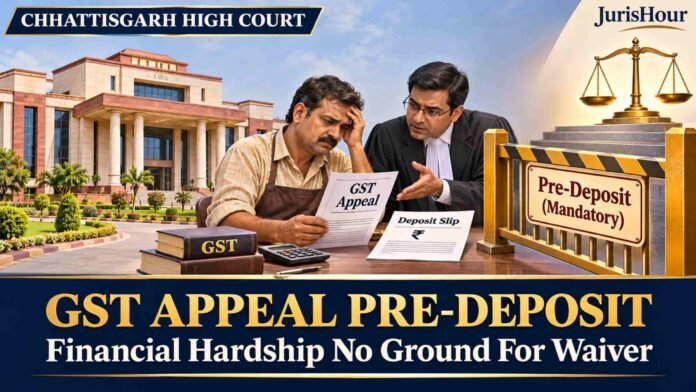
The Chhattisgarh High Court has held that an appellate authority cannot waive or reduce the mandatory pre-deposit required for filing a GST appeal unless the statute expressly confers such a power. A taxpayer’s inability to pay the prescribed amount, by itself, does not permit the authority to dispense with the statutory condition.
The bench of Justice Narendra Kumar Vyas dismissed a writ petition challenging the rejection of an appeal for non-compliance with Section 107(6) of the Central Goods and Services Tax Act, 2017 and found no illegality in the appellate authority’s decision to dismiss the appeal without examining its merits.
Buy Now: All 200+ GSTAT Judgements Till November 2026 | Comprehensive E-Magazine
The case arose from an adjudication order dated December 19, 2024, passed by the Joint Commissioner, CGST and Central Excise, determining liabilities against the taxpayer and imposing penalties.
The portions of the adjudication order reproduced in the judgment included an IGST penalty of ₹2,06,77,809 under Sections 74(1) and 74(9) of the CGST Act.
The order also confirmed a GST demand of ₹3,51,820, comprising CGST and SGST of ₹1,75,910 each, for alleged clandestine removal of goods without payment of tax and without issuing invoices during October 2020.
The adjudicating authority directed recovery of interest under Section 50 on this demand and imposed an equivalent penalty of ₹3,51,820 under Sections 74(1) and 74(9).
Aggrieved by the adjudication order, the taxpayer approached the appellate authority. However, the appeal was dismissed on January 15, 2026, for failure to comply with the mandatory pre-deposit requirement under Section 107(6).
The appellate authority recorded that the taxpayer had failed to establish exceptional circumstances warranting exemption from the prescribed deposit and consequently held the appeal to be not maintainable.
The taxpayer subsequently challenged that decision before the High Court under Article 226 of the Constitution.
During the hearing, the High Court specifically asked whether an alternative and efficacious remedy of appeal before the GST Appellate Tribunal was available.
The taxpayer’s counsel submitted that pursuing the appeal required payment of the prescribed deposit, but the taxpayer was not in a position to deposit the amount determined by the assessing authority and affirmed by the appellate authority. Counsel therefore requested the High Court to entertain the writ petition.
The tax department opposed the petition, contending that the taxpayer had approached the High Court without exhausting the further statutory remedy available before the GST Appellate Tribunal.
The department also argued that the taxpayer had failed to deposit even the prescribed percentage of the disputed tax amount. It maintained that the appellate authority had rightly dismissed the appeal for non-compliance with the mandatory condition, without examining the substantive dispute.
The High Court identified the principal issue as whether an appeal could be entertained in the absence of the mandatory pre-deposit prescribed under the CGST Act.
The Court emphasised that taxing statutes must be interpreted strictly according to their language. Equitable considerations cannot be used to introduce exceptions or relaxation powers that the legislature has not provided.
In this context, the Court relied on the Constitution Bench judgment in Commissioner of Customs (Import) v. M/s Dilip Kumar and Company & Others, concerning the principles governing interpretation of taxation statutes.
Applying those principles, the High Court held that the language of Section 107 makes compliance with the prescribed pre-deposit mandatory for maintaining an appeal before the appellate authority.
The Court held that the appellate authority has no discretion to dispense with or reduce the pre-deposit where the statute does not confer a relaxation power.
The taxpayer’s financial inability could not create a power that the legislature had not granted.
The Court observed, “The petitioner’s inability to deposit the requisite amount, by itself, does not confer a power upon the Appellate Authority to waive a statutory condition.”
Accordingly, the Court concluded that the appellate authority had committed no illegality in dismissing the appeal for non-compliance with the mandatory requirement.
Membership Required to Access Case Details & Order Copy
To view the complete Case Details and Download Order Copy, you must have an active membership. Please subscribe to continue.
Read More: GST Composition Scheme Changes Explained

