
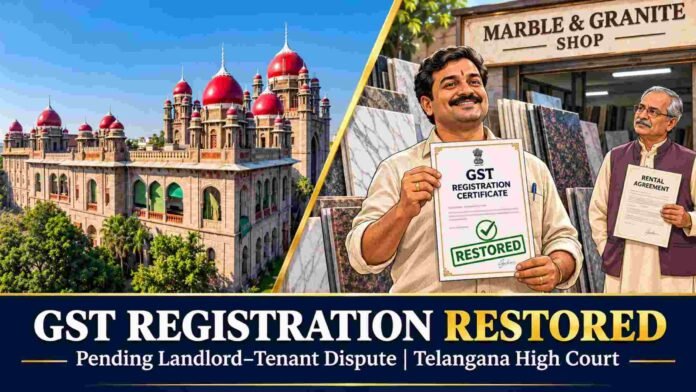
The Telangana High Court has restored the GST registration of a marble and granite trader, holding that its cancellation arising from a dispute over rented business premises was unsustainable while civil suits between the parties remained pending.
The Bench of Acting Chief Justice P. Sam Koshy and Justice Suddala Chalapathi Rao noted that the trader was in possession of the premises as a tenant and no positive restraint order against it had been placed before the Court.
Buy Now: All 200+ GSTAT Judgements Till November 2026 | Comprehensive E-Magazine
The Bench further observed that the petitioner could not be dispossessed without a decree from the competent civil court. However, it preserved the tax departments’ right to take action in accordance with law, subject to the final outcome of the pending civil proceedings.
The petitioner/assessee was engaged in trading marble and granite from rented premises in Hyderabad.
According to the facts recorded in the judgment, the original property owner executed a rental agreement in favour of the petitioner on May 12, 2017. The firm obtained GST registration with effect from July 1, 2017.
The original owner subsequently transferred the property to her son, Dr. B. Venkateshwar Rao, through a registered gift deed dated March 12, 2021.
Disputes later arose between the parties. The petitioner’s proprietor filed O.S. No. 5317 of 2025 before the V Junior Civil Judge, City Civil Court, Hyderabad, seeking a perpetual injunction against the original owner and her son.
The son, in turn, instituted O.S. Nos. 751 and 968 of 2026, seeking a perpetual injunction and eviction of the petitioner, respectively.
He also lodged a complaint with the tax authorities, alleging that the petitioner had obtained GST registration in respect of his property without his express permission or consent.
Acting on the complaint, the authorities issued a show-cause notice. Although the petitioner submitted a reply, the Deputy State Tax Officer passed an order dated September 30, 2026, in Form GST REG-19, cancelling its registration on the grounds of fraud, wilful misstatement or suppression of facts.
The trader challenged that order before the High Court.
GST Authorities Cannot Adjudicate Private Civil Disputes
Counsel for the petitioner argued that the controversy was covered by a coordinate Bench’s common order dated September 2, 2025, in W.P. Nos. 10470 and 10834 of 2020.
That earlier ruling concerned competing claims over property and businesses, with a partition suit pending before a civil court.
The coordinate Bench had held that GST authorities should not adjudicate civil disputes or conflicting claims involving the genuineness and validity of instruments such as wills and questions of succession.
It had observed:
“the appropriate jurisdiction in such matters lies with the Civil Court.”
In those proceedings, the Court revoked interim suspensions of competing GST registrations and left the authorities to take appropriate action in accordance with law after the civil court determined the parties’ rights.
In the present case, the Assistant Government Pleader for State Tax did not dispute the petitioner’s submission that the issue was covered by the earlier decision.
The Division Bench noted that the petitioner was in possession of the premises as a tenant. It also recorded that the parties’ suits for eviction and perpetual injunction remained pending before the competent civil court.
Crucially, no positive restraint orders against the petitioner had been placed on record.
In these circumstances, the Court held that cancellation of the GST registration on the stated grounds of fraud, wilful misstatement or suppression of facts was unsustainable.
The Bench further observed, “the petitioner cannot be dispossessed from the subject premises, without a decree from the Civil Court.”
Accordingly, it concluded that the cancellation order was liable to be set aside.
The High Court set aside the cancellation order dated September 30, 2026, and expressly restored the petitioner’s GST registration.
The Court clarified that its decision would not prevent the respondent authorities from taking action in accordance with law, subject to the final outcome and adjudication of the pending civil suits.
Membership Required to Access Case Details & Order Copy
To view the complete Case Details and Download Order Copy, you must have an active membership. Please subscribe to continue.
Read More: Import IGST Credit Can’t Be Denied Solely Over ICEGATE–GSTN Glitches: Bombay High Court

