
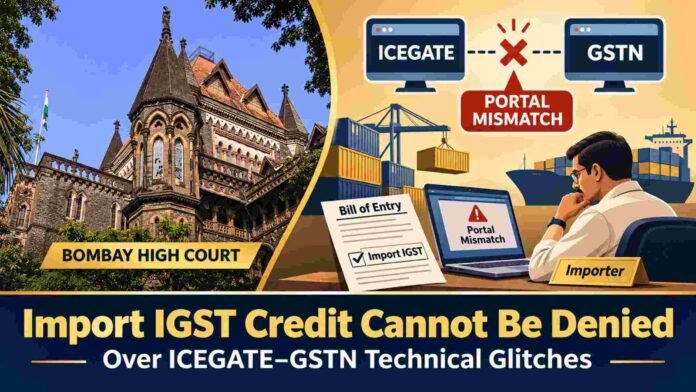
The Bombay High Court has held that a taxpayer cannot be made to suffer for technical failures in the integration between ICEGATE and GSTN, while setting aside orders concerning input tax credit on imported goods.
The Bench of Justice M. S. Karnik and Justice Sandesh D. Patil directed the authorities to reconcile and give due consideration to the import IGST by duly reflecting it in the petitioner’s Electronic Credit Ledger and called for fresh consideration of the matter while expressly keeping the merits and all parties’ contentions open.
Buy Now: All 200+ GSTAT Judgements Till November 2026 | Comprehensive E-Magazine
The dispute involved ₹1,19,38,621 in Integrated Goods and Services Tax (IGST) paid on imports during financial year 2019–2020, which had not been correctly reflected on the GST portal.
Maksur Analytical Systems approached the High Court seeking reconciliation of IGST paid at the point of entry on imported goods and corresponding reflection of the amount in its Electronic Credit Ledger.
The petitioner submitted that details of import IGST payments were required to be transmitted electronically from ICEGATE to the GST system. However, technical problems in the integration between ICEGATE and GSTN prevented the payments from being correctly reflected on the GST portal.
According to the petitioner, the discrepancy did not arise from any omission, misstatement or default on its part. It was attributable entirely to a failure of the electronic systems maintained by the authorities.
In response to a discrepancy notice for financial year 2019–2020, the petitioner stated that it had furnished complete details of the IGST paid on imports, supported by Bills of Entry and reconciliation statements.
Despite these records, the authorities allegedly failed either to rectify the technical problem or to reconcile the tax payments with the input tax credit, manually or electronically.
The petitioner argued that the authorities instead proceeded on incomplete and inaccurate system-generated information without properly considering the documentary evidence.
The petitioner challenged the adjudication order dated August 29, 2024, and the appellate order dated January 29, 2026.
It contended that the orders effectively imposed a double financial burden: IGST had already been paid when the goods were imported, but the corresponding credit was denied because the payment was not correctly reflected in the electronic system.
The petitioner sought the setting aside of these orders and reconsideration after proper reconciliation. It also relied on the Calcutta High Court’s judgment in Amar Iron Udyog Pvt. Ltd. v. Union of India, reported as 2026 SCC OnLine Cal 6356.
The Revenue opposed the petition, submitting that the impugned order had been passed in accordance with law and required no interference.
After hearing the parties, the High Court observed that the non-reflection of IGST prima facie resulted from a failure of integration between ICEGATE and GSTN.
The Bench noted that both electronic systems were maintained and controlled by the respondent authorities. The petitioner admittedly had no role in transmitting information between them.
“The Petitioner therefore cannot be made to suffer for technical or systematic lapses attributable to the Authorities themselves,” the Court observed.
The Bench found the impugned orders unsustainable on their face because they were based solely on the non-reflection of IGST on the GST portal.
The High Court recorded that the petitioner had produced documents supporting the payment of tax.
In these circumstances, the Bench considered the denial of input tax credit on the technical ground improper. It found it necessary to quash the orders and remit the matter to the authorities for a fresh decision, giving the petitioner an opportunity to place all documents supporting its case before them.
Membership Required to Access Case Details & Order Copy
To view the complete Case Details and Download Order Copy, you must have an active membership. Please subscribe to continue.

