
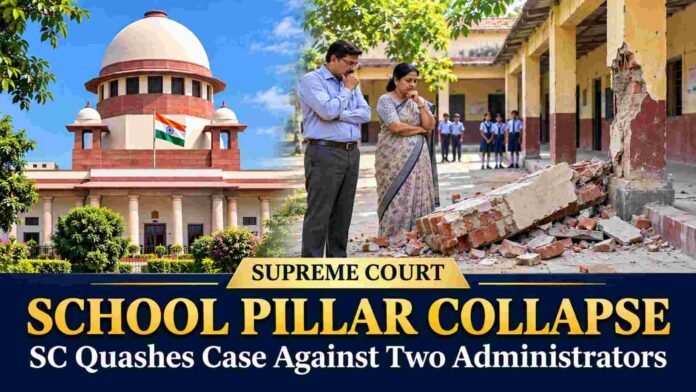
The Supreme Court has quashed criminal proceedings against the president and superintendent of a school in Maharashtra over the death of a 12-year-old student after a pillar collapsed on her, holding that their alleged failure to ensure proper construction did not establish the ingredients of culpable homicide or causing death by negligence.
A Bench of Justice J.B. Pardiwala and Justice Manmohan held that the conduct attributed to the two administrators was not the immediate and effective cause of the death. It also found that the material did not disclose the knowledge necessary to prosecute them for culpable homicide under Section 304 of the Indian Penal Code.
Buy Now: 90+ Supreme Court Judgments E-Magazine – October 2026
Allowing the appeal, the Court quashed the proceedings arising from Chargesheet No. 15 of 2020 only against the two appellants. It expressly permitted the trial to continue against any other co-accused in accordance with law.
Background: Student Died After Pillar Collapsed At School
The case concerned Bharti, a Class VII student residing at the hostel of an Adivasi Ashram Shala at Mangrul Chawala in Maharashtra’s Amravati district.
According to the complaint reproduced in the judgment, a teacher approached her father on February 15, 2020, and informed him that his daughter was unwell. The parents accompanied the teacher to hospital, where they learnt that a cement-and-brick pillar had collapsed on their daughter and other girls.
Bharti suffered a head injury and died during treatment. Other students sustained injuries.
Her father lodged an FIR on February 19, 2020, alleging that the pillar had been constructed using substandard material and without adequate precautions. Following investigation, the school’s president and superintendent were chargesheeted under Section 304 read with Section 34 IPC.
The administrators approached the High Court seeking quashing of the proceedings. They contended that even if the prosecution’s allegations were accepted entirely, the ingredients of culpable homicide not amounting to murder were absent.
The High Court rejected their application on February 25, 2026, prompting the appeal before the Supreme Court.
Why The High Court Had Allowed The Prosecution To Continue
The High Court relied on investigation material concerning the construction samples and the absence of a proper foundation around the pillar.
It considered the material sufficient to indicate that the administrators had breached their duty of care. Although there was no intention to cause death, the High Court reasoned that using substandard material and failing to prepare a proper base involved knowledge that harm or death could result.
The Supreme Court disagreed with the conclusion that these circumstances justified the criminal prosecution of the two administrators.
Appellants Disputed Knowledge And Direct Causation
Advocate Kuldeep Jauhari, appearing for the appellants, submitted that the chargesheet did not disclose the knowledge required for an offence under Section 304 Part II IPC.
He argued that the prosecution rested on the appellants’ positions as responsible office-bearers and their alleged failure to exercise sufficient care during construction.
The appellants also opposed prosecution under Section 304A IPC. Their counsel submitted that alleged inaction forming one link in the events preceding a death was insufficient: the prosecution had to establish that their conduct was its direct and effective cause.
For Maharashtra, advocate Aaditya Aniruddha Pande argued that the Court should examine only whether a prima facie case existed at the quashing stage, without weighing the evidence as it would after trial.
The State alternatively submitted that proceedings should continue at least under Section 304A, leaving the trial court to determine the appropriate offence.
Section 304 Requires The Necessary Intention Or Knowledge
The Supreme Court explained that Section 304 distinguishes between acts involving the requisite intention and those involving knowledge that death is likely to result.
Part I concerns intention to cause death or bodily injury likely to cause death. Part II addresses acts committed with knowledge that they are likely to cause death, without the intention contemplated by the provision.
On the facts before it, the Bench found that the case against the administrators did not disclose harm intentionally or knowingly inflicted, or directly and wilfully caused.
The Court held that the mere failure to meet the prescribed standard of care, resulting in the breach of duty identified by the High Court, did not establish the criminal act alleged against these appellants.
It observed that the contractor entrusted with construction could, at the most, be prima facie negligent because poor construction could result in an accident or casualty. That circumstance did not itself establish the necessary knowledge against the school’s president and superintendent.
Section 304A Requires Negligence To Be The Effective Cause Of Death
The Bench separately considered whether the administrators should face trial under Section 304A IPC, which concerns death caused by a rash or negligent act not amounting to culpable homicide.
It emphasised that the alleged rash or negligent conduct must be the proximate and efficient cause of death. A remote connection with the occurrence does not by itself meet that requirement.
The judgment examined the distinction between causa causans, meaning the immediate and effective cause, and causa sine qua non, a condition without which an event might not have occurred.
The Court also considered whether an intervening cause had broken the chain of causation.
Applying these principles, the Bench held that the act attributed to the administrators was not the causa causans. It found that an intervening cause had broken the chain, making their alleged negligent conduct something other than the immediate cause of the student’s death.
It consequently rejected the State’s alternative submission that these appellants should face trial under Section 304A.
Civil Negligence Does Not Automatically Establish Criminal Liability
Drawing on earlier decisions, the Court reiterated that negligence sufficient to support civil liability does not automatically amount to a criminal offence.
Criminal negligence requires a higher degree of culpability. The inquiry must address the nature and degree of the accused’s conduct and its causal connection with the death.
The judgment discussed authorities including Sushil Ansal v. State through Central Bureau of Investigation, Kurban Hussein Mohamedalli Rangawalla v. State of Maharashtra and Dr. P.B. Desai v. State of Maharashtra. It also referred to the principles in Jacob Mathew v. State of Punjab distinguishing civil negligence from gross or culpable negligence attracting criminal punishment.
The Court did not decide a claim for civil compensation. Its ruling concerned the sustainability of the criminal proceedings against the two administrators.
Contractor’s Responsibility Left Subject To Trial Evidence
The Supreme Court held that the appellants stood on a different footing from any other accused and should not be required to face trial under either Section 304 or Section 304A IPC.
Its observation identifying the contractor as the person who could, at the most, be prima facie responsible was expressly qualified. The Court stated that this remained subject to the evidence led at trial, if the contractor was also an accused.
The judgment therefore did not record a final finding of guilt against the contractor or terminate the prosecution against every person connected with the incident.
Court Acknowledges Parents’ Anguish, Quashes Case Against Administrators
The Bench acknowledged the pain caused by the death of a child beneath a pillar at her own school and the continuing suffering of her parents.
Nevertheless, it stressed that the tragedy could not displace the legal requirements governing criminal responsibility.
The Court allowed the appeal and quashed the proceedings arising from Chargesheet No. 15 of 2020 against the school’s president and superintendent, while permitting proceedings against any other co-accused to continue in accordance with law.
Membership Required to Access Case Details & Order Copy
To view the complete Case Details and Download Order Copy, you must have an active membership. Please subscribe to continue.

