
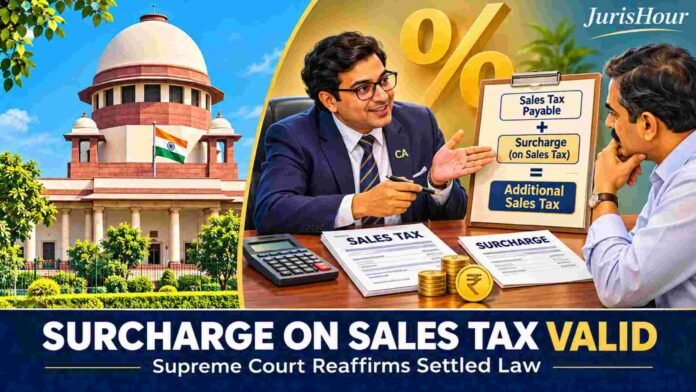
The Supreme Court has reaffirmed that an additional sales tax or surcharge calculated as a percentage of sales tax payable remains a tax on the sale or purchase of goods. The method of calculation does not, by itself, place the levy beyond the State Legislature’s constitutional authority.
A seven-judge Bench of dealing with a long-pending reference arising from sales tax disputes in Odisha and Punjab, held that the Constitution Bench ruling in S. Kodar v. State of Kerala continues to govern the issue.
The bench concluded that the perceived conflict between earlier decisions no longer required adjudication by a larger Bench. It answered the reference as infructuous and directed that the individual cases be placed before appropriate regular benches.
Buy Now: 90+ Supreme Court Judgments E-Magazine – October 2026
The ruling settles the common objection to surcharges calculated on sales tax payable, while leaving several distinct statutory and assessment-related questions open.
The central question was whether States could impose a surcharge measured by the sales tax already payable by a dealer, rather than directly by the dealer’s turnover.
The assessees argued that such a levy amounted to a “tax on tax” and fell outside Entry 54 of List II of the Seventh Schedule, as it stood during the relevant period. According to them, the surcharge effectively burdened the dealer’s income or existing fiscal liability, rather than the sale or purchase of goods.
The States maintained that the surcharge merely increased the rate of sales tax for a specified class of dealers. Using the original tax liability to calculate the additional amount, they argued, did not change the taxable event.
The reference had travelled from a two-judge Bench to a Constitution Bench and subsequently to a seven-judge Bench over nearly three decades.
Odisha Levy Applied to Dealers Crossing ₹10 Lakh Turnover
The lead proceedings concerned Section 5-A of the Orissa Sales Tax Act, 1947, inserted with effect from July 1, 1990.
The provision required dealers whose gross turnover exceeded ₹10 lakh to pay a surcharge equal to 10% of the total tax payable under the Act.
The Court explained that the surcharge attached to the underlying sales tax liability. It increased or decreased in direct proportion to the sales tax payable, which itself depended on taxable turnover.
The dispute therefore centred on whether calculating the surcharge by reference to the existing tax altered its essential constitutional character.
Punjab Cases Raised Separate Issues
The connected Punjab proceedings involved Section 5(1-C) of the Punjab General Sales Tax Act, 1948, which similarly imposed a 10% surcharge calculated on the tax payable.
An additional issue arose under Section 30-AA. That provision required industrial units otherwise exempted from sales tax under Section 30-A to pay the surcharge.
This raised the question whether a surcharge linked to tax payable could be imposed on an industrial unit enjoying exemption from the underlying sales tax. The Supreme Court expressly left this question open.
Another group of cases concerned the Punjab Social Security Act, 2000. The cess under that enactment was calculated as a percentage of sales tax payable, with its proceeds earmarked for social security measures.
The Punjab and Haryana High Court had struck down the enactment, holding, among other things, that the proceeds could not be credited directly to the Punjab Social Security Fund without first forming part of the State’s Consolidated Fund under Article 266 of the Constitution.
The Supreme Court left this constitutional question open for separate consideration.
Calculation Method Does Not Change the Nature of the Tax
The Court reaffirmed the distinction between the subject of a tax and the measure used to calculate it.
A surcharge computed as a percentage of sales tax payable can remain an enhancement of sales tax. The arithmetic used to calculate the additional liability does not automatically create a different taxable subject.
The Court relied on S. Kodar v. State of Kerala, (1974) 4 SCC 422, which upheld an additional sales tax measured by reference to the sales tax imposed.
The decision establishes that such an additional levy falls within the legislative power to tax the sale or purchase of goods under the former Entry 54 of List II.
The Court also reaffirmed that a restriction on passing the additional levy to consumers does not necessarily convert it into a tax on the dealer’s income. The character of the levy depends on its substance and connection with the taxable transaction.
No Surviving Conflict Requiring Reconsideration of S. Kodar
The reference involved earlier decisions, including Hoechst Pharmaceuticals Ltd. v. State of Bihar and India Cement Ltd. v. State of Tamil Nadu.
The Court explained that India Cement concerned a cess on royalty and legislative competence in the mineral development field. It did not establish a general prohibition against a levy merely because it was calculated as a percentage of another tax.
The nine-judge decision in Mineral Area Development Authority v. Steel Authority of India Ltd., (2024) 10 SCC 1, had subsequently overruled the proposition in India Cement that royalty is a tax.
Consequently, the Court found no surviving conflict requiring reconsideration of S. Kodar. The Constitution Bench precedent continues to govern the States’ legislative competence to impose the sales tax surcharges in question.
The Court also noted that the constitutional and statutory framework underlying the reference had changed during its pendency.
Entry 54, in the form that conferred a general power on States to tax the sale or purchase of goods, had been substituted. The sales tax enactments involved had also been replaced through the transition to VAT and subsequently GST.
These developments reduced the prospective significance of the reference.
However, the Court recognised that the individual assessees continued to have a practical stake in their appeals because liabilities relating to past assessment periods could still be enforced.
Their claims must therefore be determined by regular benches applying the settled law. Treating the larger Bench reference as infructuous does not extinguish the pending appeals.
The Supreme Court directed that the lead matter and connected cases be listed before appropriate regular benches after obtaining administrative directions from the Chief Justice of India.
Membership Required to Access Case Details & Order Copy
To view the complete Case Details and Download Order Copy, you must have an active membership. Please subscribe to continue.

