
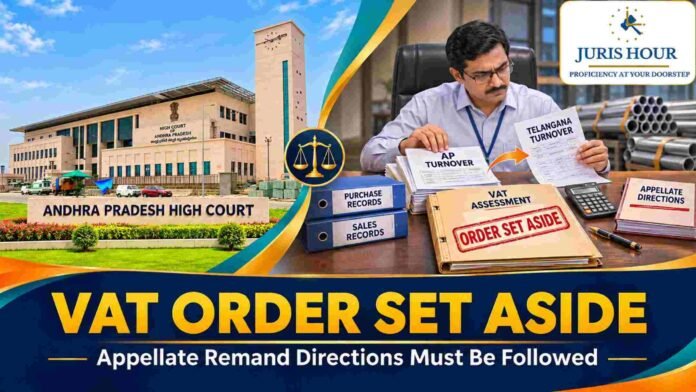
The Andhra Pradesh High Court has set aside a consequential VAT assessment order after finding that the assessing officer mechanically confirmed the original demand without complying with appellate directions to exclude Telangana-related purchase and sale turnovers from Andhra Pradesh’s assessable turnovers.
The Bench of Justice Ninala Jayasurya and Justice T.C.D. Sekhar found that the officer had neither properly verified the relevant turnover nor taken steps to obtain documents already submitted before the appellate authority.
Buy Now: All 200+ GSTAT Judgements Till November 2026 | Comprehensive E-Magazine
The bench directed the authority to issue a fresh notice, receive supporting documents and provide a hearing before passing an appropriate order.
The petitioner, a registered VAT dealer engaged in trading steel pipes, received a show cause notice dated August 6, 2018, proposing disallowance of input tax credit for 2014–15.
A revised show cause notice dated March 16, 2019, restricted the proposed disallowance to ₹55,83,514. As the dealer could not file objections, the assessing authority passed an assessment order on October 28, 2019, confirming the proposal.
The dealer challenged that order before the first appellate authority. By an order dated December 31, 2021, the appellate authority remanded the matter with a specific direction to reduce the purchase and sale turnovers relating to Telangana from Andhra Pradesh’s assessable turnovers.
The appellate authority had identified an anomaly in the adoption of turnovers recorded in income-tax returns, which conflicted with the dealer’s stated turnover and returns. It directed verification and rectification after considering the dealer’s explanations and evidence.
After excluding Telangana-related turnovers, the assessing authority remained free to assess any remaining variations in purchase and sale turnovers relating to Andhra Pradesh under the A.P. VAT Act.
Tribunal Appeal Raised Unanswered Limitation Objection
The dealer subsequently approached the Andhra Pradesh Value Added Tax Appellate Tribunal by filing an appeal on March 31, 2022.
Its grievance was that the first appellate authority had not recorded any finding on the limitation objection raised against the assessment. Along with the appeal, the dealer filed an application seeking a stay of the remand proceedings.
The assessing authority issued notices dated March 17, 2022, and December 17, 2022, to pass consequential orders pursuant to the remand.
Through replies dated December 28, 2022, and January 18, 2023, the dealer informed the authority about the pending Tribunal appeal. However, the officer passed a consequential assessment order on February 28, 2023, confirming the original demand.
That consequential order was challenged before the High Court.
The department defended the order on the ground that the dealer had not submitted the DCB report and VAT return report downloaded from the Telangana VATIS Portal despite repeated notices.
The assessing officer’s order acknowledged that the dealer had furnished Telangana VAT 200 returns, the DCB report and the VAT return report during the appellate proceedings.
Nevertheless, the officer proceeded on the basis that these records had not been submitted before the assessing authority and confirmed the original assessment demand.
The High Court observed that the appellate order clearly required the assessing authority to exclude Telangana-related purchase and sale turnovers and verify the dealer’s claim using the relevant records.
The inclusion of Telangana turnover in the original assessment had already been found fault with by the appellate authority. Despite acknowledging the remand directions, the officer had again confirmed the original assessment.
The Bench held that the consequential order was liable to be set aside because it had not been passed in accordance with those directions.
The Court emphasised that the dealer had already submitted the relevant material, including the DCB report and VAT return report downloaded from the Telangana VATIS Portal, before the appellate authority.
Nothing was placed on record to explain why the assessing officer had not taken steps to obtain those documents.
The Bench observed that, in the normal course, when an appellate authority remands a matter, the entire file along with its supporting documents would be sent to the primary authority for verification.
In the present case, the assessing officer had taken no steps to obtain the appeal file. The consequential order also contained no finding disputing the appellate directions.
The Court further found that the officer had failed to verify the dealer’s Telangana-related turnover and had passed the order mechanically, without application of mind and in a hasty manner.
Membership Required to Access Case Details & Order Copy
To view the complete Case Details and Download Order Copy, you must have an active membership. Please subscribe to continue.
Read More: GST Sanction Objection Can’t Invalidate Entire FIR Also Alleging BNS Offences: Calcutta High Court

