
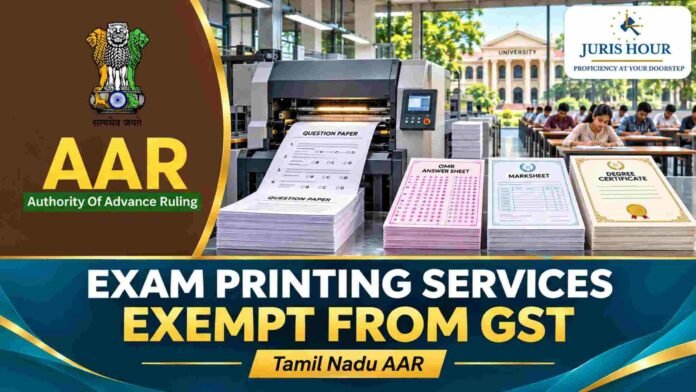
The Tamil Nadu Authority for Advance Ruling (AAR) has held that printing and supplying examination-related materials to educational institutions constitutes a supply of services and qualifies for GST exemption when the services relate to the conduct of examinations.
The bench of R.V. Pradhamesh Bhanu, Member (CGST), and B. Suseel Kumar, Member (SGST) has observed that the processing and scanning of results, printing of marksheets, certificates, etc. are essential in completing a qualification recognised by any law for time being in force. Therefore, the activity undertaken towards the post-examination process is also in relation to conduct of examination and all the reasons discussed for the pre-examination process are applicable to this part also. Hence, the post examination items (including its transportation and delivery) like marks sheets, grade sheets, degree certificates, scanning and processing of results etc. are exempt from tax as per Sl. No. 66 of the Notification No. 12/2017-Central Tax (Rate) dated 28.06.2017, as amended.
Buy Now: 210+ GST Judgments E-Magazine – October 2026
The ruling covers pre-examination work such as printing question papers, hall tickets, OMR sheets and answer booklets, as well as post-examination activities including printing marksheets, grade sheets, rank sheets and degree certificates, scanning OMR sheets and processing examination results.
The Chennai-based applicant provides pre-examination and post-examination printing services to educational boards and universities. It informed the authority that it was charging 18% GST, comprising 9% CGST and 9% SGST, on services supplied to various universities.
The educational institutions provide the content, designs, logos, barcode information and other details required for printing. The applicant prints the materials according to these specifications and arranges their transportation and delivery to the institutions or examination centres.
Its pre-examination activities include printing hall tickets, question papers and answer booklets with or without OMR. Post-examination work includes printing marksheets, grade sheets, rank sheets or rank cards and degree certificates, along with scanning and processing OMR sheets, examination data and results.
At the personal hearing, the applicant’s authorised representative explained that some clients, including universities recognised by the UGC, had informed the company that these services were exempt from GST. The applicant therefore sought clarity on their classification and eligibility for exemption.
The applicant asked whether printing and supplying examination-related items should be classified as a supply of goods or a supply of services.
It also sought a ruling on whether pre-examination printing and supply, including transportation and delivery, qualified for exemption under Serial No. 66 of Notification No. 12/2017-Central Tax (Rate), dated June 28, 2017.
The third question concerned the same exemption for post-examination printing, packing and supply, including marksheets, grade sheets, rank sheets and degree certificates, as well as OMR scanning and processing of results or data relating to examinations.
Examining the classification issue, the AAR noted that the applicant’s activity involved both goods, in the form of paper, and the service of printing. These elements were supplied together and constituted a composite supply under Section 2(30) of the CGST Act, 2017.
The authority then considered which element constituted the principal supply under Section 2(90). It observed that educational institutions approached the applicant to print examination content owned and supplied by them. Their purpose in engaging the applicant was to obtain printing services; the supply of paper was incidental to that purpose.
Ownership of the content remained with the educational institution throughout the activity, while the physical inputs belonged to the applicant. The authority consequently held that printing was the predominant element of the composite supply.
The AAR relied on CBIC Circular No. 11/11/2017-GST, dated October 20, 2017, which explains the classification of printing arrangements where the recipient supplies the content and the printer provides physical inputs, including paper.
Applying this clarification, the authority concluded that printing question papers and similar examination materials constituted a supply of services falling under Heading 9989 of the scheme of classification of services.
On the exemption question, the AAR examined Serial No. 66(b)(iv) of Notification No. 12/2017-Central Tax (Rate), as amended. The entry exempts services provided to an educational institution relating to admission to, or the conduct of examination by, that institution.
The authority referred to the notification’s definition of an educational institution, which includes institutions providing education as part of a curriculum leading to a qualification recognised by law, besides the other categories specified in the notification.
It also considered CBIC Circular No. 151/07/2021-GST, dated June 17, 2021. As discussed in the ruling, the circular clarifies the exemption for examination-related services supplied to educational institutions and the treatment of Central and State Educational Boards as educational institutions for the limited purpose of conducting examinations for students.
The AAR held that the applicant could claim the exemption for printing pre-examination materials supplied to educational institutions for conducting examinations. The operative ruling expressly covers hall tickets, question papers, OMR sheets and answer booklets.
The authority separately examined whether the exemption extended to activities undertaken after an examination, including result processing and printing certificates.
The applicant argued that these activities formed an integral part of the examination process. It submitted that printing marksheets, grade sheets and degree certificates, along with scanning and processing results, represented the final stage of that process.
The AAR accepted that processing and scanning results and printing marksheets and certificates were essential to completing a qualification recognised by law. It therefore treated post-examination work as services relating to the conduct of examinations.
Accordingly, the authority held that the exemption extended to post-examination items and activities, including marksheets, grade sheets, rank sheets, rank cards and degree certificates, together with OMR scanning and data processing supplied to educational institutions in relation to examinations. Its reasoning also addressed transportation and delivery forming part of the post-examination supply described in the application.
Membership Required to Access Case Details & Order Copy
To view the complete Case Details and Download Order Copy, you must have an active membership. Please subscribe to continue.

