
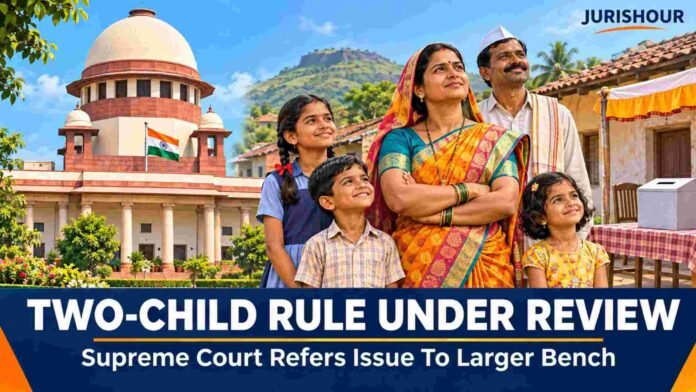
The Supreme Court has called for reconsideration of its 2003 judgment upholding the disqualification of persons with more than two children from contesting panchayat elections, observing that declining fertility and evolving constitutional protections have undermined the basis for such restrictions.
A Bench of Justice Pamidighantam Sri Narasimha and Justice Alok Aradhe referred the matter to a larger Bench while hearing an appeal concerning the disqualification of an elected Sarpanch in Maharashtra.
“We are of the strong opinion that laws that penalise having more than two children have lost their relevance,” the Bench observed.
However, the Court did not strike down the Maharashtra provision or overrule the earlier precedent. It directed that the matter be placed before the Chief Justice of India for constitution of an appropriate Bench and continued interim protection allowing the appellant to remain in her elected position.
Buy Now: 90+ Supreme Court Judgments E-Magazine – October 2026
Background: Sarpanch Disqualified For Having A Third Child
The appeal arose after Mangala Bhimrao Ingle’s election as Sarpanch of Kakoda Gram Panchayat was set aside under Section 14(1)(j-1) of the Maharashtra Village Panchayats Act, 1959, on the ground that she had more than two children.
According to the judgment, the appellant gave birth to a third child in 2014 and subsequently contested and won the Sarpanch election in 2022. Her counsel questioned the conclusiveness of the evidence concerning the third child, raising an objection relating to the place of issue of the birth certificate.
The Supreme Court explained that its concern extended beyond applying the existing provision and governing precedent to those facts. It considered whether the circumstances that originally justified the restriction had changed so substantially that the precedent sustaining such laws required reconsideration.
Why The Javed Judgment Requires A Fresh Look
In Javed v. State of Haryana, (2003) 8 SCC 369, the Supreme Court upheld provisions of the Haryana Panchayati Raj Act, 1994, disqualifying persons with more than two living children from contesting or holding panchayat positions.
That decision accepted population control as a legitimate legislative objective and rejected the equality challenge to the classification. It relied on concerns about population growth, its perceived impact on economic development and the objectives of the National Population Policy, 2000.
The present Bench observed that the demographic assumptions underlying that reasoning could no longer be taken for granted. It considered the decline in fertility sufficiently significant to warrant re-examining the connection between population policy and exclusion from elected office.
Fertility Below Replacement Level Changes Policy Context
Referring to demographic material discussed in the judgment, the Bench noted that India’s Total Fertility Rate had fallen from approximately 3.0 at the time of Javed to 1.9, below the replacement level of about 2.1.
Total Fertility Rate broadly measures the average number of children a woman would have over her reproductive life if prevailing age-specific fertility rates continued. The Court explained that this measure helps distinguish fertility behaviour from the effect of a large population concentrated in childbearing age groups.
The Bench expressly recognised that India’s total population had not begun to decline and that an immediate decline was not expected. It attributed continued growth, in substantial part, to demographic momentum: large generations born during earlier periods of higher fertility are now in their reproductive years.
Nevertheless, the Court warned that sustained low fertility and increasing longevity would alter the country’s age structure. This would increase the proportion of elderly persons and eventually reduce the relative share of the working-age population, with consequences for labour supply, economic growth and public finances.
The Bench emphasised that population policies must respond to these changing conditions.
China’s Experience Highlights Difficulty Of Reversing Fertility Decline
The judgment contrasted the reliance placed on China’s population-control measures in Javed with China’s subsequent relaxation of birth restrictions.
The Bench discussed the move away from the one-child policy towards permitting two and later three children, accompanied by measures supporting childbirth and family welfare. It observed that relaxing restrictions had not, by itself, produced the anticipated revival in births.
The Court treated this experience as a warning against assuming that fertility reduction can readily be reversed when policy priorities change. It also referred to Japan’s experience of population ageing and the associated pressures on public expenditure and care systems.
Family Size And Capacity To Hold Office
Beyond demographic change, the Bench questioned whether the number of children a person has bears a rational connection to their capacity to hold public office.
It observed that electoral disqualification on this basis excludes an entire class of citizens from political representation. The judgment stressed the importance of access to elected office for historically disadvantaged communities and the role of representation in challenging entrenched inequalities.
The Court also questioned the selective application of such restrictions to local government representatives. It noted that although proposals had contemplated a wider two-child norm extending from panchayats to Parliament, no corresponding central restriction had been introduced.
According to the Bench, the causes of higher fertility are complex and cannot fairly be attributed to a particular class merely because its members seek to participate in village-level governance.
Women Bear Disproportionate Consequences
The Bench criticised the reasoning in Javed that men and women were equally affected because both could be disqualified.
It said that such formal equality did not adequately account for social realities. In patriarchal households, a woman may face electoral disqualification because of reproductive decisions over which she has little or no control.
The judgment referred to a Ministry of Panchayati Raj-sponsored study concerning Rajasthan, Madhya Pradesh and Gujarat. It discussed documented consequences associated with the norm, including forced abortions, desertion of pregnant wives and denial of paternity in attempts to avoid disqualification.
The Bench also examined son preference as a factor influencing decisions to have additional children. It emphasised that such attitudes extend across social and economic groups and require broader policy responses.
Reproductive Choices Form Part Of Article 21 Rights
Relying on decisions including Suchita Srivastava v. Chandigarh Administration, K.S. Puttaswamy v. Union of India and X v. Principal Secretary, Health and Family Welfare Department, the Court reiterated that reproductive choice forms part of personal liberty, privacy and dignity under Article 21.
The Bench observed that decisions about whether, when and how many children to have are deeply personal. Although reproductive autonomy is subject to permissible regulation, restrictions must continue to satisfy constitutional scrutiny.
It questioned whether the State could impose adverse political consequences to indirectly coerce choices that it could not ordinarily compel directly.
Disqualification following the birth of a third child, the Court reasoned, places an individual in the position of choosing between reproductive autonomy and participation in democratic governance.
Changed Circumstances Can Require Reconsideration Of Laws
The judgment emphasised that a law considered reasonable when enacted may require reconsideration if its factual foundation changes.
The Bench expressly recorded that the constitutional validity of the Maharashtra provision had not been challenged before it and therefore could not be directly adjudicated in the appeal. Its observations instead supported referring the precedent in Javed for reconsideration.
The Court also examined the influence of Javed on Rajbala v. State of Haryana, which upheld additional qualifications and disqualifications for panchayat elections.
Referring to Sukanya Shantha v. Union of India, the Bench highlighted the need to assess the disproportionate exclusion of marginalised communities rather than confining equality review to the formal wording of a restriction.
Reference To Larger Bench; Sarpanch To Continue Under Interim Order
The Supreme Court directed its Registry to place the judgment and order before the Chief Justice of India to constitute an appropriate Bench for reconsideration of the ratio in Javed.
Membership Required to Access Case Details & Order Copy
To view the complete Case Details and Download Order Copy, you must have an active membership. Please subscribe to continue.

