
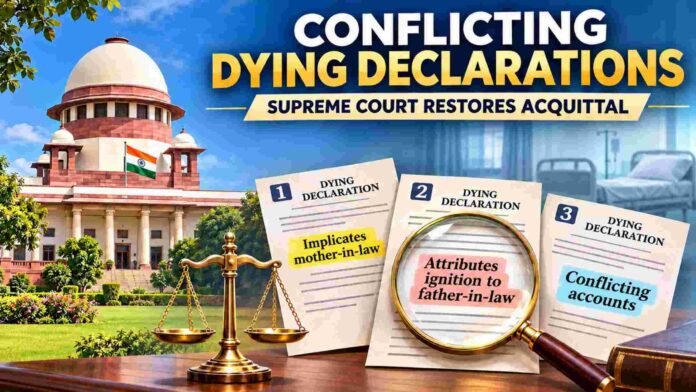
The Supreme Court has set aside the murder conviction of a woman accused of burning her daughter-in-law, holding that the Bombay High Court was not justified in reversing her acquittal by relying on one dying declaration without corroborating evidence when the victim’s other declarations gave a materially different account.
A Bench of Justice Ujjal Bhuyan and Justice Atul S. Chandurkar restored the benefit of doubt granted by the Sessions Court. It also found that, in the circumstances of the case, convicting the mother-in-law alone under Section 302 of the Indian Penal Code, when the prosecution had consistently alleged that four accused committed the murder in furtherance of their common intention, prejudiced her defence.
Buy Now: 90+ Supreme Court Judgments E-Magazine – October 2026
The judgment, authored by Justice Chandurkar, was delivered on November 5, 2026.
Background: Daughter-in-law Died Following Burn Injuries
The prosecution alleged that Sunitabai was subjected to physical and mental ill-treatment by her husband and his family because she had no children. It also alleged demands for dowry and claimed that an earlier understanding between the two families had failed to end the mistreatment.
On April 10, 2005, Sunitabai sustained severe burn injuries at her matrimonial home. She was taken to the Civil Hospital, where she died on April 15, 2005.
Her husband, father-in-law, mother-in-law and brother-in-law were prosecuted for offences under Sections 498A, 342, 406 and 302 read with Section 34 IPC.
The central dispute concerned three dying declarations that attributed different roles to the accused.
Dying Declarations Differed on Who Set the Victim Ablaze
The initial statement recorded in the medico-legal case papers at Exhibit-56 implicated the mother-in-law as the person who poured kerosene on the victim and set her on fire.
However, the subsequent declarations recorded by a police officer and a Special Executive Magistrate, at Exhibits-44 and 48, presented a different account. According to those statements, the husband and brother-in-law tied the victim’s hands and legs, the mother-in-law poured kerosene, and the father-in-law set her ablaze.
The difference over who actually ignited the fire became crucial to the courts’ assessment of the prosecution evidence.
Sessions Court Acquitted All Four Accused
The Sessions Court found material inconsistencies in the dying declarations and identified gaps in the prosecution evidence.
It attached significance to the failure to examine Vishwas Desle, also referred to as Vishwas Patil, who had allegedly rescued the victim and taken her to hospital. The absence of testimony from neighbours and shortcomings in the evidence concerning the allegation that the victim had been restrained with a rope also weighed with the trial court.
The Sessions Court consequently acquitted all four accused.
High Court Convicted Mother-in-law on the Hospital Statement
On the State’s appeal, the Bombay High Court’s Aurangabad Bench accepted the statement recorded by Dr. Prashant Shinde in the medico-legal case papers. It considered that account voluntary and truthful while rejecting the subsequent dying declarations as inconsistent with it.
The High Court also relied on the defence position that only the mother-in-law and the victim were inside the house when the incident occurred. It concluded that the mother-in-law alone had poured kerosene and set the victim on fire.
By its judgment dated September 28, 2017, the High Court convicted her under Section 302 IPC and sentenced her to rigorous imprisonment for life, along with a fine of ₹25,000. It maintained the acquittal of the other three accused and the acquittals on the remaining charges.
Corroboration Was Necessary in the Circumstances: Supreme Court
The Supreme Court noted that both the Sessions Court and the High Court had rejected the dying declarations recorded by the police officer and the Special Executive Magistrate. The prosecution had not challenged that finding.
The conviction therefore rested solely on the doctor’s deposition and the statement contained in the medico-legal papers.
The Bench held that, having found the declarations inconsistent, the High Court should have looked for corroborative material before accepting Exhibit-56 as the basis for reversing the acquittal. It also took into account the extensive burn injuries, which the treating doctor assessed at 94%.
The Court’s conclusion concerned the particular evidentiary circumstances of the case: conflicting declarations, the absence of corroboration and an existing acquittal. On that record, the hospital statement could not alone justify reversing the trial court’s decision.
Non-examination of the Rescuer Was a Material Gap
The Supreme Court attached particular importance to the prosecution’s failure to examine Vishwas Desle.
The investigating officer had acknowledged that he was the first person to reach the house, extinguish the fire and take the victim to hospital. Although his statement had been recorded during the investigation, no reason was furnished for not examining him at trial.
According to the medical officer, he was also present when the victim’s history was recorded in the medico-legal papers. His testimony was therefore relevant to assessing the reliability of the statement on which the High Court based the conviction.
The Bench further observed that he could have provided material evidence concerning the allegation that the victim had been restrained with a rope.
While the High Court had treated his non-examination as having no adverse effect on the prosecution case, the Supreme Court held that he was a material witness whose absence required consideration.
Convicting One Accused on a Different Basis Prejudiced Her Defence
The Supreme Court separately examined the difference between the prosecution’s charge and the basis on which the High Court ultimately convicted the mother-in-law.
The charge alleged that all four accused had caused the victim’s death in furtherance of their common intention. No independent charge under Section 302 IPC alone had been framed against the mother-in-law.
The Bench observed that the defence statement concerning her presence in the house had been made in response to that joint accusation. Using it to conclude that she alone had poured kerosene and ignited the fire amounted, in the facts of this case, to making out a new accusation with which she had never been charged.
The Court stated that the position would have been different had an independent murder charge also been framed against her. Since the prosecution’s case throughout alleged the involvement of all four accused acting together, the High Court’s approach prejudiced her defence.
Acquittal Strengthened the Presumption of Innocence
The Supreme Court held that the Sessions Court’s view could not be characterised as perverse or illegal.
The inconsistencies in the three dying declarations justified extending the benefit of doubt. The High Court should have given due consideration to that assessment before overturning the acquittal.
The Bench emphasised that the presumption of innocence in the mother-in-law’s favour had been strengthened by her acquittal. The uncorroborated hospital statement did not justify displacing the trial court’s conclusion on the evidence available.
High Court Also Failed to Hear Her on Sentence
The Supreme Court identified an additional procedural infirmity: after reversing the acquittal and convicting the mother-in-law, the High Court had not heard her on the quantum of sentence, as required by Section 386(a) of the Code of Criminal Procedure.
However, since the conviction itself was being set aside, the Bench stated that nothing further turned on that defect.
Conviction Quashed; Immediate Release Ordered
Allowing the appeal, the Supreme Court quashed the Bombay High Court’s judgment in Criminal Appeal No.63 of 2008 and acquitted the mother-in-law of the offence under Section 302 IPC.
Membership Required to Access Case Details & Order Copy
To view the complete Case Details and Download Order Copy, you must have an active membership. Please subscribe to continue.
Read More: GST Refund Reform: Input Services Brought Into Focus, Legislative Alignment Remains Crucial

