
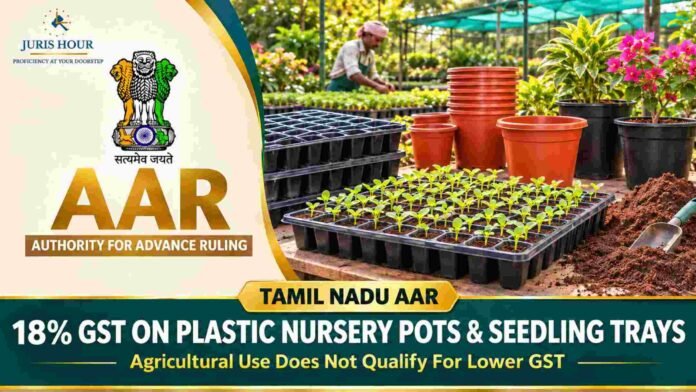
The Tamil Nadu Authority for Advance Ruling (AAR) has held that plastic nursery pots, pots for flowering plants and seedling trays attract 18% GST under Heading 3926, rejecting the contention that their use in agriculture and horticulture qualifies them for exemption or a concessional rate as agricultural implements.
The bench of R.V. Pradhamesh Bhanu and B. Suseel Kumar differentiated the classification according to the material used, holding that nursery pots and seedling trays made from polypropylene fall under HSN 39269080, while those made from high-density polyethylene (HDPE) fall under HSN 39269099.
Buy Now: 210+ GST Judgments E-Magazine – October 2026
Background Of The Application
The Chennai-based applicant manufactures plastic nursery pots, pots for flowering plants and seedling trays using polypropylene and HDPE. The products are used to raise seedlings of crops, vegetables and other plants in nurseries before transplantation.
According to the application, the goods are manufactured through injection moulding and thermoforming of plastic granules. The company either manufactures them itself or supplies raw materials to third parties for manufacture on a job-work basis.
The applicant described the products as reusable, lightweight, durable and recyclable. They are supplied to farmers, horticulturists, government horticulture departments, agricultural universities under subsidy schemes, nurseries and plantations.
Seeking clarity on classification and tax treatment, the company asked whether the goods should be treated as articles of plastic under Heading 3926, agricultural or horticultural hand tools under Heading 8201, or agricultural and horticultural machinery under Heading 8436.
It also sought a ruling on the applicable GST rate and whether Schedule I of Notification No. 9/2025-Central Tax (Rate), dated September 17, 2025, applied.
Applicant Relied On Exclusive Agricultural Use And Earlier VAT Exemption
The applicant argued that classification should take account of the products’ primary function and end-use, rather than their material alone. It submitted that raising seedlings is an essential stage of agricultural production and that the products aid propagation, root development and transplantation.
The company maintained that the goods were specifically designed for agriculture and horticulture rather than general household use. It therefore sought their treatment as agricultural implements or horticultural tools eligible for exemption or a lower GST rate.
The applicant also relied on the treatment of similar products under the erstwhile Tamil Nadu Value Added Tax regime. It referred to a departmental clarification and the notified list of agricultural implements under which such products had been exempted.
It argued that the earlier treatment should continue where the characteristics and end-use remained unchanged, and that taxing the products at 18% would increase costs for farmers.
Tariff Headings And Notes Govern Classification
The Authority examined the competing headings by applying Rule 1 of the General Rules for the Interpretation of the Customs Tariff.
It explained that classification must first be determined according to the terms of the tariff headings and the relevant Section and Chapter Notes. Subsequent interpretative rules are considered only where the headings and notes do not otherwise resolve the classification.
Applying this approach, the AAR rejected classification under Headings 8201 and 8436 and held that the products were covered by Heading 3926.
Polypropylene And HDPE Products Assigned Different HSN Codes
The Authority noted that Heading 3926 covers other articles of plastics and articles of materials falling under Headings 3901 to 3914.
The goods did not fall within the specifically listed categories such as office or school supplies, apparel accessories, furniture fittings or ornamental articles. The Authority therefore examined the residual subheadings under 392690.
It found that polypropylene articles not elsewhere specified or included are specifically covered by HSN 39269080. Nursery pots and seedling trays made from polypropylene were accordingly classified under that code.
The corresponding HDPE products were classified under HSN 39269099.
Plastic Products Do Not Qualify As Agricultural Hand Tools
Rejecting Heading 8201, the AAR observed that Chapter 82 falls within Section XV of the Customs Tariff, which concerns base metals and articles of base metals.
The products before it were made from polypropylene and HDPE rather than base metals. Consequently, the Authority held that they could not be classified under Chapter 82 or Heading 8201.
Their use in cultivation did not overcome the requirements of the relevant tariff provisions.
Seedling Trays Are Not Parts Of Transplanting Machinery
The Authority also examined samples to determine whether the goods could fall under Heading 8436.
It found that the nursery and flowering-plant pots were simple moulded plastic articles with drainage holes, used to hold soil for growing plants. The seedling trays similarly held suitable soil and allowed water drainage.
As seedlings grow, their roots intertwine to form a mat. These mats are then removed from the trays and either planted manually or placed in transplanting machinery.
The AAR drew a distinction between the trays and the seedling mats: transplanting machinery uses the mats grown in the trays, rather than the trays themselves.
It therefore concluded that the products were neither parts of agricultural machinery nor used with such machinery in the manner required for classification under Chapter 84 and Heading 8436.
The AAR referred to Serial No. 127 of Schedule II of Notification No. 9/2025-Central Tax (Rate), dated September 17, 2025, covering other articles of plastics under Heading 3926, subject to the exclusions specified in that entry.
It held that the applicable central tax rate was 9%, resulting in a total GST rate of 18%.
The Authority expressly rejected the claim that the goods qualified as agricultural implements or horticultural tools eligible for exemption or a lower rate. It also answered in the negative the question concerning the applicability of Schedule I of the September 2025 notification.
The applicant’s reliance on the earlier TNVAT exemption was rejected; the Authority determined classification and tax treatment under the GST tariff provisions and notification examined in the ruling.
Membership Required to Access Case Details & Order Copy
To view the complete Case Details and Download Order Copy, you must have an active membership. Please subscribe to continue.
Read More: Reassessment Beyond 3 Years Over Rs. 10.20 Lakh Transaction Fails: CIT(A) Allows Legal Heir’s Appeal

