
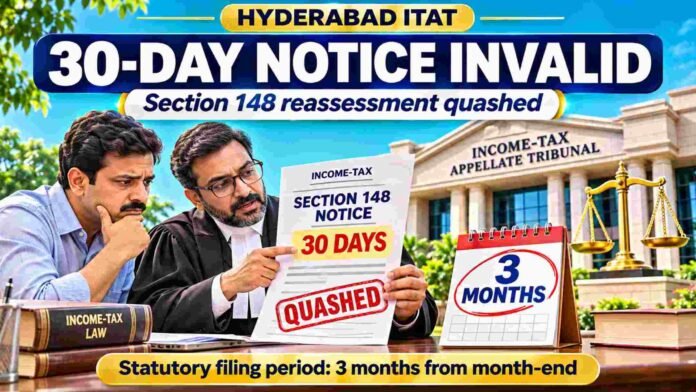
The Hyderabad Bench of the Income Tax Appellate Tribunal (ITAT) has quashed a reassessment notice that allowed a taxpayer only 30 days to furnish a return of income, holding that the notice violated the statutory requirement of granting three months from the end of the month in which it was issued.
The Bench of Vijay Pal Rao (Vice President) and Manjunatha G. (Accountant Member) has observed that compliance with the prescribed filing period was a mandatory condition for assuming reassessment jurisdiction. The invalid notice consequently vitiated the reassessment order.
Buy Now: Direct tax (Income Tax) Judgments E-Magazine October 2026
The appeal concerned Assessment Year 2022–23 and included a challenge to an addition of ₹1,03,98,000. However, after deciding the jurisdictional issue in the taxpayer’s favour, the Tribunal did not examine the merits of that addition.
The proceedings arose from a search and seizure operation conducted on January 4, 2023, in the case of the Excel Rubber Group of entities.
According to the background recorded in the order, the seized material included an agreement of sale dated September 8, 2021. Relying on this material, the Assessing Officer reopened the assessment to examine alleged on-money received by the taxpayer on the sale of property to the group.
The taxpayer had not filed a return under Section 139 of the Income Tax Act, 1961, for the relevant assessment year.
On March 12, 2024, the Assessing Officer issued a notice under Section 148 directing the taxpayer to furnish a return within 30 days from service of the notice.
The taxpayer challenged the assessment before the Commissioner of Income Tax (Appeals)-11, Hyderabad, whose order dated March 6, 2026, was subsequently carried in appeal to the Tribunal.
Before the ITAT, the taxpayer argued that the notice failed to comply with Section 148 as amended by the Finance Act, 2023, with effect from April 1, 2023.
Under the provision applicable when the notice was issued, the taxpayer was entitled to three months from the end of the month in which the notice was issued to furnish the return. The Assessing Officer could allow a further period on an application by the taxpayer.
The taxpayer submitted that granting only 30 days from service was contrary to this statutory requirement and rendered the notice, as well as the resulting reassessment, invalid.
The taxpayer relied on judicial decisions concerning notices that failed to provide the return-filing period prescribed by law, including CIT v. Micro Labs Ltd., CIT v. Amit K. Jain and CIT v. Ramsukh Motilal.
The Revenue opposed the challenge, pointing out that the taxpayer had neither filed an original return nor furnished a return within the statutory period following the reassessment notice.
The departmental representative submitted that the taxpayer filed the return only on March 11, 2025, almost a year after the notice was issued.
The Revenue argued that the taxpayer had not been prevented from filing within the period prescribed by law and had not sought an extension. It therefore maintained that mentioning 30 days in the notice was inconsequential and caused no prejudice.
The Tribunal nevertheless found that the notice failed to satisfy a mandatory condition governing reassessment jurisdiction.
Examining the notice, the Tribunal found that its second paragraph expressly required the taxpayer to furnish a return within 30 days from service.
The Bench contrasted this direction with the version of Section 148 applicable on March 12, 2024, which required three months from the end of the month in which the notice was issued.
The Tribunal noted that Section 148 was subsequently amended by the Finance Act, 2024, with effect from September 1, 2024. However, that later amendment did not apply to the notice under consideration.
It held that the Assessing Officer’s direction granting only 30 days contravened the statutory provision applicable at the relevant time.
The Bench explained that where the statute prescribes conditions for initiating proceedings, the Assessing Officer must proceed in the manner specified. A departure from those conditions rendered the proceedings void from the outset and unsustainable in law.
The Tribunal treated a valid notice under Section 148 as a jurisdictional requirement for making an assessment under Section 147.
Failure to comply with the conditions precedent for issuing the notice, it held, rendered the notice invalid and the consequential proceedings without jurisdiction.
The Bench relied on the Karnataka High Court’s decision in CIT v. Micro Labs Ltd., which concerned a notice under Section 158BC that failed to grant the prescribed minimum period for filing a return.
Drawing support from that decision, the Tribunal reiterated that jurisdiction flows from the statute and cannot be conferred through the taxpayer’s consent or waiver.
It also distinguished a curable mistake under Section 292B from a violation of a mandatory statutory requirement. The failure to provide the prescribed filing period was treated as a violation of law, rather than a defect capable of being cured under that provision.
The ITAT observed that the taxpayer had challenged the validity of the reopening and the Section 148 notice before the Commissioner (Appeals).
However, the appellate authority had not recorded a specific finding on that issue. Instead, it had referred to the taxpayer’s failure to furnish information and supporting evidence despite various notices.
The Tribunal examined the jurisdictional objection and concluded that the shortened filing period invalidated the notice.
Allowing the appeal, the Tribunal quashed the Section 148 notice dated March 12, 2024, for violating the mandatory statutory condition concerning the time allowed to furnish a return.
Membership Required to Access Case Details & Order Copy
To view the complete Case Details and Download Order Copy, you must have an active membership. Please subscribe to continue.
Read More: Service Tax Proceedings Abate On Taxpayer’s Death, Legal Heirs Can’t Be Roped In: Orissa High Court

