
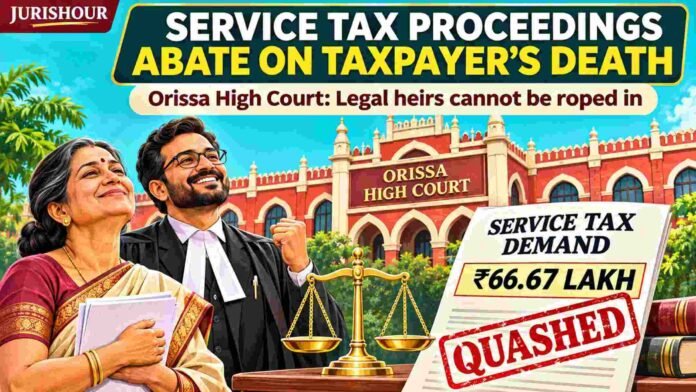
The Orissa High Court has held that service tax proceedings against an individual service provider cannot continue after his death in the absence of a statutory provision permitting their continuation against legal heirs and set aside an adjudication order passed against a deceased taxpayer and quashed a consequential recovery direction demanding ₹66.67 lakh along with applicable interest.
The Bench of Justice Sanjeeb K. Panigrahi and Justice Murahari Sri Raman allowed the petition filed by the deceased taxpayer’s wife, holding that a legal heir does not become an “assessee” under Section 65(7) of the Finance Act, 1994 merely because of that relationship.
Buy Now: All 200+ GSTAT Judgements Till November 2026 | Comprehensive E-Magazine
The dispute arose from service tax proceedings concerning the financial year 2015–16. The taxpayer died on April 27, 2020. However, the Assistant Commissioner, GST and Central Excise, Rourkela-I Division, passed an Order-in-Original dated May 4, 2023 in his name.
A subsequent recovery letter dated April 5, 2024 demanded ₹66,67,040, described as service tax including penalty and late fee, if any, together with applicable interest.
The letter required payment within 15 days and warned of recovery action under Section 87 of the Finance Act, 1994, read with Section 79 of the CGST Act, 2017.
The taxpayer’s wife informed the department of his death through a letter dated August 2, 2024, enclosing his death certificate. The judgment records that the department acknowledged receipt on August 5, 2024. She subsequently approached the High Court challenging the adjudication order and recovery action.
The petitioner argued that the adjudication order was a nullity because it had been passed against a person who was no longer alive. Her counsel submitted that proceedings must abate when the statute contains no provision authorising their continuation against legal representatives.
The petitioner contrasted the service tax framework with Section 159 of the Income Tax Act, 1961, which expressly addresses legal representatives. She maintained that a comparable provision was absent from Chapter V of the Finance Act, 1994 and that liability could not be imposed by importing provisions from another tax law.
Counsel also questioned the underlying basis of the demand. The adjudication order, as reproduced in the judgment, treated receipts of ₹2,28,86,339 during 2015–16 as consideration for taxable services and referred to a nil taxable value in ST-3 returns.
The petitioner contended that income disclosed in an income tax return did not automatically establish service tax liability. According to her, the authority was required to examine the nature of the accommodation services, the duration of accommodation and the applicability of exemptions.
The High Court’s decision ultimately turned on the authority’s jurisdiction to complete proceedings after the taxpayer’s death.
The Revenue defended the ex parte adjudication, submitting that there had been no representation despite notices or intimations. It argued that the authority had consequently proceeded to determine the liability.
The department also urged the Court to direct the petitioner to the statutory appellate remedy under Section 85 of the Finance Act, 1994.
The Bench nevertheless examined the challenge and granted relief after finding that the proceedings could not lawfully culminate in an adjudication order against the deceased service provider.
The Court examined Section 65(7), which defines an assessee as a person liable to pay service tax and includes that person’s agent.
It held that a legal heir of an individual service provider could not, merely by reason of inheritance, be treated either as the person liable to pay service tax or as the deceased’s agent.
The Bench noted that the department had not claimed that the deceased had engaged his legal heirs as agents in his business.
After considering the principles governing agency and statutory definitions, the Court explained that an inclusive definition must be interpreted in its statutory context. The inclusion of an agent within the definition of assessee did not authorise the department to treat every legal heir as an assessee.
Accordingly, the Bench held that the Section 73 proceedings could not have been completed after the service provider’s death and that the order issued in his name was legally untenable.
Relying on Shabina Abraham, the High Court emphasised that taxing statutes must be applied according to their express language. Courts cannot supply an omitted provision or extend tax liability through assumptions or equitable considerations.
The Court found no express provision in Chapter V of the Finance Act, 1994 empowering the authority to continue the proceedings against a legal heir. It recorded that the petitioner’s submission regarding the absence of such a provision remained uncontroverted by the Revenue.
The Bench also referred to the coordinate Bench decision in Smt. Kanakatala Senapati v. The Assistant Commissioner GST and Central Excise, Bhubaneswar-II Division, 2026 SCC OnLine Ori 156, which had followed Shabina Abraham and decided the issue in favour of the petitioner.
The High Court concluded that proceedings under Section 73 abate on the death of an individual service provider where no statutory provision empowers the authority to continue them.
It set aside the Order-in-Original dated May 4, 2023 and quashed the direction contained in the recovery letter dated April 5, 2024 requiring discharge of the liability.
Membership Required to Access Case Details & Order Copy
To view the complete Case Details and Download Order Copy, you must have an active membership. Please subscribe to continue.

