
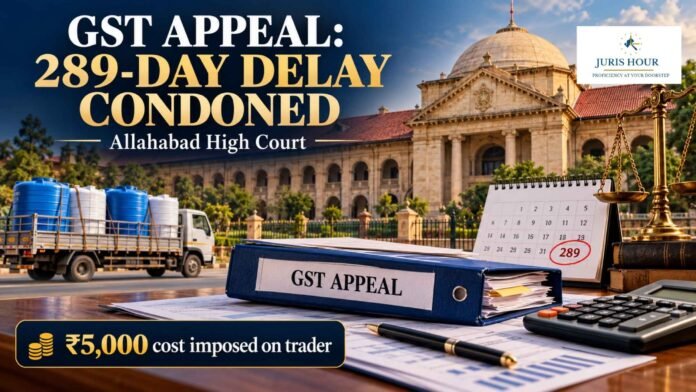
The Allahabad High Court has condoned a delay of 289 days in filing an appeal against an order under Section 129(3) of the Uttar Pradesh GST Act, 2017, after observing that the appellate authority had failed to consider the trader’s explanation that its accountant had not informed it about the appeal deadline.
The bench of Justice Vikas Budhwar restored the appeal to its original number and directed the appellate authority to decide it within three months, subject to the petitioner depositing ₹5,000 by November 6, 2026 and clarified that its order did not express any opinion on the merits of the underlying GST dispute.
Buy Now: 160+ GST E-Magazine September 2026
The petitioner/assessee approached the High Court following the rejection of its appeal against an order arising from the interception of goods in transit.
According to the petitioner, it was engaged in trading storage water tanks and had sold 70 tanks valued at ₹2,03,415 under a tax invoice dated April 13, 2025. The invoice reflected State GST and Central GST at 9% each, amounting to ₹18,307.35 under each head.
The consignment was being transported from Siddharthnagar to Sikandrabad in Uttar Pradesh.
The petitioner claimed that a technical glitch on the GST portal had prevented the generation of an electronic tax invoice when the goods were loaded, leading it to issue a regular tax invoice. It also relied on particulars recorded in the invoice and e-way bill in support of its case.
Following interception, the authorities prepared the prescribed inspection and verification documents and issued a detention order dated April 15, 2025, alleging tax evasion.
A notice proposing a penalty under Section 129(3) followed, and the adjudicating authority passed an order against the petitioner on April 16, 2025.
The petitioner subsequently filed an appeal with a delay of approximately 289 days and sought condonation of that delay.
Its explanation was that its former accountant had failed to provide proper information or guidance about the statutory time limit for filing an appeal. The petitioner stated that it was an ordinary trader unfamiliar with the complexities of legal provisions and had relied on the accountant.
According to the trader, it became aware of the available appellate remedy only after consulting a lawyer. It maintained that the delay arose from a lack of proper guidance and was neither deliberate nor attributable to an intention to prolong proceedings.
The appellate authority rejected the appeal on limitation grounds. It referred to Section 107(1), which provides for filing an appeal within three months from communication of the order, and Section 107(4), which permits the appellate authority to allow a further month upon sufficient cause being shown.
The authority proceeded on the basis that it could not exercise powers beyond the statutory framework to condone the delay.
Although the writ petition initially questioned both the original order and the appellate rejection, the petitioner confined its immediate relief to the appellate order. It reserved its right to challenge the original order at the appropriate stage.
Counsel for the petitioner argued that the appellate authority should have considered the reasons advanced for the delay instead of rejecting the request solely by referring to Section 107.
The petitioner also expressed willingness to comply with conditions imposed for having the appeal heard on merits.
The State disputed the justification offered for the delay. However, its counsel stated that there was no objection to a decision on merits if the petitioner deposited a cost payable to the respondents.
Examining the record, the High Court noted that the petitioner had specifically attributed the delay to the accountant’s failure to explain the limitation period.
The Court observed that the appellate authority had relied on Section 107 while completely brushing aside the explanation offered by the petitioner.
The bench stated that grounds raised by an appellant, whether ultimately acceptable or unacceptable, ought to be considered in their proper perspective. The Court emphasised that such consideration could result in a finding either in favour of or against the appellant.
Taking into account the submissions of both sides concerning disposal of the appeal on merits upon payment of costs, the Court granted conditional relief without further examining the dispute.
The High Court set aside the appellate rejection, condoned the delay and restored the appeal to its original number.
It directed that, subject to the petitioner depositing ₹5,000 by November 6, 2026, the appellate authority must decide the appeal within a further period of three months.
The Court expressly warned that the benefit of its order would cease to be available if the petitioner failed to deposit the amount or violated the stipulated conditions.
Membership Required to Access Case Details & Order Copy
To view the complete Case Details and Download Order Copy, you must have an active membership. Please subscribe to continue.
Read More: GST Appeal Can’t Be Rejected Without Considering Grounds For Delay Condonation: Allahabad High Court

