
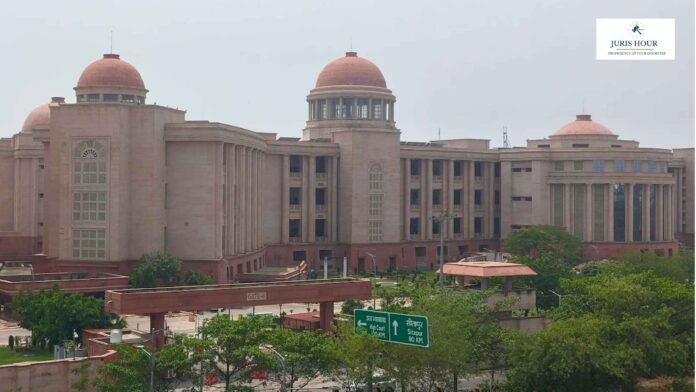
The Allahabad High Court’s Lucknow Bench has stayed reassessment proceedings for Assessment Year 2017–18 in a petition challenging the constitutional validity of Section 147A of the Income Tax Act, 1961, particularly its retrospective operation.
A Division Bench comprising Justice J.J. Munir and Justice Prashant Kumar found that a prima facie case had been made out and admitted the petition.
Buy Now: Direct tax (Income Tax) E-Magazine September 2026
The petitioner also questioned the jurisdiction to reopen the assessment, arguing that the extended ten-year reassessment period could be invoked only where escaped income exceeded ₹50 lakh, whereas the alleged escaped income in its case was ₹4 lakh.
The petitioner/assessee challenged Section 147A on the ground that it violated Articles 14 and 265 of the Constitution, particularly insofar as the provision operated retrospectively.
Article 14 guarantees equality before the law, while Article 265 provides that no tax shall be levied or collected except by authority of law.
The company challenged a notice dated March 10, 2026, issued under Section 148 of the Income Tax Act, through which reassessment proceedings had been initiated. Its challenge linked the legality of that notice to the retrospective insertion of Section 147A.
A central contention concerned the limitation period for reopening the assessment.
The petitioner argued that the reassessment limitation, enlarged to ten years after amendment, would apply only where escaped income exceeded ₹50 lakh. According to the petitioner, the escaped income involved in the present case was merely ₹4 lakh.
On that basis, the petitioner contended that reopening the assessment suffered from a jurisdictional error.
The order records these submissions but does not finally determine the applicable limitation period or whether the reopening satisfied the statutory conditions.
The petitioner’s counsel submitted that Section 147A had been struck down by the Punjab and Haryana High Court and the Andhra Pradesh High Court.
Counsel further submitted that, in special leave proceedings against those judgments, the Supreme Court had passed an interim order on September 18, 2026, staying the operation of the High Court judgments. According to the submissions recorded in the order, the Supreme Court had also stayed assessment and reassessment proceedings pursuant to the impugned provisions.
These references formed part of the petitioner’s arguments before the Allahabad High Court. The present order does not independently examine the reasoning or precise scope of those other decisions.
After considering the submissions, the Bench found that a prima facie case existed and admitted the writ petition.
The Court directed that notice be issued to the Attorney General of India, returnable on the date fixed. Notices for the three respondents were accepted by their respective counsel.
All respondents were granted two weeks to file counter-affidavits.
The Bench also directed that the matter be connected with Writ Tax No. 1213 of 2026 and Writ Tax No. 1201 of 2026.
The High Court directed that further reassessment proceedings against the petitioner for Assessment Year 2017–18 remain stayed until further orders.
The Court instructed the Senior Registrar to communicate the order to the Director General of Income Tax (Investigation), Lucknow, and the Deputy/Assistant Commissioner of Income Tax, Central Circle-I, Lucknow, through the Chief Judicial Magistrate, Lucknow, by Monday.
The matter was listed for November 25, 2026, along with a report on the status of pleadings.
The order grants interim protection while the constitutional and jurisdictional challenges remain pending. It neither strikes down Section 147A nor finally quashes the reassessment notice.
Membership Required to Access Case Details & Order Copy
To view the complete Case Details and Download Order Copy, you must have an active membership. Please subscribe to continue.
Read More: Reassessment Without S. 143(2) Notice Invalid Despite Taxpayer’s Participation: Supreme Court

