
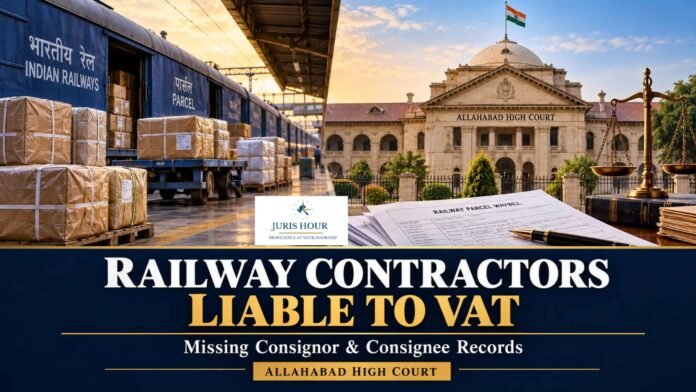
The Allahabad High Court has rejected three tax revisions filed by railway container contractors, holding that they could not escape treatment as deemed dealers under the Uttar Pradesh Value Added Tax Act, 2008, after failing to produce records identifying the consignors and consignees of goods transported through their leased railway parcel space.
The bench of Justice Vikas Budhwar upheld the Commercial Tax Tribunal’s orders dated January 27, 2026, observing that an earlier High Court judgment between the same parties had already settled their status as deemed dealers. That judgment had attained finality and could not be reopened before a coordinate bench of equal strength.
Buy Now: 80+ Judgements Indirect Tax – September 2026 E-Magazine
The bench also relied on the Tribunal’s finding that the contractors had failed to furnish the prescribed transport records despite being given an opportunity to do so.
The proceedings concerned the assessment year 2010–11. The revisionists described themselves as railway contractors and forwarding agents engaged in transporting goods from one railway station to another.
In the leading case, information received by the Special Investigation Branch of the Commercial Tax Department from the Chief Parcel Supervisor at Bareilly Railway Junction indicated that 17,599 packages had been transported from Delhi to Bareilly between April 2010 and January 2011.
The consignments included PVC goods, electrical goods, motor parts, stationery, hosiery, cosmetics and hardware.
On the basis of this information, the assessing officer passed an ex parte assessment order dated March 31, 2014, valuing the goods at ₹1.76 crore and determining tax liability of ₹20.02 lakh.
In the two connected matters, the assessed value of goods was ₹1 crore and ₹4.10 crore, with tax liabilities of ₹10.10 lakh and ₹46,63,750, respectively.
The contractors initially challenged the assessments before the first appellate authority, which set aside the assessment orders and remanded the matters for fresh consideration.
They then approached the Commercial Tax Tribunal, which allowed their second appeals on March 4, 2016, setting aside both the first appellate orders and the assessments.
The Revenue challenged those decisions before the High Court. By a common judgment dated March 31, 2022, the High Court allowed the Revenue’s revisions and remanded the matters to the Tribunal for reconsideration.
In that judgment, the Court held that the contractors were required to comply with the statutory obligations applicable to railway container contractors, including maintaining records concerning the persons whose goods they transported.
Following the remand, the Tribunal dismissed the contractors’ second appeals on January 27, 2026. Those orders were challenged in the present proceedings.
The revisionists contended that they did not fall within the definition of “dealer” under Section 2(h)(ix) of the U.P. VAT Act.
They argued that their role was confined to logistical activities, including loading goods onto trains and collecting them at the destination. According to them, the Revenue had not established that taxable goods were found in their possession or custody in a manner attracting tax liability.
They further submitted that the burden of establishing the conditions necessary for treating them as dealers rested on the department.
The contractors relied on Clause 11.8 of their railway agreement, which prescribed the preparation and retention of four copies of a consignment manifest. They also invoked Rule 54 of the U.P. VAT Rules, 2008, concerning documents accompanying goods and check-post procedures.
On this basis, they sought to challenge both their classification as dealers and the tax liability arising from that classification.
The High Court held that the March 31, 2022 judgment had already determined that the revisionists were railway container contractors deemed to be dealers.
Since that decision remained intact, the contractors could not seek a contrary finding in the subsequent round of proceedings before a coordinate bench.
The Court explained that the appropriate course for challenging the earlier finding was to approach a higher forum. It was not open to the revisionists to reopen the same issue once the judgment had attained finality.
The reliance on Rule 54 did not assist them in overcoming that binding determination.
The High Court also examined the Tribunal’s findings concerning non-production of records.
The Tribunal had recorded that the contractors did not produce the registers, receipts, office copies of transport documents and delivery registers contemplated under Rule 38(7) of the U.P. VAT Rules.
They were given an opportunity to furnish the documents. The Tribunal also indicated that records could be summoned if they had previously been submitted before the assessing officer. Nevertheless, no supporting documents were produced.
The Tribunal consequently held that the statutory recordkeeping requirements had not been complied with and sustained the treatment of the contractors as dealers.
The High Court found no reason to interfere with that conclusion.
The judgment reproduced the reasoning in the earlier 2022 decision, which distinguished regular assessment proceedings from reassessment proceedings.
That decision had held that, in regular assessment proceedings, contractors seeking to establish that no tax liability arose were required to produce the relevant documents, forms, books of account and other evidence supporting their position.
The earlier Tribunal orders could not be sustained merely on the ground that the Revenue had failed to produce evidence, without examining the contractors’ own records and their compliance with statutory requirements.
In the present round, their continued failure to produce those records supported the Tribunal’s rejection of the appeals.
The revisionists raised questions concerning their dealer status, the burden of proof, the absence of recovery of taxable goods from their possession and whether tax evasion could be presumed against a transporter without evidence of trading.
The High Court held that none of the questions warranted admission of the revisions. Finding no ground for interference in its revisional jurisdiction, it rejected all three petitions.
Membership Required to Access Case Details & Order Copy
To view the complete Case Details and Download Order Copy, you must have an active membership. Please subscribe to continue.
Read More: No Reverse Charge Service Tax On Services Received Before April 18, 2006: CESTAT

