
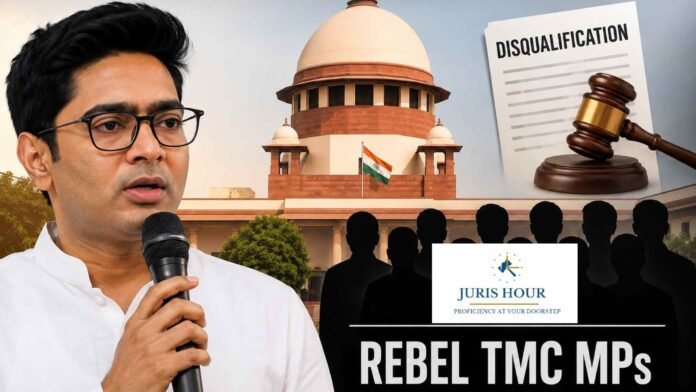
The Supreme Court on Tuesday issued notice to 20 rebel Trinamool Congress (TMC) MPs on a plea filed by TMC leader and Lok Sabha MP Abhishek Banerjee challenging the alleged delay in deciding disqualification petitions against them by Lok Sabha Speaker Om Birla.
A Bench comprising Chief Justice of India Surya Kant and Justices Joymalya Bagchi and V. Mohana sought responses from the 20 MPs. However, the Court did not issue notice to Speaker Om Birla, who is the principal authority before whom the disqualification proceedings are pending.
Buy Now: 50+ Supreme Court Judgments – July 2026
Issue Before Supreme Court Is Timely Conclusion of Proceedings
The proceedings before the Supreme Court arise from Banerjee’s challenge to the alleged delay in deciding separate disqualification petitions filed against the 20 MPs.
During the hearing, Solicitor General Tushar Mehta, appearing for the Central government, requested that notice not be issued to the Lok Sabha Speaker. He stated that he had reservations about issuing notice to a constitutional authority.
Justice Joymalya Bagchi clarified the Bench’s concern, observing that the issue was not merely about issuing notices but about ensuring that the proceedings before the Speaker are concluded within a time frame.
The Court ultimately issued notice to the 20 rebel MPs while refraining from issuing notice to the Speaker.
Speaker Has Already Issued Notices to the 20 MPs
An important development disclosed during the hearing was that the Lok Sabha Speaker has already issued notices to the 20 MPs on the disqualification petitions filed by the TMC.
Solicitor General Tushar Mehta informed the Bench that he had instructions to state that notices had been issued by the Speaker. This appears to have been a significant part of the Court’s consideration while deciding how to proceed with Banerjee’s plea.
Justice Bagchi’s observation that the question concerns the conclusion of the proceedings within a time frame, rather than merely the issuance of notices, therefore brings the focus of the litigation onto the pace at which the pending disqualification proceedings are to be completed.
How the TMC Rebel MPs Dispute Started
The dispute concerns 20 Lok Sabha MPs who were elected on TMC tickets and subsequently broke away from the party and aligned themselves with the Nationalist Citizens Party of India (NCPI).
The development followed a rebellion within the TMC parliamentary party after the party’s defeat in the West Bengal Assembly elections. The rebel MPs have sought recognition as a separate group in the Lok Sabha.
The TMC has challenged the position taken by the MPs and contends that their move to another political formation attracts the anti-defection provisions of the Constitution.
The rebel MPs, however, maintain that their move constitutes a valid merger. The dispute consequently places the question of their status before the Speaker in the context of the anti-defection provisions.
Banerjee Had Earlier Approached the Speaker
Before approaching the Supreme Court, Banerjee had filed separate disqualification petitions against the 20 MPs before Speaker Om Birla.
He subsequently sought an expeditious decision on those petitions. According to the available reports, Banerjee sent a written reminder to the Speaker on July 27 and met Birla on August 12 concerning the matter.
The Supreme Court petition was filed under Article 32 of the Constitution and seeks an expeditious decision by the Speaker on the disqualification proceedings.
Separate Seating Already Allotted to Rebel MPs
The dispute has also resulted in changes in the parliamentary arrangements for the 20 MPs.
The Speaker had allotted separate seating arrangements to the rebel TMC MPs during the Monsoon Session. The MPs have been treated as an NCPI group in Parliament and have participated in NDA parliamentary activities, according to reports.
The TMC’s challenge to their status is now before the Speaker through the disqualification proceedings, while the Supreme Court is examining Banerjee’s grievance regarding the alleged delay in deciding those proceedings.
Supreme Court’s Approach Keeps Focus on Pending Proceedings
The most significant aspect of Tuesday’s hearing is that the Supreme Court did not itself enter into the merits of whether the 20 MPs should ultimately be disqualified.
Instead, the Court issued notice to the MPs on Banerjee’s plea concerning the pending proceedings. At the same time, the Bench declined to issue notice to the Speaker’s office after the Solicitor General stated that he was representing the Speaker and that notices had already been issued to the MPs.
The distinction is important because the disqualification proceedings themselves remain before the Speaker.
The immediate question before the Supreme Court is therefore connected to the alleged delay in completing those proceedings, rather than a direct determination by the Court on the disqualification of the MPs.
Twenty MPs Named in the Supreme Court Proceedings
The 20 MPs named as respondents in the Supreme Court proceedings are Kakoli Ghosh Dastidar, Sudip Bandyopadhyay, Satabdi Roy, Prasun Banerjee, Rachana Banerjee, Jagadish Chandra Barma Basunia, Partha Bhowmick, Arup Chakraborty, Adhikari Deepak Dev, Sayani Ghosh, Bapi Haldar, Md Abu Taher Khan, Kalipada Saren Kherwal, Asit Kumar Mal, June Maliah, Mitali Bag, Khalilur Rahaman, Mala Roy, Sharmila Sarkar and Pathan Yusuf.
The case is titled , and is registered as
A Question of Procedure, Not Yet a Decision on Disqualification
Tuesday’s proceedings do not amount to a finding by the Supreme Court that the 20 MPs have incurred disqualification.
The Court has only sought their responses to Banerjee’s plea challenging the delay in the decision-making process. The substantive disqualification proceedings remain before the Lok Sabha Speaker.
The immediate significance of the Supreme Court’s intervention lies in its scrutiny of the time taken to complete proceedings under the anti-defection framework. Justice Bagchi’s observation that the matter concerns concluding the proceedings within a time frame captures the precise procedural issue that has brought the dispute before the Court.
Legal Issue: Whether the Supreme Court should intervene to ensure timely completion of disqualification proceedings pending before the Lok Sabha Speaker under the anti-defection provisions of the Constitution, where notices have already been issued to the concerned MPs.
Case Title: Abhishek Banerjee v. Hon’ble Speaker, Lok Sabha & Ors.
Citation: W.P.(C) No. 1033/2026.
Read More: 10-Year Jail Term in Rape Case: Supreme Court Orders Tarun Tejpal to Surrender Within Two Weeks

