
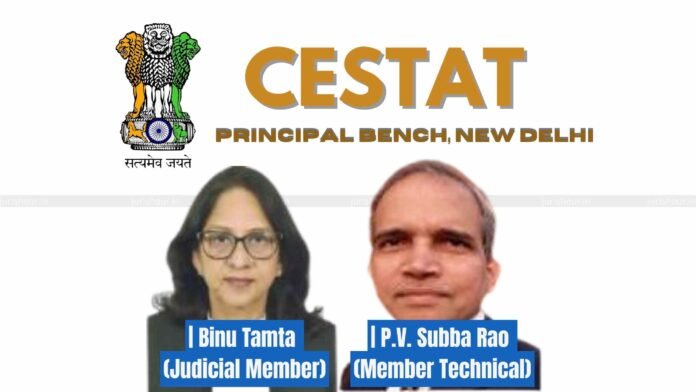
The Customs, Excise & Service Tax Appellate Tribunal (CESTAT), New Delhi Principal Bench, has held that consultancy and advisory services provided to an overseas client could not be classified as “intermediary services” merely because the consultancy assisted the client in dealing with Indian Railways.
The bench of Binu Tamta (Judicial Member) and P. V. Subba Rao (Technical Member) that the concept of intermediary service necessarily requires the presence of at least three parties and an intermediary who arranges or facilitates a principal supply between two other parties. Where a service provider renders consultancy or advisory services directly to its client on its own account, the service cannot be converted into an intermediary service merely because the advice enables the client to interact with or conduct business with third parties.
The dispute arose from an order dated 9 September 2021 passed by the Principal Commissioner, CGST & Central Excise, Jaipur, whereby proceedings initiated against National Engineering Industries Limited were dropped.
Buy Now: 70+ Judgements Indirect Tax – July 2026 | E-Magazine
The department had proposed a service tax demand of ₹9,46,60,726, along with applicable interest and penalties under Sections 75, 77 and 78 of the Finance Act, 1994. The demand was proposed under the extended period provisions contained in the proviso to Section 73(1).
National Engineering Industries Limited, Jaipur, is engaged in the manufacture of ball bearings and axle boxes. Apart from its Central Excise registration, the company also held service tax registration for providing consultancy services. During an audit, the Accountant General Audit took the view that the company had provided services valued at ₹31,33,91,662 during April 2016 to March 2017 to Electro Motive Diesel (EMD), USA under an agreement.
According to the department, the services constituted intermediary services and were therefore taxable in India under the Place of Provision of Services Rules, 2012.
The case turned principally on whether the services supplied by the Jaipur-based company to EMD, USA were consultancy services or intermediary services.
The Tribunal noted that after 2012, services other than those covered by the negative list were generally subject to service tax. Where the service provider and service recipient were located in different jurisdictions, the Place of Provision of Services Rules, 2012 determined where the service was considered to have been provided.
Under Rule 3, the general rule was that the place of provision of a service was the location of the service recipient. However, Rule 9 created specific exceptions, including intermediary services, for which the place of provision was the location of the service provider.
This distinction was crucial. If the services provided to EMD were ordinary consultancy services, the place of provision would be the location of EMD in the USA, outside the taxable territory. If they were intermediary services, however, the place of provision would be Jaipur, making them liable to service tax.
The agreement between National Engineering Industries and EMD, USA contained a wide range of consultancy and advisory functions.
These included providing recommendations regarding EMD’s business in India, assisting with meetings and liaisoning, organising studies, advising on interaction with the press and media, providing updates regarding the political scenario, and advising on local rules and regulations affecting EMD’s Indian business.
The company was also required to provide guidance concerning warranty and claim verification, joint inspection of materials, temporary warehousing, coordination with Indian Railways’ production and maintenance facilities, customs clearance, FOB supplies, tendering procedures, bid bonds, monitoring tender processes, preparation of tender documents and certain rectification-related activities.
The Revenue relied particularly upon the portions of the agreement dealing with coordination with Indian Railways, tender procedures and clearing of material. According to the department, these activities demonstrated that the company was acting as a go-between between EMD and Indian Railways.
The Revenue therefore contended that National Engineering Industries was functioning as an intermediary and that the place of provision of the service was Jaipur. On that basis, the department argued that service tax, interest and penalties should have been imposed.
National Engineering Industries disputed the intermediary classification.
Its case was that there was no contractual relationship or “lis” between it and Indian Railways. It had merely been engaged by EMD to provide consultancy, advice and assistance concerning the Indian business environment.
The company explained that a multinational corporation entering or conducting business in India may require assistance in understanding local systems, tender procedures and the manner of dealing with domestic organisations. The company’s role was to provide such consultancy and guidance to EMD.
It therefore argued that it was not arranging or facilitating a supply between EMD and Indian Railways as an intermediary. Since the services were provided directly to EMD, USA, the general rule under Rule 3 of the Place of Provision of Services Rules applied, making the USA the place of provision. Consequently, no service tax was payable in India.
The Tribunal accepted the assessee’s position.
Examining the agreement, CESTAT found that National Engineering Industries was required to provide consultancy and guidance to EMD, USA in dealing with Indian Railways. However, there was no contractual relationship between National Engineering Industries and Indian Railways.
The Tribunal categorically observed that the company was not acting as a “go between” between EMD and Indian Railways.
According to the Tribunal, for a person to qualify as an intermediary, there must be three parties to the arrangement, with the intermediary liaising between the other two parties. Where the agreement is only between the service provider and one client, the service provider is providing the service to that client alone. The fact that the consultancy may assist the client in dealing with another entity does not, by itself, transform the consultancy into intermediary services.
The Tribunal also relied upon the Delhi High Court’s decision in Cube Highways and Transportation Assets Advisor Pvt. Ltd. v. Assistant Commissioner of CGST, reported at 2023 (77) G.S.T.L. 387 (Del.).
In that case, the Delhi High Court had examined whether advisory services provided directly to a client could be characterised as intermediary services merely because the services involved identifying investment opportunities and analysing investment-related matters.
The High Court had held that where the service provider renders advisory services directly to its client and does not merely facilitate the supply of services by another provider, the activity does not constitute intermediary service.
CESTAT considered this principle directly applicable to the present dispute.
The Tribunal reproduced and relied upon the principles contained in the CBIC’s Circular dated 20 September 2021, which explains the scope of intermediary services.
The definition of intermediary under Section 2(13) of the IGST Act refers to a broker, agent or another person who arranges or facilitates the supply of goods, services or securities between two or more persons, while excluding a person who supplies such goods, services or securities on his own account.
The Tribunal highlighted the CBIC’s explanation that intermediary services have certain basic prerequisites.
First, there must ordinarily be a minimum of three parties—two parties involved in the main supply and a third party arranging or facilitating that supply.
Second, there must be two distinct supplies: the main supply between the principals and an ancillary supply consisting of arranging or facilitating that main supply.
Third, the intermediary must have the character of an agent, broker or similar person performing a subsidiary role.
Finally, a person supplying goods or services on his own account does not fall within the intermediary definition.
Applying these principles, the Tribunal held that the essential characteristics of intermediary services were absent.
CESTAT noted that an intermediary arrangement necessarily involves three entities—the supplier of the principal service, the recipient of that principal service and the intermediary facilitating or arranging the supply.
By contrast, where a consultant provides advisory or consultancy services on its own account, there are only two entities: the consultant and its client.
The Tribunal therefore endorsed the distinction between providing consultancy directly and merely arranging or facilitating a separate supply. In the former situation, the consultancy service does not become an intermediary service simply because the advice may help the recipient conduct business with other parties.
Once the Tribunal concluded that the services were consultancy services and not intermediary services, the consequence under the Place of Provision of Services Rules followed.
Since the recipient, EMD, was located in the USA, the general rule under Rule 3 treated the location of the service recipient as the place of provision.
Thus, the services were considered to have been provided outside the taxable territory and could not be subjected to Indian service tax merely because the consultancy related to EMD’s business activities in India.
The Tribunal consequently found that the Commissioner had correctly dropped the proceedings.
CESTAT concluded that National Engineering Industries had not rendered intermediary services to EMD, USA.
The Tribunal held that the Commissioner had correctly dropped the proceedings initiated through the show cause notice and found no basis to interfere with the impugned order.
The Tribunal upheld the Commissioner’s order and dismissed the Revenue’s appeal.
Membership Required to Access Case Details & Order Copy
To view the complete Case Details and Download Order Copy, you must have an active membership. Please subscribe to continue.
Read More: Municipal Body’s Commercial Renting and Hoarding-Space Activities Taxable: CESTAT

