
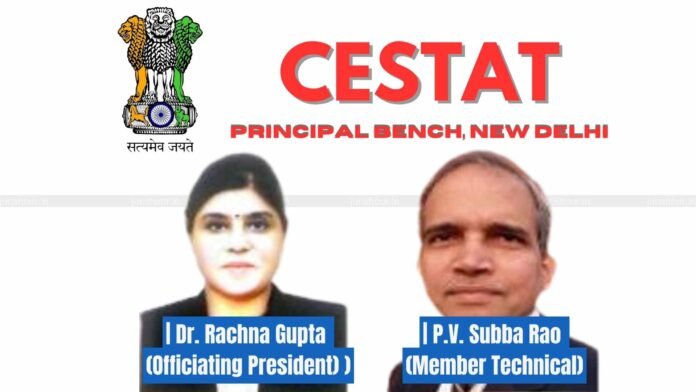
The Customs, Excise & Service Tax Appellate Tribunal (CESTAT), Principal Bench, New Delhi, has held that a separately executed contract for erection, commissioning and installation (ECIS) cannot be treated as a “Works Contract Service” merely because a separate supply contract exists between the parties and goods are used in execution of the project.
The bench of Dr. Rachna Gupta (Judicial Member) and P.V. Subba Rao (Technical Member) ruled that the essential characteristic of a works contract under the erstwhile service-tax regime was the transfer of property in goods during execution of the composite contract. Where the supply of goods and provision of erection and installation services were covered by separate contracts, and the material used for the ECIS activity was supplied free of cost by the service recipient, the service portion could not automatically be classified as a works contract.
The appellant/assessee was engaged in the manufacture of power cables, ABC cables and ACSR conductors, besides providing various taxable services, including Business Auxiliary Service, Goods Transport Agency Service, Erection, Commissioning and Installation Service and Works Contract Service.
Buy Now: 70+ Judgements Indirect Tax – July 2026 | E-Magazine
For the period April 2011 to March 2016, the assessee had claimed the benefit of the applicable abatement for Works Contract Service by deducting 60% from the taxable value received. The Department took the view that the conditions for treating the activity as a works contract were not satisfied.
According to the Department, there was no demonstrated transfer of property in goods in the execution of the relevant contract. It also alleged that the value of goods supplied free of cost by the service recipient had not been included in the taxable value. On this basis, a service-tax short-payment of ₹32,55,453 was alleged, along with interest and penalties.
The adjudicating authority had originally dropped the proceedings. The departmental review mechanism was thereafter invoked, following which an appeal was filed before the Commissioner (Appeals), Jaipur. The Commissioner (Appeals), through Order-in-Appeal No. 93/2019 dated March 11, 2019, allowed the Department’s appeal and confirmed the proposal contained in the show-cause proceedings. The assessee subsequently approached the CESTAT.
A central feature of the dispute was the contractual arrangement entered into with Power Grid Corporation of India Limited (PGCIL).
The assessee had entered into two separate work orders. The first covered the supply of equipment and material manufactured by the assessee. The second covered inland transportation, insurance, unloading, handling, storage at site, erection, testing and commissioning of the equipment and material for rural electrification works in Nagaur District, Rajasthan, under the Rajeev Gandhi Grameen Vidyutikaran Yojana.
The assessee argued that the overall activity involved both material and labour and therefore constituted a Works Contract Service. It also pointed out that works contract tax under the Rajasthan VAT law had been paid and that service tax had been discharged under the Works Contract (Composition Scheme for Payment of Service Tax) Rules, 2007.
The assessee maintained that even under the second contract, material and equipment were supplied as part of the contractual arrangement and that ownership of the material transferred to PGCIL when supplied. It therefore claimed eligibility for the works-contract abatement.
The assessee relied, among other authorities, upon decisions including Gammon India Ltd., International Metro Civil Contractors, Real Value Promoters Pvt. Ltd., M.K. Enterprises and SEW Infrastructure Limited.
Another important issue concerned material supplied free of cost by PGCIL.
The assessee contended that the value of such free-supply material could not be included in the taxable value. It relied upon departmental circulars, including the CBIC circular dated February 8, 2012, and contended that the Department’s own instructions supported exclusion of free supplies.
The assessee also argued that it had made adequate disclosures in its statutory records and returns and therefore the allegation of suppression, which was relied upon for invoking the extended limitation period, was unsustainable.
The Department, on the other hand, argued that the assessee itself had divided the arrangement into two portions—one concerning supply of goods and the other concerning services.
According to the Department, this separation meant that the assessee could not claim the benefit of the Works Contract Composition Scheme for the service contract. The Department contended that service tax was required to be paid on the full value of the second contract in accordance with the applicable valuation provisions.
The Department further submitted that the Works Contract Composition Scheme had been withdrawn with effect from July 1, 2012, and that valuation of ongoing contracts thereafter was governed by Rule 2A of the Service Tax (Determination of Value) Rules, 2006.
The Tribunal began its analysis by examining the statutory definition of Works Contract Service.
Under Section 65(105)(zzzza) of the Finance Act, 1994, as applicable from June 1, 2007, a works contract involved a contract where transfer of property in goods involved in execution of the contract was leviable to tax as a sale of goods, and the contract was for specified activities including erection, commissioning or installation of plant, machinery, equipment or structures.
The Tribunal noted that, following the introduction of the negative-list regime from July 1, 2012, the definition under Section 65B also continued to revolve around a contract involving transfer of property in goods and specified construction, erection, commissioning, installation, repair or similar activities.
The Tribunal emphasised that the transfer of property in goods was a critical component of the statutory definition. Thus, an erection or installation activity could qualify as a works contract only where the required transfer of property in goods occurred during execution of that activity.
The Tribunal found that the assessee had entered into two separate agreements—one for supply of goods and another for service.
The Tribunal observed that the assessee had not produced evidence establishing that the material was transferred as part of the second ECIS contract. Although the assessee claimed that the value of material used in the second contract exceeded 40% of the overall contract value, the Tribunal found that this claim was not supported by evidence demonstrating transfer of the material during provision of the ECIS service.
The Tribunal also rejected the argument that payment of VAT under the Rajasthan VAT Act, by itself, established that the second contract was a works contract. According to the Tribunal, the VAT payment relied upon did not establish payment of VAT in respect of the separate service contract.
The Tribunal therefore treated the contractual separation as decisive in the facts before it.
The Tribunal noted that the second contract for erection, commissioning and installation had itself been separately executed on December 3, 2008.
In the Tribunal’s assessment, the contractual structure demonstrated that the first agreement dealt with supply of goods, while the second agreement concerned the provision of erection, commissioning and installation services. The Tribunal further noted that PGCIL had provided material free of cost for the ECIS activity.
Consequently, the Tribunal concluded that the second contract was a service simpliciter contract under Erection, Commissioning and Installation Services, and that the first contract for supply of goods could not be relied upon to convert the second contract into a works contract.
The Tribunal made an important distinction regarding goods supplied free of cost by the service recipient.
It held that goods supplied free of cost by the service recipient could not constitute a transfer of property in goods by the service provider in the manner contemplated by the statutory definition of Works Contract Service.
The Tribunal also referred to the Larger Bench decision in Bhayana Builders Pvt. Ltd. v. Commissioner of Central Excise, New Delhi, concerning the treatment of free-supply material, as well as the relevant CBEC circular dealing with works contract classification.
Thus, the Tribunal drew a clear distinction between goods supplied by the service provider as part of a composite contract and goods supplied independently and free of cost by the recipient.
Having concluded that the second contract was not a composite works contract, the Tribunal held that the assessee could not claim the abatement available to Works Contract Service.
The Tribunal specifically held that there was no question of allowing the works-contract abatement in respect of the separate ECIS service contract. It further held that Rule 2A of the Service Tax (Determination of Value) Rules, 2006 could not be invoked in the manner claimed by the assessee, nor could the assessee claim abatement on the separate contract for supply of material.
At the same time, the Tribunal did not accept the Department’s position in its entirety.
While upholding the finding that the second contract was a service simpliciter and that the assessee was not entitled to works-contract abatement, the Tribunal expressly carved out the issue of free supplies.
It held that the value of free supplies, if any, was not to be included in the assessable value. Accordingly, the Tribunal upheld the impugned order only to the extent consistent with this finding and modified it to exclude the value of free supplies.
The CESTAT held that the assessee was liable to service tax in respect of the second contract as a separate Erection, Commissioning and Installation service, rather than as Works Contract Service.
The Tribunal found no infirmity in the Commissioner (Appeals)’s conclusion that there were two distinct contracts—one for supply of material and another for services.
Accordingly, the appeal was dismissed, while the order was upheld subject to the exclusion of the value of free supplies from the assessable value. The order was pronounced in open court on August 12, 2026.
Membership Required to Access Case Details & Order Copy
To view the complete Case Details and Download Order Copy, you must have an active membership. Please subscribe to continue.
Read More: Consultancy Services to US Client Not Intermediary Services: CESTAT

