
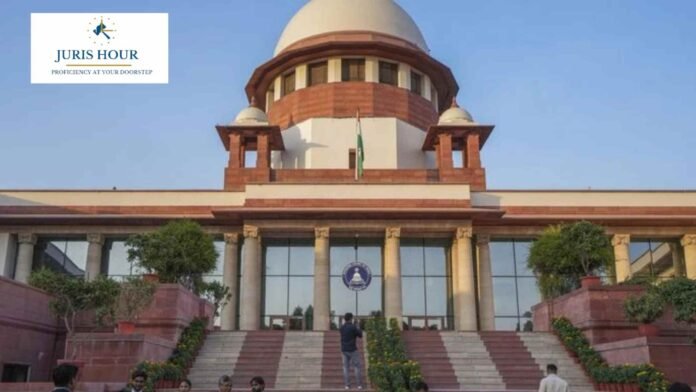
The Supreme Court has held that documents and averments placed on record in testamentary proceedings should not ordinarily be shut out at the initial stage when their relevance or admissibility is not prima facie in doubt.
The bench of Justice Sanjay Karol and Justice Nongmeikapam Kotiswar Singh reiterated that objections regarding admissibility can, in appropriate cases, be recorded and the evidence provisionally exhibited, leaving the question of its evidentiary value to be determined at the final stage.
The litigation originated with a petition filed by the respondent on October 17, 2019, seeking probate of the Will of late C. Shyamalavalli before the Madras High Court. The proceedings were initially registered as O.P. No. 164 of 2020 and were subsequently converted into T.O.S. No. 12 of 2021. The testamentary suit remained pending when the Supreme Court considered the appeal.
Buy Now: 50+ Supreme Court Judgments – July 2026
The appellants, who were defendants in the testamentary proceedings, filed their written statement on April 19, 2021. Subsequently, the plaintiff filed a proof affidavit on August 10, 2022.
The appellants objected to the affidavit and sought to have the proof affidavit, its averments and the documents exhibited along with it eschewed from the record. Their principal contention was that certain documents and averments were irrelevant to the testamentary proceedings.
The Single Judge of the Madras High Court rejected the application on November 4, 2022.
The Court noted, among other things, that the length of the proof affidavit could not by itself be a ground for rejecting it, particularly when the defendants themselves had filed a 16-page written statement in response to a five-page petition.
The Single Judge also distinguished between marking a Will as an exhibit and proving the Will. The Will could be marked through the beneficiary who was examined as PW-1, although the ultimate requirement of proving the Will in accordance with law would remain.
At the same time, the Single Judge did not permit documents numbered 5 to 9 to be marked because only photocopies had been produced and there was no explanation for the non-availability of the originals.
The remaining documents were allowed to be received in evidence for purposes including establishing title and adjudicating the rival claims concerning the Will.
The appellants carried the matter in appeal. On August 21, 2024, the Division Bench dismissed the appeal.
The Division Bench observed that merely filing an affidavit does not amount to proof of the statements contained in it. The contents would still have to be established through relevant evidence.
It further held that excluding the affidavit in the circumstances of the case could cause serious prejudice. Since the proceedings were testamentary in nature, the plaintiff would ultimately have to establish the Will to the satisfaction of the Court.
The High Court also emphasised that evidence—both oral and documentary—should not ordinarily be shut down at the initial stage. It imposed costs of ₹10,000 on the appellants, taking into account their conduct in the litigation.
Before the Supreme Court, the central question concerned the propriety of rejecting the documents at the threshold under Order XIII Rule 3 of the Code of Civil Procedure, 1908.
Order XIII Rule 3 empowers the Court to reject, at any stage of a suit, a document which it considers irrelevant or otherwise inadmissible, provided reasons for rejection are recorded.
The Supreme Court found no reason to interfere with the approach adopted by the courts below.
The Bench specifically approved the Single Judge’s decision to exclude the photocopies where no explanation had been given for the absence of the originals. However, with respect to the other documents, the Court found that the objections raised did not establish that the documents were prima facie inadmissible in law or irrelevant to the properties involved in the suit.
Consequently, the Supreme Court held that there was no occasion to exercise the power under Order XIII Rule 3 CPC to reject those documents at that stage.
An important aspect of the ruling concerned documents and averments relating to the pendency of other suits and transfers of properties within the same family structure.
The Supreme Court held that such material could not be rejected at the threshold. The Court considered the material sufficiently connected with the dispute to warrant allowing it to remain on record, subject to its eventual proof and evidentiary value.
The ruling therefore draws an important distinction between allowing material to remain on the record and accepting that material as proved evidence.
The Bench referred to the three-Judge Bench decision in Bipin Shantilal Panchal v. State of Gujarat, where the Supreme Court had criticised the practice of stopping proceedings every time an objection to admissibility was raised during the evidence stage.
The earlier ruling explained that if evidence is excluded at the trial stage and a higher court subsequently takes a different view on its admissibility, the appellate court may be forced to send the matter back to the trial court to record that evidence. Such a course can unnecessarily prolong litigation.
The Supreme Court in the present case relied upon that approach and reiterated the procedural solution suggested in Bipin Shantilal Panchal: where an objection to admissibility is raised during evidence-taking, the court may note the objection and tentatively mark the document as an exhibit, leaving the objection to be decided at the appropriate later stage.
If the objection is ultimately found sustainable, the evidence can be excluded from consideration while deciding the case. The Supreme Court noted the recognised exception where the objection concerns deficiency of stamp duty, which has to be dealt with before the proceedings move forward.
At the same time, the Supreme Court made an equally important clarification: mere marking of a document as an exhibit does not prove its contents.
The Court referred to its earlier decision in LIC v. Ram Pal Singh Bisen, which held that admission of a document into evidence does not by itself amount to proof. The contents of documents must still be established in accordance with the applicable law of evidence.
The Court reiterated that documents may have to be proved through primary or secondary evidence, as the law requires, and that merely filing a document before the Court does not establish the truth of its contents.
Applying these principles, the Supreme Court held that the documents which had been marked or exhibited in the present proceedings would still have to be proved in accordance with law.
However, that requirement did not justify excluding them at the preliminary stage.
The Court therefore found no reason to eschew the documents at that point in the litigation.
This distinction is significant in civil and testamentary litigation: admissibility, exhibition and proof are separate procedural questions. A document may be permitted to remain on the record while the opposing party retains the right to challenge its admissibility, authenticity, relevance or evidentiary value at the appropriate stage.
The Supreme Court ultimately dismissed the appeal and upheld the Madras High Court’s judgment dated August 21, 2024, in OSA No. 31 of 2023.
The Court also clarified that the testamentary proceedings would continue uninfluenced by the observations made in the Supreme Court judgment.
The stay of proceedings that had been granted by the Supreme Court on November 11, 2024, was also vacated. Any pending applications were ordered to stand disposed of.
Membership Required to Access Case Details & Order Copy
To view the complete Case Details and Download Order Copy, you must have an active membership. Please subscribe to continue.
Read More: Part Payment of Sale Consideration Doesn’t Invalidate Registered Sale Deed: Supreme Court

