
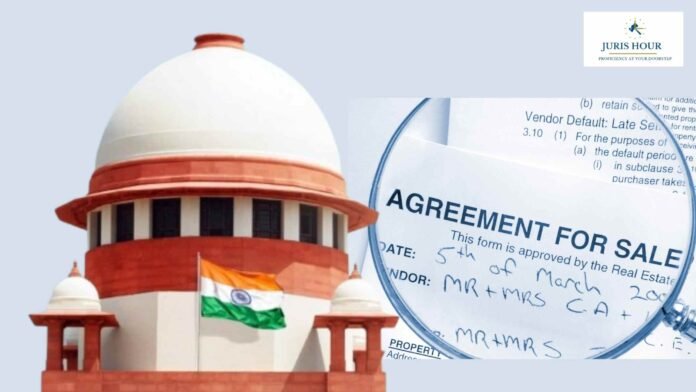
The Supreme Court has held that a registered sale deed does not become void or inoperative merely because the purchaser has not paid the entire sale consideration.
The bench of Justice J.B. Pardiwala and Justice K. Vinod Chandran reiterated that under Section 54 of the Transfer of Property Act, 1882, a sale can be completed even where the consideration is only partly paid and the balance is promised to be paid subsequently.
The dispute arose out of two sale deeds executed on March 10, 1975, concerning properties belonging to the plaintiffs. The plaintiffs had sought a declaration that the sale deeds were void and inoperative, cancellation of the deeds, a declaration that they continued to be the absolute owners of the properties and a permanent injunction against interference with their ownership and possession.
Buy Now: 50+ Supreme Court Judgments – July 2026
According to the plaintiffs, the sale transactions took place against the backdrop of debts owed by them to various financial institutions and government departments. The original defendant had initially offered to help them find a purchaser for their properties. When the prospective purchaser withdrew, the defendant himself agreed to purchase the properties.
The consideration fixed for each property was ₹7,000. At the time of execution of the sale deeds, however, only ₹2,500 for each property was paid. The remaining ₹4,500 in respect of each property was retained by the purchaser with an obligation to use the amount to clear the plaintiffs’ outstanding dues.
The purchaser subsequently failed to discharge the outstanding liabilities. When the plaintiffs approached him, further agreements were executed. In relation to one property, the purchaser agreed to hand over the remaining ₹4,500, while in respect of the other property he assumed responsibility for repayment of the loans.
The sale deeds were produced before the Trial Court as Exhibits 66 and 67, while the subsequent agreements were marked as Exhibits 60 and 63.
The Trial Court nevertheless concluded that the transaction constituted a concluded sale. It noted that the sale deeds did not contain any clause providing that failure to pay the balance consideration would result in cancellation of the sale.
The subsequent agreements, according to the Trial Court, merely reaffirmed the purchaser’s obligation to pay the balance consideration of ₹4,500 for each property, amounting to ₹9,000 in total.
The Trial Court also examined the question of possession. Proceedings under Section 145 of the Code of Criminal Procedure, 1973, had resulted in the Sub-Divisional Magistrate taking possession and subsequently handing it over to the plaintiffs.
While holding that the purchaser was required to pay the balance consideration with interest from March 10, 1975, the Trial Court rejected the plaintiffs’ prayers for cancellation of the sale deeds, declaration of ownership and permanent injunction. The First Appellate Court affirmed the Trial Court’s decision.
In the second appeal, the High Court framed questions concerning whether the sale deeds remained valid despite the non-payment of the entire consideration and whether the plaintiffs were entitled to a declaration of ownership and an injunction.
The High Court concluded that the purchaser had been required to discharge the plaintiffs’ outstanding dues and found that there was no evidence showing payment of the balance consideration or satisfaction of the outstanding liabilities.
It consequently treated the sale deeds as inoperative and declared the plaintiffs to be owners of the properties. The High Court also directed repayment of ₹5,000 with 9% simple interest from March 10, 1975 to March 31, 2010.
The Supreme Court disagreed with the High Court’s approach and relied upon its earlier decisions in Vidhyadhar v. Manikrao & Anr. and Dahiben v. Arvindbhai Kalyanji Bhanusali (Gajra), Dead through Legal Representatives & Ors.
The Court reiterated the principle that the entire sale consideration need not necessarily be paid at the time of execution of a sale deed. Section 54 recognizes a sale for a price that is paid, promised, or partly paid and partly promised.
Referring to the principle laid down in Vidhyadhar, the Court emphasized that actual payment of the whole price at the time of execution of the sale deed is not a prerequisite for completion of the sale. Where the document is executed and registered and the parties intend to transfer ownership for consideration, the sale can be complete even though part of the consideration remains unpaid.
The Supreme Court stressed that the intention of the parties is central to determining whether a transaction constitutes a sale. Such intention has to be gathered from the recitals contained in the sale deed, the conduct of the parties and the evidence available on record.
The Court also relied on its decision in Dahiben, reiterating that non-payment of the balance sale price does not invalidate a completed and registered sale.
According to the Supreme Court, once a registered sale deed has been executed pursuant to an agreement to transfer ownership, even part payment of consideration can be sufficient for the sale to take effect. The unpaid balance ordinarily gives rise to a claim for recovery of the outstanding consideration, rather than a right to seek cancellation of the sale deed merely on the ground of non-payment.
Applying this principle to the facts, the Supreme Court found that the sale deeds themselves clearly recorded that ₹4,500 had been retained in respect of each property for clearing the plaintiffs’ dues.
The Court noted that subsequent agreements executed in 1975 and 1976 further demonstrated that the purchaser had undertaken to pay the full consideration and discharge the relevant liabilities. The plaintiffs, however, instituted the suit in 1984 seeking cancellation of the sale deeds instead of pursuing a claim for recovery of the unpaid consideration.
The Supreme Court therefore held that the sale had become final. The fact that the balance consideration promised under the sale deeds had not been paid could not, by itself, render the registered sale deeds void or inoperative.
The Court made it clear that the plaintiffs’ legal remedy was to seek recovery of the balance sale consideration, and not to seek a declaration that the sale deeds were null and void.
While restoring the Trial Court’s decision, the Supreme Court noted that the appellants would have to pay the balance sale consideration with interest calculated at the rate charged by the plaintiffs’ creditors.
The Court also observed that the appellants could seek possession of the property if they were entitled to it, but found no reason to interfere with the existing possession arrangement.
The Supreme Court ultimately allowed the appeal, reversed the High Court’s judgment and restored the judgment of the Trial Court as affirmed by the First Appellate Court.
Membership Required to Access Case Details & Order Copy
To view the complete Case Details and Download Order Copy, you must have an active membership. Please subscribe to continue.

