
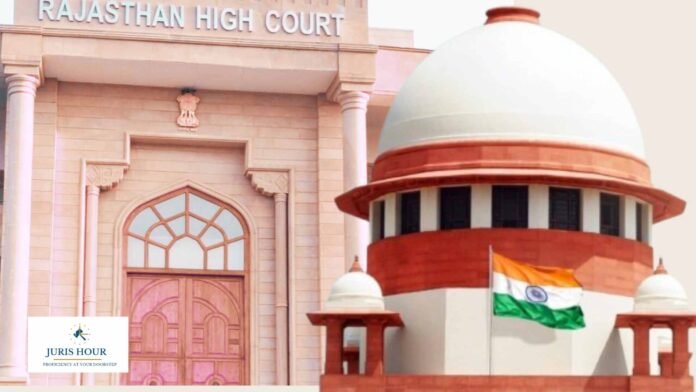
The Supreme Court has held that an employer cannot deny Selection Scale or Super Time Scale merely because the required Annual Confidential Reports (ACRs) are unavailable when such non-availability is the direct consequence of the employer’s own wrongful action.
The bench of Justice J.B. Pardiwala and Justice Manoj Misra that an employee cannot be made to suffer career progression setbacks arising from an illegal discharge from service and directed the Rajasthan High Court to grant Selection Scale and Super Time Scale benefits to a judicial officer based on his valid available ACRs.
The judicial officer was appointed as an Additional District Judge in Rajasthan in 2013 but was discharged from service in January 2016 following disciplinary proceedings linked to a bail order passed during his tenure. His challenge before the Rajasthan High Court failed, prompting him to approach the Supreme Court.
Buy Now: Supreme court Judgements E-Compilation – JUNE 2026
In March 2022, the Supreme Court quashed the discharge order, holding it to be illegal. It directed that the officer be reinstated with continuity of service, seniority and all consequential benefits while restricting back wages to 50%. Following reinstatement in April 2022, the officer sought grant of Selection Scale and later Super Time Scale, contending that he had become eligible in the normal course of service.
However, the Rajasthan High Court’s Higher Judiciary Committee noted that because the officer had remained out of service from 2016 to 2022, ACRs for six of the preceding seven years were unavailable. Since the Full Court’s criteria required a specified number of satisfactory ACRs for grant of Selection Scale and Super Time Scale, the High Court sought clarification from the Supreme Court regarding whether “consequential benefits” automatically included these promotional scales despite the absence of requisite ACRs.
The principal question before the Supreme Court was whether a judicial officer reinstated with continuity of service and consequential benefits could be denied Selection Scale or Super Time Scale solely because the required ACRs were unavailable due to his wrongful discharge.
The Court observed that the dispute essentially required balancing service rules prescribing minimum ACR requirements with the principle that an employer should not benefit from its own unlawful conduct.
The Bench emphasized that the judicial officer’s inability to earn ACRs during the disputed period was entirely attributable to the High Court’s wrongful discharge order, which had already been quashed by the Supreme Court.
The Court held that once the discharge was declared illegal, the inevitable consequence was that the officer could not have earned ACRs for the period during which he was unlawfully kept out of service. Therefore, denying him career progression because of missing ACRs would amount to allowing the employer to profit from its own wrong.
The judgment reiterated the settled legal principle that an employer cannot rely upon deficiencies created by its own illegal action to deprive an employee of service benefits.
The Bench extensively relied upon earlier decisions including Union of India v. K.V. Jankiraman, Central Bank of India v. Dragendra Singh Jadon, Prabhu Dayal Khandelwal v. UPSC, and R.K. Jibanlata Devi v. High Court of Manipur.
Referring to these judgments, the Court observed that where employees are wrongly kept out of service or where ACRs become unavailable due to the employer’s fault, promotion or career advancement must be assessed on the basis of the remaining valid ACRs rather than denying consideration altogether.
The Court reiterated that an employee who is completely exonerated cannot be deprived of seniority, promotional benefits or pay progression merely because eligibility conditions became impossible to satisfy due to the employer’s unlawful conduct.
The Court noted that the judicial officer’s available ACRs for 2013, 2014 (Part I) and 2014 (Part II) contained ratings of “Very Good”, “Very Good” and “Good” respectively.
It also recalled its findings in the 2022 judgment that the officer’s 2015 ACR had never been communicated to him and therefore could not legally be relied upon. Since uncommunicated ACRs cannot prejudice an employee, the Court held that only the valid communicated ACRs should be considered for evaluating eligibility for Selection Scale and Super Time Scale.
The Bench found no material suggesting unsatisfactory performance warranting denial of career progression and concluded that the officer’s service record justified grant of both scales.
The Supreme Court held that, after treating the officer’s service as continuous from his original appointment in July 2013, he became eligible for Selection Scale upon completion of five years of service.
Accordingly, the Court directed that he be granted Selection Scale with effect from July 16, 2018, and Super Time Scale with effect from July 16, 2021, the same dates from which officers appointed alongside or junior to him had received those benefits.
The Court further directed the Rajasthan High Court to re-fix his pay, revise all consequential benefits and compute arrears consistent with the earlier order limiting back wages to 50%.
All arrears are to be disbursed within three months.
Membership Required to Access Case Details & Order Copy
To view the complete Case Details and Download Order Copy, you must have an active membership. Please subscribe to continue.

