
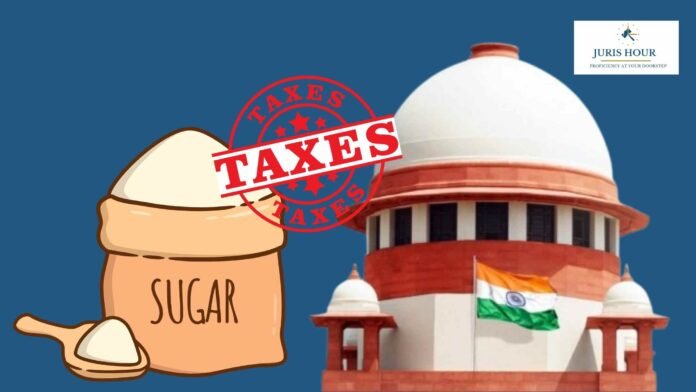
The Supreme Court has upheld the constitutional validity of Karnataka’s retrospective amendment restricting sales tax exemption on imported sugar.
The bench of Justice Aravind Kumar and Justice Prasanna B. Varale ruled that while the State may recover the principal tax liability, it cannot impose penalties or levy interest retrospectively on dealers who had acted under the earlier exemption regime and had not collected tax from customers.
The controversy arose from the Karnataka Sales Tax Act, 1957, under which “sugar” was included in the Fifth Schedule as an exempt commodity. Over the years, the exemption entry underwent several amendments but continued to refer simply to “sugar” or sugar as described under the Additional Duties of Excise (Goods of Special Importance) Act, 1957. Notably, it did not distinguish between domestically produced and imported sugar.
Buy Now: Supreme court Judgements E-Compilation – JUNE 2026
Between 1994 and 1996, the appellants imported sugar and sold it within Karnataka and in inter-State trade without collecting sales tax, relying on the exemption available under the statute. Their assessments were originally completed by the tax department granting exemption, following the legal position affirmed by earlier judicial precedents that imported sugar was also covered under the exemption.
The position changed in 2001 when Karnataka enacted Act No. 5 of 2001, inserting the words “produced or manufactured in India” after the word “Sugar” in the exemption entry. The amendment was given retrospective effect through a deeming provision, effectively excluding imported sugar from the exemption for earlier assessment years and triggering reassessment proceedings against dealers.
The assessees contended that the amendment introduced a substantive restriction rather than merely clarifying existing law. Since they had not collected tax from purchasers because imported sugar was treated as exempt, they argued that retrospectively imposing tax, interest and penalty years later would unfairly shift the burden entirely onto them.
A Single Judge of the Karnataka High Court had accepted this contention, striking down the retrospective operation of the amendment. However, a Division Bench reversed that decision and upheld the amendment, leading to the appeals before the Supreme Court.
The Supreme Court first examined whether imported sugar was covered by the exemption before the 2001 amendment.
The Court held that prior to Karnataka Act No. 5 of 2001, the exemption entry referred only to “sugar” and contained no words restricting the benefit to sugar produced or manufactured in India. Merely adopting the description of sugar from the Additional Duties of Excise Act did not import a territorial limitation. Instead, the reference was intended only to identify the commodity and not its place of manufacture.
The Bench also noted that the Karnataka tax department itself had consistently granted exemption on imported sugar in the original assessments and had relied upon the Supreme Court’s earlier affirmation of the Kerala High Court’s interpretation in a similar matter. This reinforced the conclusion that imported sugar was indeed covered under the exemption before 2001.
While agreeing that imported sugar had originally been exempt, the Court held that the State Legislature was fully competent to retrospectively amend the exemption.
The Bench observed that the power to levy tax necessarily includes the power to grant, restrict or withdraw exemptions. Since exemptions are matters of fiscal policy, dealers cannot claim a vested right that an exemption must continue indefinitely. The Legislature was therefore entitled to retrospectively insert the words “produced or manufactured in India” and confine the exemption to domestically manufactured sugar.
The Court rejected the argument that retrospective taxation is unconstitutional merely because it creates hardship, noting that retrospective fiscal legislation has long been recognised as valid, subject to constitutional limitations.
The Supreme Court, however, held that the consequences flowing from retrospective legislation cannot be mechanically imposed.
The Bench identified several crucial circumstances:
- Imported sugar was genuinely exempt before the amendment.
- The tax department itself had granted exemption in the original assessments.
- Dealers had not collected sales tax from purchasers.
- The reassessment proceedings arose solely because of the retrospective amendment enacted years later.
The Court observed that imposing penalty under these circumstances would be fundamentally unfair because penalty presupposes some culpable default or breach of an existing legal obligation. Dealers who had complied with the law as it then stood could not be punished for failing to collect tax that was not payable at the time of sale.
Similarly, the Bench ruled that charging interest from the original transaction dates would effectively become punitive rather than compensatory. Since the tax liability itself was created retrospectively, interest could not run from a period when no enforceable liability existed.
Accordingly, the Supreme Court held that reassessment proceedings may continue only for determining the principal tax liability.
It directed that no penalty shall be imposed or recovered for transactions preceding Karnataka Act No. 5 of 2001. Interest, wherever legally payable, shall run only from the date of lawful demand raised after reassessment and not from the original assessment period. Inter-State sales must be recomputed strictly in accordance with Section 8(2) of the Central Sales Tax Act, 1956. Any penalty or interest already recovered contrary to these directions must either be adjusted against lawful principal tax dues or refunded where no such dues remain.
Membership Required to Access Case Details & Order Copy
To view the complete Case Details and Download Order Copy, you must have an active membership. Please subscribe to continue.

