
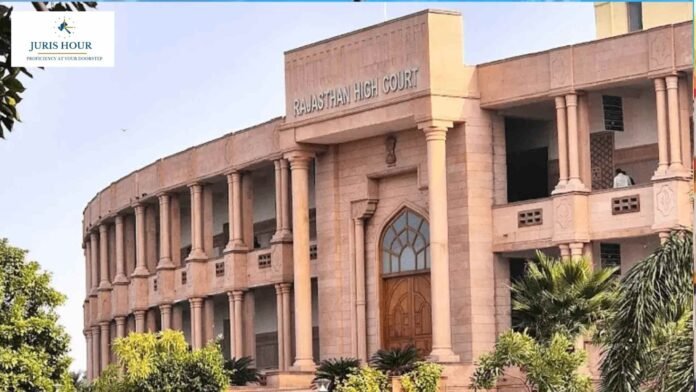
The Rajasthan High Court has quashed ex-parte orders reducing a manufacturer’s sales tax exemption under the Rajasthan Sales Tax Incentive Scheme, 1987.
The Bench of Justice Munnuri Laxman and Justice Anuroop Singhi has held that authorities cannot retrospectively curtail benefits already granted under an incentive scheme, particularly without providing an opportunity of hearing or establishing fraud or concealment by the beneficiary.
The petitioner, a manufacturer of polythene packing materials, had undertaken expansion of its existing industrial unit by making an additional capital investment of ₹41 lakh. Based on this investment, the District Level Screening Committee (DLSC) granted the company an eligibility certificate on 6 May 1994, entitling it to 100% sales tax exemption for seven years up to ₹36.90 lakh, representing 90% of the eligible investment.
Buy Now: June 2026 Ultimate Legal & Taxation Combo
However, years later, the DLSC passed ex-parte decisions dated 20 January 1998 and 25 July 2000, reducing the eligible investment from ₹41 lakh to ₹32.69 lakh by excluding investments made in DG Sets and Electronic Installations. Consequently, the tax exemption was reduced from ₹36.90 lakh to ₹29.42 lakh, and reassessment notices were issued on 6 October 2000.
Aggrieved by these actions, the company approached the Rajasthan High Court.
The petitioner argued that the entire investment of ₹41 lakh, including expenditure on DG Sets and Electronic Installations, had been fully disclosed while seeking benefits under the Incentive Scheme. The DLSC had initially examined and accepted the investment before granting the eligibility certificate. There was no concealment, misrepresentation, or fraud on the part of the company. The authorities amended the eligibility certificate and reduced the exemption without issuing any notice or granting an opportunity of hearing, violating the principles of natural justice. The reassessment notices were merely consequential to the illegal reduction in exemption and therefore deserved to be quashed.
The petitioner also relied upon several judicial precedents holding that benefits validly granted under an incentive scheme cannot subsequently be withdrawn in the absence of fraud.
The State contended that the DLSC had mistakenly included investments in DG Sets and Electronic Installations while calculating eligible capital investment. An audit objection and a departmental circular dated 24 August 1995 prompted correction of the earlier mistake. Consequently, the reduction in exemption was justified. The writ petition was also not maintainable since the petitioner had an alternative statutory remedy.
After examining the Rajasthan Sales Tax Incentive Scheme, 1987, the Division Bench observed that the scheme was intended to encourage industrial expansion through additional capital investment.
The Court found that the petitioner had fully disclosed every component of its investment at the time of applying for exemption. The authorities themselves accepted the investment details before issuing the eligibility certificate. The scheme did not contain any provision excluding DG Sets or Electronic Installations from the computation of additional capital investment. Although the State relied upon a departmental circular, the circular was never produced before the Court, nor was it shown to have been in force when the petitioner applied for the incentive. Therefore, the petitioner’s claim had to be decided strictly under the original incentive scheme and not on the basis of a subsequent administrative interpretation.
The Court attached considerable importance to the manner in which the exemption was reduced.
It held that the DLSC altered the eligibility certificate and reduced the exemption behind the petitioner’s back, without issuing any notice or granting an opportunity to explain its position.
The Bench observed that such unilateral ex-parte decisions affecting vested rights are legally unsustainable and liable to be set aside on this ground alone.
The High Court reiterated an important legal principle governing industrial incentive schemes.
It held that once an incentive benefit has been granted after considering all disclosed facts and has been acted upon by the beneficiary, the authorities cannot subsequently withdraw or curtail that benefit unless it is established that it was obtained through fraud, concealment, or misrepresentation.
Since the State never alleged any fraud or suppression by the petitioner, the withdrawal of benefits was held to be impermissible.
The State’s objection regarding availability of an alternative statutory remedy was also rejected.
The Court noted that the writ petition had been pending since 2000. It had already been admitted by the High Court decades earlier. The case involved a clear violation of the principles of natural justice.
The Court held that it would be inappropriate to dismiss the petition on the ground of alternative remedy.
The Rajasthan High Court quashed the DLSC’s ex-parte decisions dated 20 January 1998 and 25 July 2000, set aside the consequential orders reducing the value of additional capital investment, restored the petitioner’s original sales tax exemption of ₹36.90 lakh under the Eligibility Certificate dated 6 May 1994, and quashed the reassessment notices dated 6 October 2000 issued pursuant to the reduction of exemption.
Membership Required to Access Case Details & Order Copy
To view the complete Case Details and Download Order Copy, you must have an active membership. Please subscribe to continue.
Read More: ITR-1 Excel Utility: Salaried Taxpayers Can Now Report 2 House Properties

