
The Customs, Excise & Service Tax Appellate Tribunal (CESTAT), New Delhi, has held that refund claims relating to Krishi Kalyan Cess (KKC) and Swachh Bharat Cess (SBC) arising from cancelled insurance policies cannot be rejected on the grounds of limitation or unjust enrichment.
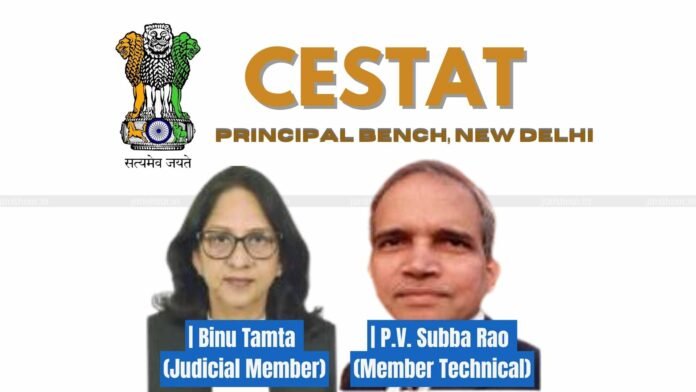
The Bench of Binu Tamta (Judicial Member) and P.V. Subba Rao (Technical Member) has observed that In insurance transactions, premium amounts are frequently received through financiers or corporate agents. Where policies are cancelled, the insurer refunds the amount to such intermediaries, who in turn credit the insured customers.
The appellant/assessee is engaged in providing general insurance services, had collected service tax along with applicable cesses on insurance premiums under the Finance Act, 1994. Subsequently, several insurance policies were cancelled after the introduction of GST due to reasons such as cheque dishonour, customer-requested cancellation, policy alterations, or reduction in insured risk.
Buy Now: Service Tax Judgement E-Compilation : June 2026
Since the services were either not rendered or only partially rendered, the insurer refunded the corresponding premium amount along with the service tax component to its customers. It thereafter filed refund claims under Section 142(5) of the Central Goods and Services Tax Act, 2017, seeking refund of taxes paid under the pre-GST regime.
While the Tribunal had already allowed the refund of the service tax component in an earlier order, the Department rejected the separate refund claim of ₹28,57,192 relating to Krishi Kalyan Cess and Swachh Bharat Cess, holding it to be time-barred and hit by the doctrine of unjust enrichment.
The Tribunal examined two principal questions: Whether a refund claim filed under Section 142(5) of the CGST Act could be rejected as barred by limitation under Section 11B of the Central Excise Act; and Whether the doctrine of unjust enrichment prevented the insurer from claiming refund of KKC and SBC after cancellation of insurance policies.
The insurer argued that the controversy was no longer res integra, pointing out that identical issues had already been decided in its favour and in several earlier Tribunal decisions including Punj Lloyd Ltd., Wave Megacity Centre Pvt. Ltd., Indiabulls Distribution Services Ltd., and Wave One Pvt. Ltd.
It was further contended that KKC and SBC merely formed part of the service tax levy. Therefore, once refund of the principal service tax had already been held admissible, there was no legal basis to deny refund of these cesses separately.
Notably, the Department’s Authorized Representative fairly conceded before the Tribunal that the controversy stood covered by earlier decisions rendered in favour of the assessee.
The Tribunal reiterated that under Rule 6(3) of the Service Tax Rules, 1994 and Section 142(5) of the CGST Act, where services are not provided and the consideration is refunded, the assessee becomes entitled to claim refund of the taxes paid.
The Tribunal held that this mode of refund fully satisfies the statutory requirement that the amount should be returned to the person from whom it was received.
Rejecting the Department’s reliance on Section 64VB of the Insurance Act, 1938, the Bench held that compliance with that provision was not a prerequisite for claiming refund under Rule 6(3) or Section 142(5). The essential requirement is that the amount ultimately reaches the service recipient and that no taxable service is ultimately rendered.
On the question of unjust enrichment, the Tribunal held that the insurer had successfully demonstrated that the premium together with the tax component had been returned after cancellation of the insurance policies.
Since the incidence of tax had not been retained by the assessee but had ultimately been passed back to the insured customers through financiers or agents, the refund claim could not be denied by invoking the doctrine of unjust enrichment.
The Bench also rejected the Department’s contention that the refund application was barred by limitation.
Relying upon a consistent line of Tribunal precedents, particularly Wave Megacity Centre Pvt. Ltd., it held that refund applications filed under Section 142(5) of the CGST Act are governed by the transitional provisions and cannot be rejected solely on the basis of the limitation prescribed under Section 11B of the Central Excise Act.
The Tribunal reiterated that the only relevant restriction under Section 142(5) is the principle of unjust enrichment, and once that test is satisfied, refund cannot be denied merely because the application was filed beyond the limitation period applicable under the erstwhile law. It further observed that where services are never rendered due to cancellation of contracts or insurance policies, there remains no taxable event justifying retention of the tax by the Government.
Allowing the appeal, the Tribunal set aside the impugned orders and held that Shriram General Insurance Co. Ltd. is entitled to refund of ₹28.57 lakh towards Krishi Kalyan Cess and Swachh Bharat Cess.
The Bench concluded that such refund claims filed under Section 142(5) of the CGST Act cannot be rejected either on the ground of limitation or by applying the doctrine of unjust enrichment where the tax burden has been returned following cancellation of the underlying services.
Membership Required to Access Case Details & Order Copy
To view the complete Case Details and Download Order Copy, you must have an active membership. Please subscribe to continue.

