
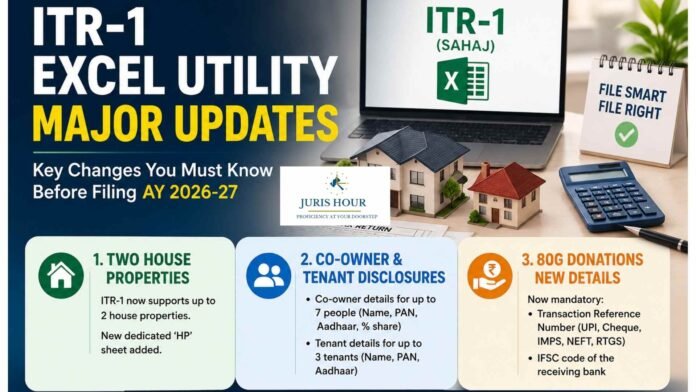
The Income Tax Department has introduced several significant changes to the ITR-1 (Sahaj) Excel utility for Assessment Year (AY) 2026-27, making the return filing process more comprehensive while expanding the scope of the simplified return form.
The changes are particularly relevant for salaried individuals, pensioners, and taxpayers with limited sources of income who intend to file their income tax returns using ITR-1.
The revised utility introduces new reporting requirements for taxpayers earning rental income, expands the eligibility of ITR-1 to include up to two house properties, and mandates additional documentation for claiming deductions under Section 80G.
Buy Now: INCOME TAX E-COMPILATION – JUNE 2026
ITR-1 Now Covers Two House Properties
One of the most notable changes is the expansion of ITR-1 to accommodate up to two house properties.
Previously, taxpayers owning or reporting income from a second house property generally had to switch to ITR-2, which involved comparatively detailed disclosures. Under the revised utility, eligible taxpayers can continue filing the simpler ITR-1 even if they have two house properties.
To facilitate this change, the Excel utility now includes a dedicated ‘House Property (HP)’ sheet, enabling taxpayers to separately disclose details of both properties.
This modification is expected to benefit a large number of salaried individuals who own multiple residential properties but otherwise qualify for filing ITR-1.
Mandatory Disclosure of Co-Owners and Tenants
The revised utility also introduces enhanced disclosure requirements for taxpayers reporting rental income.
Where income from house property is disclosed, taxpayers must now provide details of:
- Co-owners (up to seven individuals), including:
- Name
- PAN
- Aadhaar Number
- Percentage share in the property
- Tenants (up to three tenants), including:
- Name
- PAN
- Aadhaar Number
These disclosures are intended to improve transparency and assist the Income Tax Department in cross-verifying ownership and rental income declarations.
Section 80G Claims Now Require Transaction Reference Details
The utility has also tightened compliance requirements for taxpayers claiming deductions under Section 80G for eligible charitable donations.
Apart from the existing information, taxpayers are now required to furnish:
- Transaction Reference Number of the donation, such as:
- UPI
- Cheque Number
- IMPS Reference
- NEFT Reference
- RTGS Reference
- IFSC Code of the recipient bank.
These additional fields were not available in the earlier utility and are likely aimed at strengthening verification of donation claims and reducing fraudulent deductions.
Greater Transparency in Return Filing
The latest changes indicate the Income Tax Department’s continued emphasis on collecting more granular information while retaining the convenience of simplified return filing for eligible taxpayers.
While the inclusion of two house properties broadens the utility of ITR-1, taxpayers should ensure that ownership details, tenant information, and donation-related banking particulars are readily available before filing their returns to avoid errors or processing delays.

