
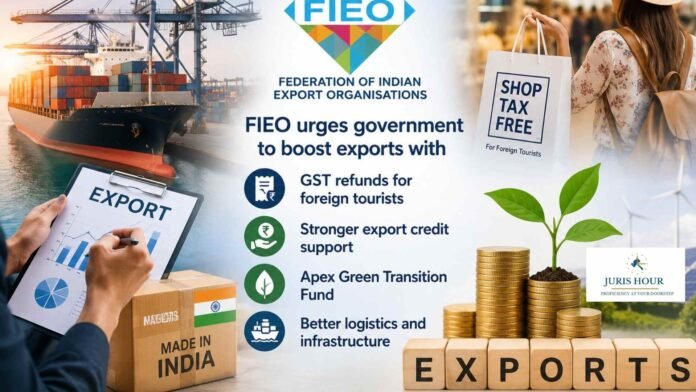
India’s apex exporters’ body, the Federation of Indian Export Organisations (FIEO), has urged the Central Government to immediately operationalise the long-pending Goods and Services Tax (GST) refund mechanism for foreign tourists, arguing that the move could significantly boost tourism-driven retail exports while enhancing India’s attractiveness as a global shopping destination.
The recommendations were presented during the meeting of the Board of Trade chaired by Commerce and Industry Minister Piyush Goyal, where FIEO also called for stronger institutional credit support, improved logistics infrastructure, and the creation of a dedicated fund to help exporters transition towards sustainable manufacturing.
Buy Now: FAO Versus JAO Matters Remanded Back To HC : CASE COMPILATION & LITIGATION GUIDE
GST Refund Scheme for Foreign Tourists Still Awaiting Implementation
FIEO highlighted that although the Integrated Goods and Services Tax (IGST) Act, 2017 contains a specific provision enabling GST refunds on goods purchased by foreign tourists in India, the mechanism has yet to be implemented despite nearly nine years having passed since the rollout of GST.
According to the exporters’ body, introducing a tourist refund scheme would encourage international visitors to spend more on Indian products, thereby promoting retail exports while simultaneously strengthening the country’s tourism sector. Several leading economies already operate similar tax refund systems, making shopping more attractive for overseas travellers.
FIEO believes that activating this provision would provide an additional avenue for export earnings without requiring significant structural changes to the tax framework.
Export Credit Support Needs Immediate Attention
A major concern raised by the organisation relates to the declining availability of export finance.
While India’s merchandise and services exports have remained resilient despite volatile global trade conditions, exporters are facing increasing challenges in obtaining adequate working capital from banks. FIEO noted that priority sector lending for exports has fallen sharply, with export credit reportedly contracting by around 14 percent in recent times.
The federation warned that shrinking access to institutional finance is placing considerable pressure on exporters, particularly Micro, Small and Medium Enterprises (MSMEs), which account for a substantial share of India’s export base.
Exporters are currently dealing with multiple headwinds, including extended payment cycles, rising freight expenses, higher compliance costs and intensifying international competition. Under such circumstances, affordable and timely pre-shipment as well as post-shipment credit has become essential for fulfilling export orders and expanding into newer overseas markets.
FIEO has requested the government to engage with the Reserve Bank of India (RBI) and commercial banks to restore export finance as a strategic national priority. It has also advocated internationally competitive interest rates, faster loan processing and a more supportive banking approach towards exporters.
According to the federation, a robust export financing ecosystem will be indispensable if India is to realise its ambition of becoming a USD 2 trillion export economy.
Proposal for an Apex Green Transition Fund
Recognising the growing importance of sustainability in global trade, FIEO has proposed the establishment of an “Apex Green Transition Fund” dedicated to supporting Indian exporters in meeting emerging environmental standards.
The proposed fund would assist businesses in adopting cleaner manufacturing technologies, improving energy efficiency and lowering carbon emissions. It would also facilitate access to concessional finance, financial assistance for green investments, advanced technology transfer and carbon compliance measures.
The federation emphasised that support for carbon audits, traceability systems and sustainability certification will become increasingly important as international markets introduce stricter environmental regulations, including carbon-related compliance requirements.
Such assistance, FIEO argued, would help Indian exporters remain competitive while adapting to evolving global trade norms.
Logistics Challenges Continue to Affect Export Competitiveness
Apart from financing concerns, exporters also urged the government to prioritise reforms in logistics.
FIEO called for greater transparency in freight pricing, improved availability of shipping containers and vessels for Indian export cargo, and the creation of a structured mechanism for regular engagement between exporters and shipping companies.
The organisation believes that addressing these operational bottlenecks would reduce logistics costs, improve supply chain efficiency and enhance India’s competitiveness in international markets.
Industry Seeks Comprehensive Policy Support
The exporters’ body stressed that India’s export sector has demonstrated resilience despite geopolitical uncertainties and disruptions in global trade. However, sustaining this momentum will require coordinated policy measures addressing finance, taxation, logistics and sustainability.
FIEO expressed confidence that timely implementation of these reforms—including GST refunds for foreign tourists, restoration of export credit, creation of a green transition fund and logistics improvements—would strengthen India’s position in global trade while supporting long-term export growth.
The recommendations form part of broader industry efforts to ensure that Indian exporters remain competitive amid changing international market dynamics and are well-equipped to contribute towards the country’s long-term export ambitions.
Read More: CBIC Member Surjit Bhujabal Visits Thar Dry Port ICD at Hirnoda, Reviews Import-Export Operations

