
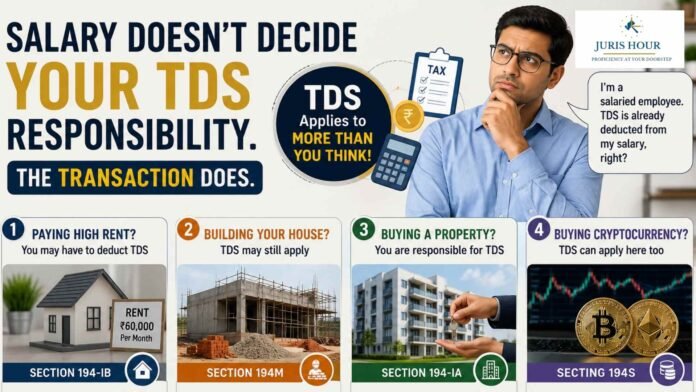
Many salaried taxpayers assume that once their employer deducts Tax Deducted at Source (TDS) from their salary, they have no further TDS obligations. While this is true in most routine cases, the Income-tax Act places TDS responsibilities on individuals as well for certain specified transactions.
Whether you are paying high-value rent, constructing your dream home, purchasing property, or even buying cryptocurrency, you may be legally required to deduct TDS before making the payment.
Here’s a simple conversation that explains this common misconception.
“My Employer Already Deducts TDS. Why Should I?”
Ramesh (Salaried Employee):
“My employer already deducts TDS from my salary. So I don’t have to deduct TDS anywhere else, right?”
Chartered Accountant:
“That’s what most salaried employees think. But that’s not always correct. Your TDS obligation depends on the nature of the transaction—not your profession.”
Let’s understand the situations where a salaried individual may also become a “TDS deductor.”
Situation 1: Paying High Rent? You May Have to Deduct TDS
Ramesh:
“I pay ₹60,000 per month as rent. Why would I have to deduct TDS?”
CA:
“If you’re an individual or Hindu Undivided Family (HUF) who is not liable for a tax audit and your monthly rent exceeds ₹50,000, Section 194-IB requires you to deduct TDS from the rent paid to your landlord.”
What the law says
Under Section 194-IB, an individual or HUF paying rent exceeding ₹50,000 per month must deduct TDS.
Key points
- Applicable even if you are a salaried employee.
- No requirement to obtain a TAN.
- TDS is generally deducted once during the financial year or at the end of the tenancy.
- Payment is made using Form 26QC.
Situation 2: Constructing Your House? Personal Expense Doesn’t Mean No TDS
Ramesh:
“I’m constructing my own house and paid a contractor ₹65 lakh. It’s my personal expense. Does TDS still apply?”
CA:
“Yes. Under Section 194M, if payments to a resident contractor or professional exceed ₹50 lakh during a financial year, TDS has to be deducted.”
Understanding Section 194M
Many people assume TDS applies only to business payments. However, Section 194M covers specified payments made by individuals and HUFs who are not required to deduct TDS under other business-related provisions.
When it applies
- Payment to contractors
- Professional fees
- Commission or brokerage
- Aggregate payment exceeds ₹50 lakh in a financial year.
Again, obtaining a TAN is generally not required for compliance under this section.
Situation 3: Buying a Property? The Buyer Has TDS Responsibility
Ramesh:
“I purchased a flat worth ₹80 lakh. Isn’t it the seller who has to pay tax?”
CA:
“The seller pays capital gains tax, but you, as the buyer, must deduct TDS under Section 194-IA before making payment.”
What buyers should know
If you’re purchasing an immovable property (other than agricultural land) for ₹50 lakh or more, the buyer must deduct TDS.
Important points
- Applicable on residential and commercial properties.
- TDS is deducted at the prescribed rate before making payment.
- Deposit is made through Form 26QB.
- The buyer must also issue Form 16B to the seller after depositing the tax.
Many first-time homebuyers miss this compliance, leading to notices and interest liability later.
Situation 4: Buying Cryptocurrency? TDS May Apply
Ramesh:
“I bought cryptocurrency directly from another individual. I never imagined TDS could apply.”
CA:
“It certainly can. Section 194S requires deduction of TDS on transfer of virtual digital assets when the prescribed conditions and thresholds are satisfied.”
When Section 194S applies
TDS provisions cover transfers of Virtual Digital Assets (VDAs) such as cryptocurrencies and NFTs.
Depending on the nature of the transaction, the buyer may be responsible for deducting TDS before making payment to the seller.
Taxpayers dealing in peer-to-peer crypto transactions should carefully examine whether the threshold limits and compliance requirements apply.
Why This Confuses Salaried Taxpayers
Most salaried individuals are familiar only with the TDS deducted from their monthly salary by employers. However, the Income-tax Act imposes separate TDS obligations based on specific transactions.
This means a person can simultaneously be:
- A salaried employee whose employer deducts TDS on salary; and
- A TDS deductor in respect of rent, property purchase, contractor payments, or other notified transactions.
The obligation arises because of the transaction itself—not because the person is carrying on a business.
Consequences of Ignoring TDS Obligations
Failure to deduct or deposit TDS where required may result in:
- Interest on delayed deduction or payment.
- Late filing fees, where applicable.
- Penalties under the Income-tax Act.
- Difficulty in completing the transaction or obtaining tax credits.
Therefore, taxpayers should verify whether TDS provisions apply before making high-value payments.
| Transaction | Relevant Section | When TDS Applies |
| Rent payment | Section 194-IB | Monthly rent exceeds ₹50,000 |
| Payment to contractor/professional | Section 194M | Aggregate payment exceeds ₹50 lakh in a financial year |
| Purchase of immovable property | Section 194-IA | Property value is ₹50 lakh or more |
| Purchase of cryptocurrency/Virtual Digital Asset | Section 194S | Subject to prescribed conditions and threshold limits |
Conclusion
Being a salaried employee does not automatically exempt you from TDS responsibilities. While your employer deducts TDS on your salary, you may also be required to deduct and deposit TDS when entering into certain high-value transactions such as paying substantial rent, constructing a house, purchasing property, or buying cryptocurrency.
The key takeaway is simple: Your salary doesn’t determine your TDS responsibility—the transaction does. Before making any significant payment, it’s advisable to check whether the Income-tax Act requires you to deduct TDS to avoid future tax disputes and penalties.
Read More: FIEO Urges Government to Roll Out GST Refunds for Foreign Tourists

