
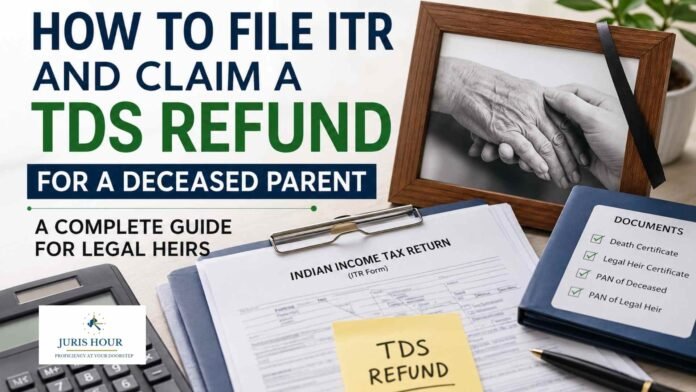
Filing an Income Tax Return (ITR) on behalf of a deceased parent is an important legal responsibility that often falls on the surviving family members. Apart from ensuring tax compliance, filing the return is also necessary to claim any Tax Deducted at Source (TDS) refund that may be due to the deceased.
Although the process may seem complicated during an emotionally difficult time, the Income Tax Department allows legal heirs to complete the filing through its online portal after completing a simple registration process.
Can a Legal Heir File the Income Tax Return of a Deceased Parent?
Yes. A legal heir or an authorised representative can file the income tax return on behalf of a deceased taxpayer. If excess tax has been deducted or paid, the legal heir can also claim the applicable refund through the same return.
The return is filed in the name of the deceased person, while the legal heir acts as the authorised representative after obtaining approval from the Income Tax Department.
Step 1: Obtain Legal Heir Proof
Before filing the return, the legal heir must obtain documentary evidence establishing the relationship with the deceased.
In several states, including Maharashtra, a Legal Heir Certificate can be obtained from the office of the Tehsildar of the jurisdiction where the deceased resided. The applicant generally needs to submit:
- Death certificate of the deceased
- Identity proof of the applicant
- Address proof
- Relationship documents, wherever applicable
After document verification and payment of the prescribed fee, the certificate is issued. Depending on the state and local administration, the process may take a few weeks.
Step 2: Register as a Legal Heir on the Income Tax Portal
Once the legal heir certificate has been obtained, the applicant must register as the legal heir on the Income Tax Department’s e-filing portal.
During the registration process, the applicant is required to upload supporting documents, including:
- Death certificate
- PAN card of the deceased
- PAN card of the legal heir
- Legal heir certificate or other accepted proof
- Identity documents of the legal heir
The Income Tax Department verifies the application before granting approval. Once approved, the legal heir gains the authority to file the deceased person’s income tax return electronically.
Step 3: File the Income Tax Return
The return should include all income earned by the deceased from the beginning of the financial year up to the date of death.
This may include:
- Salary received before death
- Pension
- Interest earned on bank deposits
- Rental income
- Capital gains, if any
- Other taxable income accrued before the date of death
Any tax deducted during this period, including TDS, can be claimed while filing the return.
What About Income Earned After Death?
Income generated after the date of death is not taxable in the hands of the deceased.
For example, interest credited on bank deposits after the date of death or rental income received subsequently becomes taxable in the hands of the legal heir or other beneficiaries, depending on the succession of the assets.
Accordingly, such post-death income should be reported in the income tax return of the legal heir or the estate, as applicable, and not in the return of the deceased.
How to Claim a TDS Refund
If TDS has been deducted in excess from the deceased’s income, the legal heir can claim the refund by filing the ITR after obtaining legal heir registration.
Once the Income Tax Department processes the return, the refund is issued to the eligible claimant.
If the deceased’s original bank account has already been closed, the legal heir may need to submit a refund reissue request after validating their own bank account on the income tax portal, subject to the department’s prescribed procedure.
Is It Necessary to Inform the Income Tax Department Separately?
Generally, no separate intimation regarding the taxpayer’s death is required.
The legal heir registration process on the income tax portal serves as the official mechanism for recognising the authorised representative. However, where multiple legal heirs exist, families should ensure there is clarity regarding who will file the return to avoid future disputes or objections.
Documents to Keep Ready
Legal heirs should preserve the following records until the return is processed and the refund is received:
- Death certificate
- Legal heir certificate
- PAN of the deceased
- PAN of the legal heir
- Aadhaar and identity documents
- Income statements
- Form 16 or Form 16A, where applicable
- TDS certificates
- Bank account details
- Succession-related documents, if required
Common Mistakes to Avoid
Many taxpayers face delays in refund processing due to avoidable errors, including:
- Filing the return without legal heir registration.
- Reporting income earned after the date of death in the deceased’s return.
- Failing to validate the correct bank account for refund credit.
- Uploading incomplete or incorrect legal heir documents.
- Omitting TDS details available in Form 26AS or the Annual Information Statement (AIS).
Conclusion
Filing the income tax return of a deceased parent is both a legal obligation and an important step in recovering any tax refunds due. By obtaining a legal heir certificate, registering as an authorised representative on the Income Tax Department’s portal, and accurately reporting the deceased’s income up to the date of death, legal heirs can complete the process smoothly.
While the procedure is largely digital and straightforward, maintaining proper documentation and ensuring accurate disclosure can help avoid delays in processing and refund issuance.
Read More: ICAI Releases CA Final November 2026 Eligibility Criteria

